CART
NIST 800-171 templates are easy to find and easy to get wrong, because the first
decision is not which documents you need — it is which revision they cite. Get that wrong and you
produce a polished document set that an assessor cannot accept.
Free gap assessment
What would your SPRS score be today?
Score all 110 NIST SP 800-171 requirements, free, plus the DFARS duties around them: plans of action, 72-hour incident reporting and flow-down.
Run the free NIST SP 800-171 gap assessment → or View premium report sample
There are two live answers to that question at the same time, which is why the topic is so
confused.
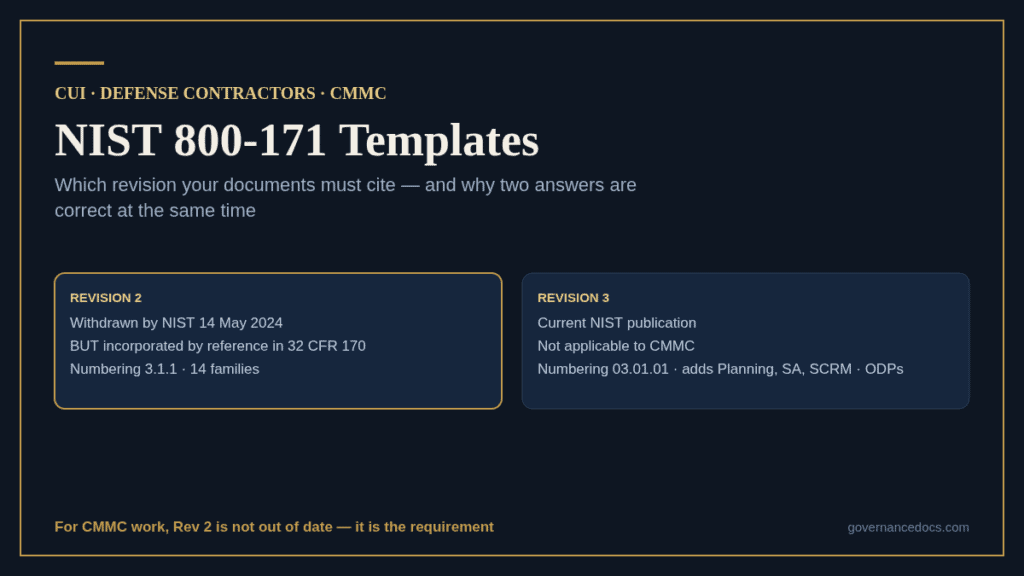
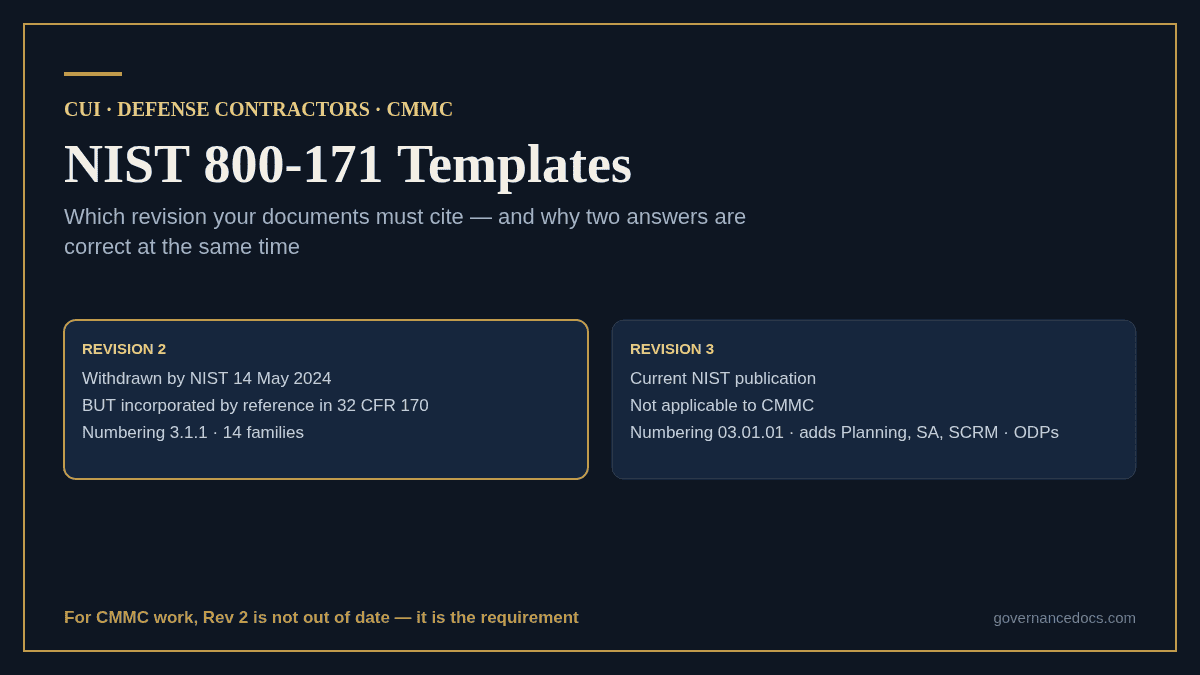
At NIST, Revision 2 is gone. NIST’s own publication page records SP 800-171
Rev. 2 as withdrawn on 14 May 2024, superseded by SP 800-171 Rev. 3. If you are following the
standard on its own terms, Rev 3 is the current publication.
In the regulation, Revision 2 is the requirement. The CMMC Model rule at
32 CFR 170.14 states that the model incorporates the security requirements from
NIST SP 800-171 R2, incorporated by reference, and that the CMMC domains map to the
requirement families defined in R2. That is the current regulatory text.
So for a defence contractor, documentation written to Rev 2 is not out of date. It is the version
the obligation actually points at. Templates that have been “helpfully updated” to Rev 3 are the ones
that create a problem.
| Revision 2 | Revision 3 | |
|---|---|---|
| Status at NIST | Withdrawn 14 May 2024 | Current |
| Used by CMMC | Yes — incorporated by reference in 32 CFR 170 | No |
| Requirement numbering | 3.1.1 |
03.01.01 |
| Families | 14 (3.1 to 3.14) | Adds Planning, System and Services Acquisition, and Supply Chain Risk Management |
| Tailoring | Fixed requirement text | Organization-defined parameters (ODPs) |
Free ISO 27001 risk assessment
Which of your risks sit above your appetite line?
Set your own risk criteria, pick from 61 information security risk scenarios, rate likelihood and impact, and decide how to treat each one. You get a heat map, a process score and the findings an auditor would raise, free.
Run the free risk assessment → or View premium report sample
The numbering format settles it on sight. Rev 2 writes requirements as 3.1.1 across
fourteen families. Rev 3 writes them as 03.01.01 and introduces three families the
earlier revision did not have. If a document contains organization-defined parameters — bracketed
values you are expected to set yourself — it is Rev 3 content.
This check matters more than it sounds. The common failure is not a wholesale switch but a
mismatch: Rev 2 requirement text sitting under a Rev 3 label, or a cover page claiming one revision
while the body numbers the other. Both look authoritative and neither survives an assessment.
A usable set is not one document per requirement. It divides into five groups.
A Rev 2 document set, built for the rule as written.
The NIST SP 800-171 Toolkit ships the scoping guides, the SSP and POA&M templates, a policy for each of the fourteen requirement families, SP 800-171A assessment plan and report templates, and the asset, CUI, risk, flowdown, exception and training registers — plus a control RACI, a metrics catalogue and an implementation roadmap.
Everything else supports these two.
The System Security Plan describes the system boundary and states how each
requirement is met. Its weakness is almost always the boundary: a plan that describes an idealised
network rather than the one you run will fail on the first walkthrough. Write the boundary before you
write anything else, and make the CUI data flow inventory agree with it.
The Plan of Action and Milestones records what is not yet met, with an owner and a
date. Contractors routinely treat a POA&M as an admission of failure and try to submit an empty
one. That reads as a programme that has not looked, and a POA&M with honest dates is a stronger
position than a clean sheet nobody believes.
NIST 800-171 templates give you structure, defensible wording and a complete list of what to produce. They
cannot make the scoping decision, because only you know where CUI actually goes. They cannot
implement multifactor authentication or FIPS-validated cryptography. And they cannot generate the
evidence — the access reviews, the log retention, the training records — that turns a written control
into an assessed one.
Budget accordingly. In most programmes the documentation is finished in weeks and the technical
remediation runs for months, which is the reverse of what the template shopping implies.
The requirements apply to the systems that process, store or transmit CUI. That sentence is the
whole cost model, because the number of in-scope systems drives the number of policies, registers and
evidence streams you will maintain for years.
Two approaches dominate. The enterprise approach treats the whole environment as
in scope: simpler to describe, far more expensive to evidence, and it drags every workstation and
every SaaS application into the assessment. The enclave approach puts CUI into a
defined segment with controlled entry and exit, so the requirements apply to a much smaller estate.
An enclave costs more to design and much less to run, and it makes the System Security Plan
tractable. The mistake to avoid is declaring an enclave you do not actually enforce — if CUI reaches
email, shared drives or laptops outside the boundary, the real scope is the whole estate no matter
what the plan says. Write the data flow inventory honestly first, then decide.
If you pass CUI to a subcontractor, the obligation travels with it. That means contract clauses,
a record of which suppliers hold CUI, and some assurance that they meet the same requirements.
This is the gap that surfaces late, because it lives with procurement rather than IT and nobody
owns it until an assessor asks. A vendor and subcontractor flowdown register is a small document that
prevents a large problem: it forces the question of who actually holds your CUI, which is often a
longer list than anyone expects.
Having the documents is not the same as knowing where to start. The order that wastes least effort
runs: identify CUI, draw the boundary, then write the System Security Plan against that boundary.
Only then work through the family policies, because a policy written before the boundary is settled
gets rewritten once the scope changes.
Run the assessment last, using the SP 800-171A procedures, and let it populate the POA&M rather
than trying to guess your gaps in advance. Teams that reverse this — policies first, scope later —
generally produce a complete-looking set of NIST 800-171 templates that describes a system they do not
operate.
Should my NIST 800-171 templates use Rev 2 or Rev 3?
Rev 2 if you are in scope for CMMC or a DFARS clause pointing at it, because 32 CFR 170 incorporates
R2 by reference. Rev 3 if you are following NIST’s current publication outside that regime.
Is Rev 2 withdrawn?
At NIST, yes — withdrawn 14 May 2024 and superseded by Rev 3. That does not change what the CMMC rule
requires, which is why both statements are true at once.
What is the difference between 800-171 and 800-171A?
800-171 states the security requirements. 800-171A gives the assessment procedures used to determine
whether each one is satisfied.
Do I need a separate policy for every family?
Not strictly, but it is the structure assessors expect and it makes the mapping obvious. Fourteen
focused policies are easier to maintain than one document that tries to cover everything.
Can I submit an empty POA&M?
You can, but only if every requirement is genuinely met and evidenced. An empty POA&M on an
immature programme invites scrutiny rather than avoiding it.
Settle the revision first, and settle it from the rule rather than from whichever version is
newest. For CMMC work that means Rev 2, with its 3.1.1 numbering and fourteen families,
even though NIST has withdrawn it — an obligation frozen at an older edition makes the older edition
correct.
Then build the set in order: scope, then the System Security Plan, then the family policies, then
the registers that prove them. NIST 800-171 templates shorten the writing. The scoping decision and
the evidence are still yours.
The document set is covered by the NIST SP 800-171 Toolkit, or start with the free ISO templates.

October 14, 2026
October 13, 2026
October 12, 2026
October 12, 2026

October 12, 2026

