CART
A material weakness is the most serious finding an assessment of internal control over financial reporting can produce, and the definition that governs it is short: “a deficiency, or a combination of deficiencies, in internal control over financial reporting, such that there is a reasonable possibility that a material misstatement of the company’s annual or interim financial statements will not be prevented or detected on a timely basis” — PCAOB Auditing Standard 2201, Appendix A, mirrored in the SEC’s rules. One rung down sits the significant deficiency: “less severe than a material weakness, yet important enough to merit attention by those responsible for oversight of the company’s financial reporting.” Below both is the plain deficiency. The three-level scale looks like a matter of degree and is in fact a matter of consequence: the top level means ICFR is not effective, management says so in its 404(a) report, the auditor issues an adverse opinion under 404(b), and the market reads both. This guide sets out the three definitions, the two-factor test that separates them, the indicators AS 2201 treats as presumptive, the role of compensating controls, who is told what, and how remediation is evidenced so the weakness closes.
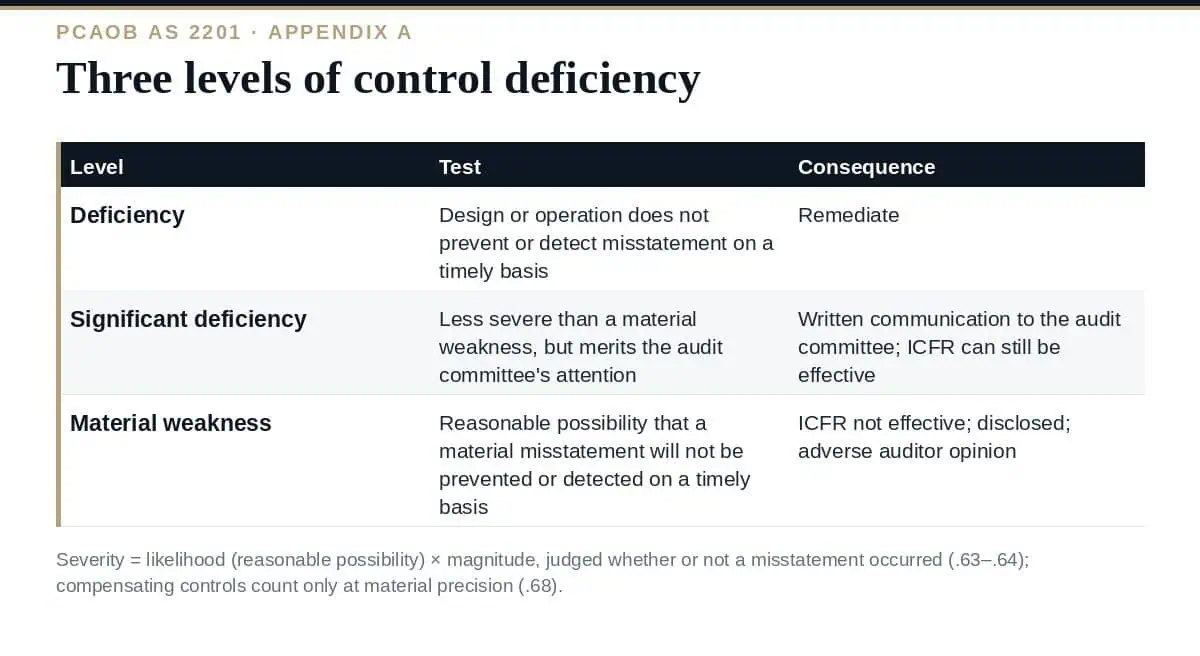
| Level | Definition (PCAOB AS 2201, Appendix A) | Consequence |
|---|---|---|
| Deficiency | Exists ‘when the design or operation of a control does not allow management or employees, in the normal course of performing their assigned functions, to prevent or detect misstatements on a timely basis’. A design deficiency: a necessary control is missing, or exists but would not meet the objective even if it operated. An operation deficiency: a properly designed control does not operate as designed, or the person performing it lacks the authority or competence | Remediate; no external reporting |
| Significant deficiency | ‘A deficiency, or a combination of deficiencies, in internal control over financial reporting that is less severe than a material weakness, yet important enough to merit attention by those responsible for oversight of the company’s financial reporting’ | Communicated in writing to the audit committee; ICFR can still be effective |
| Material weakness | ‘A deficiency, or a combination of deficiencies, in internal control over financial reporting, such that there is a reasonable possibility that a material misstatement of the company’s annual or interim financial statements will not be prevented or detected on a timely basis’ | ICFR is not effective; disclosed in management’s report; adverse auditor opinion on ICFR; communicated in writing to management and the audit committee before the report is issued |
Two words in the top definition do the work. “Reasonable possibility” is defined by reference to FAS 5 (now ASC 450): the likelihood is either reasonably possible or probable — a lower bar than “likely”. And “material misstatement” ties the assessment to materiality for the financial statements as a whole, interim as well as annual.
AS 2201 .63 states that the severity of a deficiency depends on two things: whether there is a reasonable possibility that the controls will fail to prevent or detect a misstatement of an account balance or disclosure, and the magnitude of the potential misstatement. Paragraph .64 adds the point most often missed: severity “does not depend on whether a misstatement actually has occurred”. A control that failed and, by luck, produced no error is assessed on what could have happened.
| Factor | What AS 2201 says affects it | How to evidence the judgement |
|---|---|---|
| Likelihood (reasonable possibility) | .65: the nature of the accounts, disclosures and assertions; susceptibility to loss or fraud; subjectivity, complexity and extent of judgement; the interaction of controls; the interaction of the deficiencies; the possible future consequences | A written analysis per deficiency naming the assertion, the accounts, and the other controls that interact |
| Magnitude | .66: the amounts or total transactions exposed to the deficiency; the volume of activity in the account in the current and expected periods. .67: the maximum overstatement is generally the recorded amount; understatements could be larger | The population exposed, quantified, against the materiality used for the audit |
| Compensating controls | .68: evaluated when deciding whether a deficiency is a material weakness — but to count, the compensating control ‘should operate at a level of precision that would prevent or detect a misstatement that could be material’ | The compensating control identified, tested, and its precision documented — a general review is not enough |
| Combination | Deficiencies in the same account or assertion are considered in aggregate; a set of individually minor deficiencies can be a material weakness together | The aggregation analysis by account and by COSO component |
AS 2201 .69 lists four indicators — circumstances that point strongly to a material weakness whatever the likelihood-and-magnitude analysis says:
The third indicator is the everyday one: an audit adjustment that is material is, in effect, evidence that the controls did not catch it. The first is the reason a fraud by a senior officer for a trivial amount still qualifies — it speaks to the control environment, not the amount. Our guide to entity-level controls covers the environment and oversight controls the fourth indicator tests.
| Finding | Management’s 404(a) report | Auditor (404(b) engagements) | Audit committee |
|---|---|---|---|
| Deficiency | Not disclosed | Communicated to management; all deficiencies of which the auditor is aware | At the auditor’s discretion; usually in aggregate |
| Significant deficiency | Not disclosed (ICFR remains effective) | Communicated in writing to the audit committee | Receives the written communication |
| Material weakness | Disclosed: ICFR not effective, the weakness described | Adverse opinion on ICFR; written communication to management and the audit committee before the report; the report includes the definition and the weakness | Receives the written communication; if the auditor concludes the committee’s oversight is ineffective, the board is told in writing |
Smaller reporting companies and non-accelerated filers make the management assessment without the auditor’s attestation, but the definitions and the disclosure are the same. Our guide to SOX 404 covers who is subject to which part.
What is the difference between a material weakness and a significant deficiency?
Severity. A material weakness is a deficiency or combination where there is a reasonable possibility that a material misstatement will not be prevented or detected on a timely basis; it makes ICFR ineffective and is disclosed. A significant deficiency is less severe than that but important enough to merit the audit committee’s attention; it is communicated in writing to the committee and ICFR can still be effective.
Does a misstatement have to have occurred?
No. AS 2201 .64 says severity does not depend on whether a misstatement actually occurred, but on whether there is a reasonable possibility the controls would fail to prevent or detect one. A control failure with no resulting error can still qualify.
Can compensating controls prevent that conclusion?
Yes, if they operate at a level of precision that would prevent or detect a misstatement that could be material (AS 2201 .68). A high-level review that would not catch a material error does not count.
Is a restatement automatically a material weakness?
A restatement to correct a material misstatement is one of the four indicators in AS 2201 .69. It is not an automatic conclusion, but it creates a strong presumption that the auditor and management must rebut with analysis.
How long does a material weakness take to remediate?
Until the redesigned control has operated for enough periods to be tested and found effective — typically at least a quarter, often longer for annual controls. It is reported until then, with the remediation plan disclosed.
Classify every deficiency with the two-factor test in writing — reasonable possibility, magnitude, compensating controls at material precision, combinations by account — check it against the four indicators, and let the classification drive the communication: significant deficiencies to the audit committee, the top level to the world. Then remediate at the root, at the right precision, for long enough to test, because the standard asks what the controls would prevent, not what they happened to catch.
The deficiency evaluation worksheet with the likelihood-and-magnitude analysis, the aggregation register by account and component, the remediation plan template and the audit committee communication are in the COSO ERM & Internal Control Toolkit, or start with the free templates.

October 11, 2026
October 11, 2026

October 11, 2026
October 11, 2026
October 11, 2026

