

Firewall for PCI Compliance: The Complete 2026 Guide
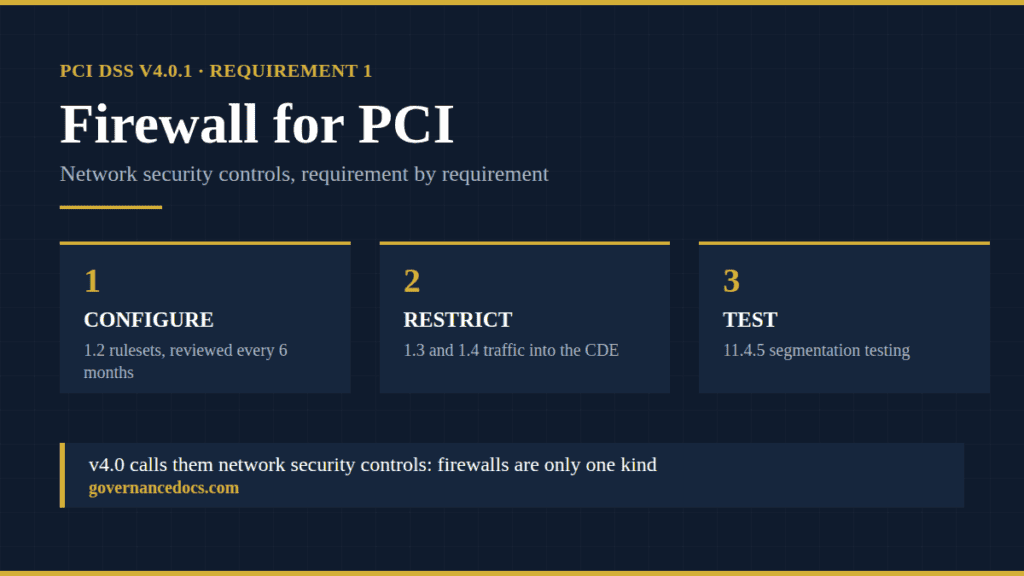
A firewall for PCI compliance is no longer just a box at the network edge: PCI DSS v4.0.1 Requirement 1 asks you to install and maintain “network security controls” wherever traffic needs to be filtered around cardholder data. This guide walks through every section of Requirement 1 in plain words, shows the evidence an assessor will ask for, and gives you a ruleset review checklist you can use this month.
It is written for merchants and service providers working to v4.0.1, the only active version since v4.0 was retired on 31 December 2024. For the wider programme, start with our guide to PCI DSS v4.0 compliance.
Free gap assessment
How much of PCI DSS v4 is actually in place?
Score all twelve requirements at sub-requirement level, free, including the ones that stopped being future-dated in 2025.
Run the free PCI DSS 4.0 gap assessment → or View premium report sample
What a firewall for PCI compliance must do under Requirement 1
Requirement 1 is titled “Install and Maintain Network Security Controls.” Its job is simple to state: only the traffic your business needs may reach or leave the cardholder data environment (CDE), and everything else is denied.
The requirement has five sections, 1.1 to 1.5. Its testing procedures tell you exactly what a Qualified Security Assessor (QSA) will examine.
Why “firewalls and routers” became network security controls
In PCI DSS v3.2.1, Requirement 1 was titled “Install and maintain a firewall configuration to protect cardholder data.” Version 4.0 replaced that wording with network security controls (NSCs).
The reason is practical. The standard’s own overview says this function was traditionally provided by physical firewalls, but may now be provided by virtual devices, cloud access controls, virtualization or container systems and other software-defined networking. A rule that only mentioned firewalls and routers no longer described how most cardholder data environments are built.
What counts as an NSC
PCI DSS describes NSCs as network policy enforcement points that control traffic between network segments based on pre-defined rules. In practice, your NSC inventory may include:
- Physical perimeter and internal firewalls
- Virtual firewall appliances in a hypervisor or cloud tenant
- Cloud security groups and network access control lists
- Routers with access control lists that separate segments
- Container and Kubernetes network policies, and other software-defined networking rules
If a component decides whether traffic may pass into or out of the CDE, treat it as an NSC. That means its rules fall under the same configuration standards, change control and six-monthly review as any PCI firewall.
Out-of-scope networks count as untrusted
This catches many teams out. The standard lists the Internet, business-to-business links, wireless, carrier and third-party networks as untrusted. It also says corporate networks that are out of scope for PCI DSS must be treated as untrusted, because their controls have not been verified.
So your office LAN, if it is out of scope, needs the same filtering toward the CDE as the Internet does.
PCI DSS firewall requirements, section by section
Here is what each part of Requirement 1 asks for, in plain words. Requirement numbers are from the PCI DSS v4.0.1 standard (June 2024).
1.1 Policies, procedures and roles
1.1.1 requires the security policies and operational procedures for Requirement 1 to be documented, kept up to date, in use and known to all affected parties. 1.1.2 requires the roles and responsibilities for Requirement 1 activities to be documented, assigned and understood.
1.2 Configure and maintain network security controls
This is the heart of the PCI DSS firewall requirements. It has eight parts:
- 1.2.1 Configuration standards for NSC rulesets are defined, implemented and maintained.
- 1.2.2 Changes to network connections and NSC configurations go through the change control process in Requirement 6.5.1.
- 1.2.3 An accurate network diagram shows all connections between the CDE and other networks, including wireless.
- 1.2.4 An accurate data-flow diagram shows all account data flows and is updated when the environment changes.
- 1.2.5 Every allowed service, protocol and port is identified, approved and has a defined business need.
- 1.2.6 Insecure services, protocols and ports in use have defined security features that mitigate the risk.
- 1.2.7 NSC configurations are reviewed at least once every six months to confirm they are relevant and effective.
- 1.2.8 NSC configuration files are secured from unauthorized access and kept consistent with the running configuration.
Note the 1.2.8 applicability note. Any file or setting used to configure NSCs counts as a configuration file, including scripts and infrastructure as code. Your Terraform or cloud templates are in scope.
1.3 Restrict traffic to and from the CDE
1.3.1 restricts inbound traffic to the CDE to only what is necessary, with all other traffic specifically denied. 1.3.2 applies the same rule to outbound traffic. Outbound filtering is easy to overlook, so expect the assessor to check it.
1.3.3 requires NSCs between all wireless networks and the CDE, whether or not the wireless network is itself a CDE. Wireless traffic into the CDE is denied by default, and only traffic with an authorized business purpose is allowed.
1.4 Control trusted and untrusted connections
- 1.4.1 NSCs are implemented between trusted and untrusted networks.
- 1.4.2 Inbound traffic from untrusted networks is limited to components authorized to offer public services, stateful responses to sessions started inside the trusted network, and nothing else.
- 1.4.3 Anti-spoofing measures detect and block forged source IP addresses.
- 1.4.4 Systems that store cardholder data are not directly accessible from untrusted networks.
- 1.4.5 Disclosure of internal IP addresses and routing information is limited to authorized parties.
1.5 Devices that connect to both
1.5.1 covers any computing device, company- or employee-owned, that connects to both untrusted networks (including the Internet) and the CDE. Think of an administrator’s laptop that goes home at night.
Those devices need specific security settings defined, controls actively running, and controls users cannot change. Exceptions are allowed only when management documents and authorizes them case by case, for a limited period.
Requirement 1 evidence table
Use this table to build the evidence folder for your firewall for PCI compliance before fieldwork. The evidence column follows the v4.0.1 testing procedures, which mostly say “examine documentation,” “examine configurations” and “interview personnel.”
| Requirement | What it means | Evidence a QSA will ask for |
|---|---|---|
| 1.1.1, 1.1.2 | Written policy and procedures for NSCs, with named owners | Approved policy, procedures, RACI or role descriptions, staff interviews |
| 1.2.1 | Ruleset configuration standards exist and are followed | Configuration standard, plus rulesets that match it |
| 1.2.2 | Firewall and connection changes go through change control | Change tickets with approvals, matched against recent config changes |
| 1.2.3, 1.2.4 | Current network and data-flow diagrams | Dated diagrams showing CDE boundaries, wireless and all account data flows |
| 1.2.5, 1.2.6 | Every open port has a business reason; insecure ones are mitigated | Approved services, protocols and ports list with justifications and security features |
| 1.2.7 | Rulesets reviewed at least every six months | Review procedure, the last two review records, proof that stale rules were removed |
| 1.2.8 | Config files protected and in sync with live devices | Access permissions on config stores and repositories, comparison with running config |
| 1.3.1 to 1.3.3 | Inbound and outbound CDE traffic limited; wireless filtered | NSC configurations showing explicit deny, wireless segment rules, diagrams |
| 1.4.1 to 1.4.5 | Untrusted networks controlled; storage not directly reachable | Edge rulesets, anti-spoofing settings, DMZ design, NAT or address-hiding settings |
| 1.5.1 | Dual-connected devices locked down | Endpoint policy, device configuration screenshots, approved exception records |
| 11.4.5 (and 11.4.6) | Segmentation proven to work | Segmentation penetration test reports and evidence of remediation |
Which rows apply to you depends on your validation route. Several self-assessment questionnaires include only part of Requirement 1, so check your form in our PCI DSS SAQ guide.
Firewall ruleset review checklist for 1.2.7
Requirement 1.2.7 sets a floor of once every six months. The testing procedure also checks that rules without a current business justification were removed or updated. A review that only says “no changes” rarely satisfies an assessor.
Run this checklist on every firewall for PCI compliance in scope, and on every cloud security group:
- Export the live ruleset and record the date, device and reviewer.
- Compare it with the backed-up configuration file and note any drift (1.2.8).
- Match every allow rule to an entry on the approved services, protocols and ports list (1.2.5).
- Flag rules with “any” in source, destination or service, and justify or tighten them.
- Confirm a default deny exists for inbound and outbound CDE traffic (1.3.1, 1.3.2).
- Find rules with zero hits since the last review and ask the owner whether they are still needed.
- Check that temporary rules from projects or incidents have been removed.
- Confirm insecure protocols still in use have their compensating security features (1.2.6).
- Trace each rule change since the last review to an approved change ticket (1.2.2).
- Update the network and data-flow diagrams if anything changed (1.2.3, 1.2.4).
- Record each finding, the decision, the change ticket raised and the sign-off date.
The guidance for 1.2.7 suggests more frequent reviews where network changes are frequent. A quarterly cycle is a sensible choice for busy cloud environments.
Segmentation: how a firewall for PCI compliance reduces scope
The standard is clear that segmenting the CDE from the rest of your network is not itself a requirement. It is strongly recommended, because it can cut the scope, cost and difficulty of an assessment.
Without segmentation, a “flat network” puts the whole network in scope. With it, a system is out of scope only if it could not affect the security of cardholder data even if it were compromised. That is the test a firewall for PCI compliance has to pass when it sits between the CDE and everything else.
Map your boundaries carefully before you rely on them. Our PCI DSS scoping guide explains how to decide which systems sit inside your assessment boundary.
Segmentation testing under 11.4.5 and 11.4.6
If you use segmentation to isolate the CDE, Requirement 11.4.5 requires penetration tests on the segmentation controls at least once every 12 months and after any change to segmentation controls or methods. This applies to merchants and service providers alike.
Requirement 11.4.6 adds a stricter cycle for service providers only: at least once every six months and after any change. In both cases the test must cover all segmentation methods in use and follow your penetration testing methodology.
The tester must be qualified and organizationally independent, but does not need to be a QSA or ASV. The test must confirm the controls are operational, effective and isolate the CDE from all out-of-scope systems.
Common Requirement 1 gaps to check first
- Cloud security groups left out of the NSC inventory and the six-monthly review.
- No outbound filtering from the CDE, so 1.3.2 fails.
- Network diagrams that predate the last migration.
- Ports list with no business justification or approval recorded.
- Admin laptops that connect to the CDE with user-editable endpoint controls.
For the other eleven requirements, work through our PCI DSS compliance checklist. If you also run an ISMS, our article on ISO 27001 network security controls shows where the two frameworks overlap.
The official standard and its supporting documents are free from the PCI SSC document library.
Firewall for PCI compliance FAQ
Do I need a hardware firewall for PCI compliance?
No. PCI DSS v4.0.1 accepts virtual devices, cloud access controls, container systems and software-defined networking as network security controls. What matters is that the control enforces your rules and meets every part of Requirement 1.
How often must PCI firewall rules be reviewed?
At least once every six months under Requirement 1.2.7. The review must confirm rules are still relevant and effective, and rules without a business justification must be removed or updated.
Are cloud security groups network security controls?
Yes, if they control traffic into or out of the CDE. They need configuration standards, change control, the six-monthly review and protected configuration files, just like a physical firewall for PCI compliance.
How often is segmentation tested?
At least every 12 months and after changes to segmentation controls, under 11.4.5. Service providers must test at least every six months and after changes, under 11.4.6.
Our PCI DSS Toolkit provides 180+ editable templates for PCI DSS v4.0.1 — including the Firewall and Router Policy, Network Security Policy, PCI Scope Inventory and Penetration Testing Methodology — for $99.
When a standard changes, know first
One email a month: edition changes, new deadlines, and what they mean for documentation you already have. No sales sequence.

Governance Docs
Governance Docs LLC
Recent Posts

November 27, 2026

November 27, 2026

November 26, 2026

November 26, 2026

November 26, 2026