CART
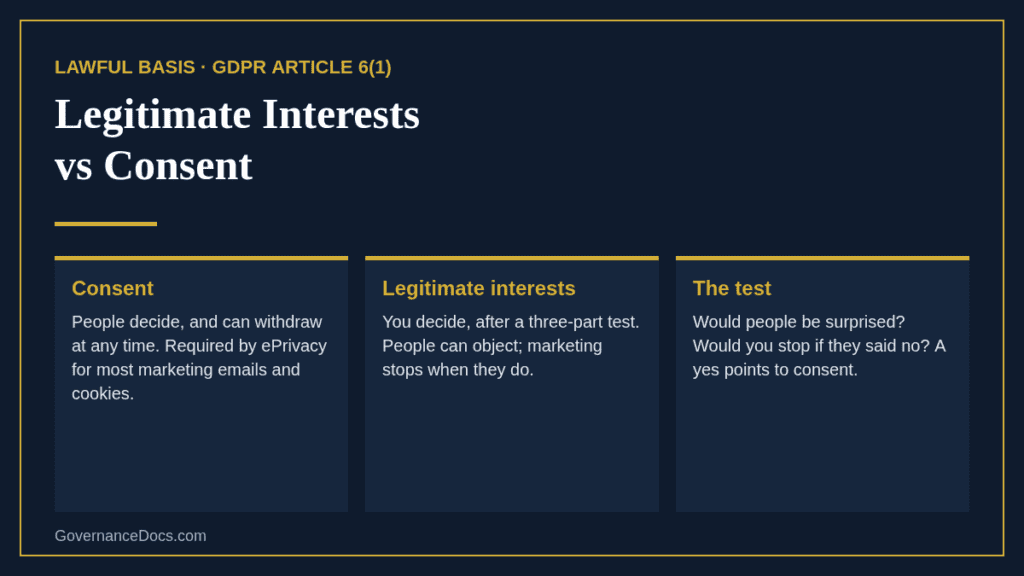
Legitimate interests vs consent is the lawful basis choice most organizations get wrong, usually by asking for consent they do not need or by relying on legitimate interests where the law requires consent. Both are lawful bases under Article 6(1) of the GDPR, and neither ranks above the other. They work very differently, though: consent hands control to the individual, while legitimate interests puts the responsibility on you to show the processing is fair. This guide sets out the differences and how to choose.
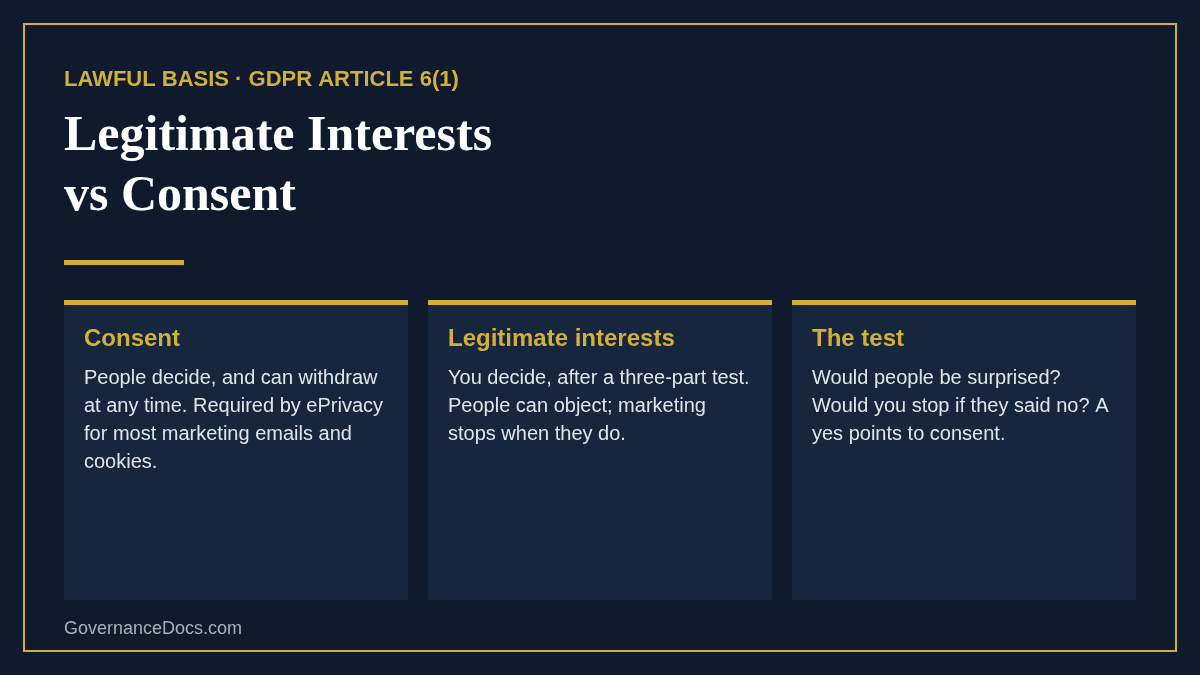
Use consent when you want to give people real choice and control, when you can let them say no without consequence, and when another law requires it, such as the ePrivacy rules for most marketing emails and non-essential cookies. Use legitimate interests when the processing is something people would reasonably expect, has a minimal privacy impact or a compelling justification, and you can offer a genuine right to object. If you would carry on processing after someone refused consent, consent was never the right basis.
| Consent (Art 6(1)(a)) | Legitimate interests (Art 6(1)(f)) | |
|---|---|---|
| Who decides | The individual | You, after a three-part test |
| What it takes | Freely given, specific, informed and unambiguous agreement by a clear affirmative act (Art 4(11), 7) | A legitimate interest, necessity, and a balance that favours the processing |
| Record to keep | Who consented, when, to what, and how | A legitimate interests assessment |
| Can people stop it? | Withdraw at any time, as easily as they gave it (Art 7(3)) | Object (Art 21); you must stop unless you show compelling grounds, and always for direct marketing |
| Data portability (Art 20) | Applies | Does not apply |
| Public authorities | Rarely suitable because of the imbalance of power | Not available for their tasks |
| Employees | Rarely freely given | Often more suitable, with a careful balance |
| Children | Parental consent under 16 (or the national age, 13 in the UK) for online services (Art 8) | Children’s interests weigh heavily in the balance |
The GDPR does not make consent the default for anything, but other rules do. The ePrivacy Directive, implemented in the UK as PECR, requires consent for:
Where those rules require consent, the UK ICO says you must not use legitimate interests as your lawful basis for that processing, and that consent obtained under PECR is also the appropriate lawful basis under the UK GDPR. Postal marketing, and some live phone marketing to numbers not on the preference register, carry no consent requirement, so legitimate interests can be used there.
Article 9 adds another layer: special category data needs a condition as well as a lawful basis, and for many commercial uses the only condition available is explicit consent.
Legitimate interests is often the more honest basis where consent would not be a real choice:
In the UK, the Data (Use and Access) Act 2025 wrote those examples into the UK GDPR from 5 February 2026. The ICO is clear that this does not mean legitimate interests automatically applies to them: you must still do the three-part test.
Consent is the better choice where the processing is intrusive, unexpected, or something people should be able to refuse:
The Court of Justice showed where the line can fall in Meta Platforms v Bundeskartellamt (C-252/21, July 2023): it held that users of a free social network could not reasonably expect their data to be processed for personalised advertising without their consent, so their interests overrode the company’s.
The right basis depends on the facts, but these are the usual answers:
| Purpose | Usual basis | Why |
|---|---|---|
| Marketing emails to prospects | Consent | The ePrivacy rules require it |
| Marketing emails to existing customers (soft opt-in) | Legitimate interests | No consent required, and customers can opt out in every message |
| Postal marketing to customers | Legitimate interests | Expected, and no consent rule applies |
| Non-essential cookies and advertising trackers | Consent | The ePrivacy rules require it |
| Fraud checks on orders | Legitimate interests | Refusal would defeat the purpose |
| Security logging | Legitimate interests | Named in Recital 49 |
| Staff monitoring | Legitimate interests | Consent at work is rarely free; the balance needs care |
| Health data for a wellness app | Explicit consent | Article 9 needs a condition, and explicit consent is usually the one available |
When the legitimate interests vs consent answer is not obvious, ask two questions: would people be surprised by the processing, and would you stop if they said no? A yes to either points to consent.
Neither. Each is safe when it fits. Consent is weaker than it looks, because it can be withdrawn at any time; legitimate interests is weaker where the balance is doubtful.
Not for the same purpose. You can use consent for one purpose and legitimate interests for another, but each purpose needs one clear basis.
No. You need records of the consent instead. The LIA is the record for legitimate interests.
Under the ePrivacy rules they generally need consent in the EU. The UK now exempts some analytics cookies if people are told and can opt out; check the conditions before relying on it.
If legitimate interests is your answer, record the test with our free legitimate interests assessment template, and see a finished one in our legitimate interests assessment example. Our guide to the legitimate interests assessment covers the test in depth, and cookie consent covers the ePrivacy side. For privacy notices, consent records and the policies around them, see the GDPR Toolkit.


October 19, 2026

October 19, 2026

October 18, 2026

October 18, 2026

October 15, 2026

