CART
ITIL 4 is the version of the IT service management framework that most organisations are actually running — and as of 2026 it is no longer the newest one. PeopleCert has released ITIL (Version 5), and the Foundation publication is now available to read rather than trailed, with further modules still arriving.
Before anyone panics: this is not a cliff edge. PeopleCert’s own wording is that the change “is not a reset”, that existing knowledge and certifications remain fully relevant, and that ITIL 4 remains available to anyone continuing their current certification journey. But it does change how you should plan, and it changes what “current” means on a CV or a tender response.
Free gap assessment
How much of your service management system could you evidence?
Score every clause of ISO/IEC 20000-1, free, including the service management plan, service reporting and knowledge requirements generic checklists miss.
Run the free ISO 20000 gap assessment → or View premium report sample
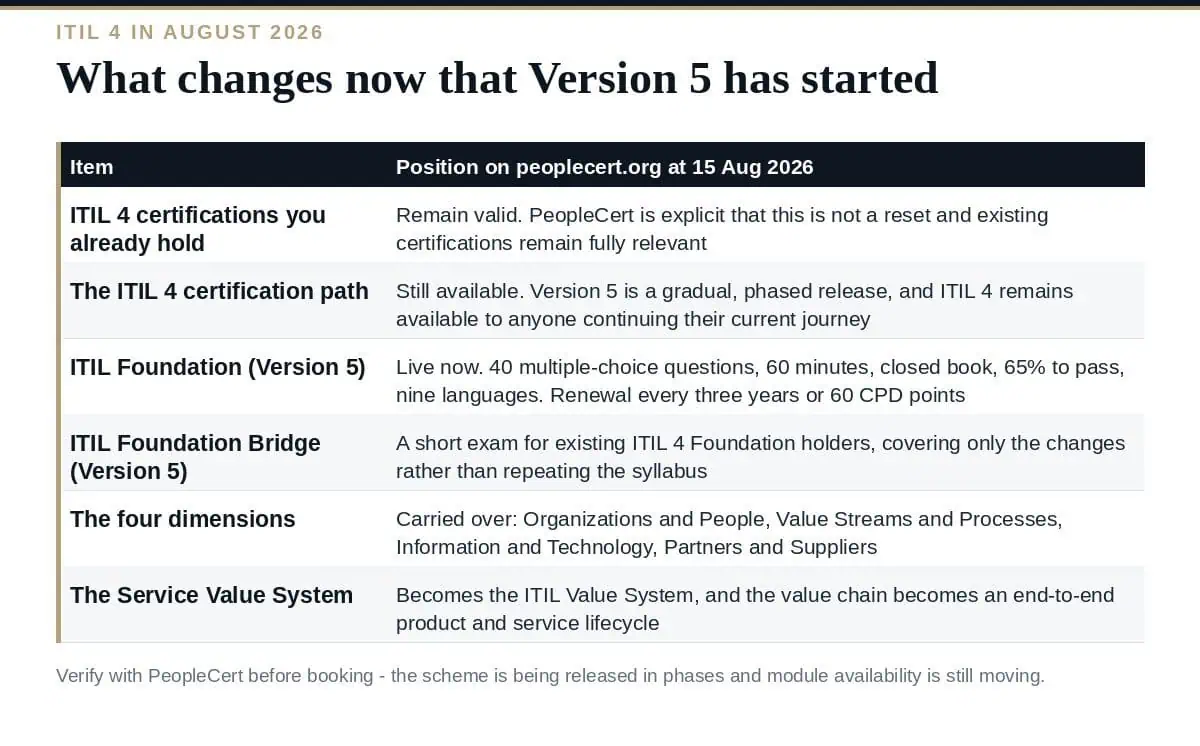
PeopleCert describes Version 5 as a gradual, phased release, with new modules and learning options arriving over time. That phrasing is worth taking literally — the scheme is genuinely mid-rollout, so anything you book should be confirmed against their current module list rather than a training provider’s brochure.
The version 3 lifecycle — strategy, design, transition, operation, continual improvement — was a sequence, and organisations implemented it as one. ITIL 4 replaced that with a system, and the change was substantive rather than cosmetic.
The Service Value System describes how everything an organisation does converts demand into value: guiding principles, governance, the service value chain, practices and continual improvement, working together rather than in order.
The service value chain holds six activities — plan, improve, engage, design and transition, obtain and build, deliver and support. Crucially they are not a sequence. A value stream picks the activities it needs, in the order it needs them, which is what allowed ITIL 4 to sit alongside Agile and DevOps instead of arguing with them.
Thirty-four practices replaced version 3’s processes: fourteen general management practices, seventeen service management practices and three technical management practices. A practice is a set of resources for doing something, not a procedure to be followed step by step — a distinction that matters when you are deciding how much to document.
The four dimensions — organisations and people, value streams and processes, information and technology, partners and suppliers — apply to everything. They are the balance check: a change that improves technology while ignoring people is an incomplete change.
Seven guiding principles, of which “start where you are” and “progress iteratively with feedback” are the two that most often rescue a stalled programme.
All of this carries forward. The four dimensions and the guiding principles appear in the Version 5 Foundation syllabus essentially intact, which is the clearest evidence that the ITIL 4 model was sound and is being extended rather than replaced.
Four things, now that the Foundation publication can be read directly.
The vocabulary shifts from services to digital products and services. The Service Value System becomes the ITIL Value System, and the six-activity value chain becomes an eight-activity product and service lifecycle: discover, design, acquire, build, transition, operate, deliver and support. Those eight are the value chain, and the publication is explicit that they are not performed as a cycle — work crosses whichever it needs, in whatever order, exactly as ITIL 4 intended its six to be used. That reflects how product-centric organisations already talk.
AI moves from context to content. Version 5 is described as AI-native by design, with an ITIL AI Governance extension module in the scheme. ITIL 4 predates most of this, and no amount of tailoring closes that gap.
The qualification scheme is restructured around roles. Foundation remains the entry point, with Managing Professional streams, a Practice Manager designation, Strategic Leader, extension modules covering transformation, product, service, experience and AI governance, and Master at the top.
Value stream mapping and management also appears explicitly at Foundation level, which it did not before.
The 34 practices are regrouped. ITIL 4’s three categories — fourteen general, seventeen service, three technical — become two: 22 product and service management practices and 12 general management practices. Nothing was added, removed or renamed; five practices changed category. In a documentation set that is one column of one table.
The continual improvement model also keeps its seven steps with two reworded — step 6 from “did we get there?” to “are we getting there?”, and step 7 from “how do we keep the momentum going?” to “how do we keep the improvements relevant?”. Both move improvement from a verdict delivered once to a question asked continuously.
For an organisation implementing service management — yes, and the answer is not close.
What you implement is practices, value streams, roles and documentation. None of that is invalidated by a framework release, and the model underneath it is being carried forward rather than discarded. An organisation that spends the next year building incident, change, problem and service request practices on ITIL 4 will not have to unpick them.
For an individual choosing a certification, the calculation differs. A new candidate starting today has a reasonable case for Foundation (Version 5). An existing ITIL 4 Foundation holder has the Bridge module — a short exam covering only what changed, rather than repeating the syllabus.
The one thing not to do is delay an organisational implementation while waiting for the phased release to finish. The practices you need exist now.
One refinement since this guide was first written: if you are producing new documentation now, structure it on Version 5 rather than ITIL 4. The practices and principles are the same, but Version 5 replaces the six-activity service value chain with an eight-activity product and service lifecycle (Discover, Design, Acquire, Build, Transition, Operate, Deliver, Support), and that is the one change that is genuinely structural — a RACI, value stream map or activity policy written around the old six activities has to be re-based, because the two lists do not map one to one. Writing it the Version 5 way from the start costs nothing and avoids that rework; ITIL 4 to ITIL 5: what needs rewriting sets out the delta.
| Framework | Relationship |
|---|---|
| ISO 20000 | The certifiable service management standard. ITIL is guidance and confers no organisational certificate — so most organisations run ITIL practices and certify to ISO 20000. Our ISO 20000 vs ITIL comparison covers the split in detail |
| COBIT 2019 | Governance rather than practice. COBIT decides what the enterprise needs from IT; ITIL delivers it. They are complementary by design |
| ISO 27001 | ITIL’s information security management practice is the operational side; ISO 27001 is the auditable management system around it |
| ISO 22301 | ITIL’s service continuity practice and ISO 22301 cover the same ground from different directions. Run one continuity analysis, not two |
We have covered each change separately: everything that changed in ITIL 5, the eight-activity lifecycle, the 34 practices and their two categories, the AI capability model, and — if you hold ITIL 4 documentation — what actually needs rewriting.
This guide reflects PeopleCert’s published material at 15 August 2026. Module availability is moving month to month during the phased release; confirm before you commit budget.
The ITIL Product and Service Management Toolkit (Version 5) provides 57 editable templates — the foundations, the eight lifecycle activity policies, the 34-practice manual, sixteen practice policies, value stream and AI governance tools, the RACI, metrics and continual improvement records, and an ITIL 4 to Version 5 transition guide for organisations with existing documentation. Its companion guides were re-issued on 11 September 2026 for the Version 5 structure. These are the artefacts an implementation needs regardless of which version number is on the exam paper.

October 15, 2026
October 15, 2026
October 14, 2026
October 14, 2026
October 14, 2026

