
CART
No products in the cart.
ISO Compliance Insights & Best Practices
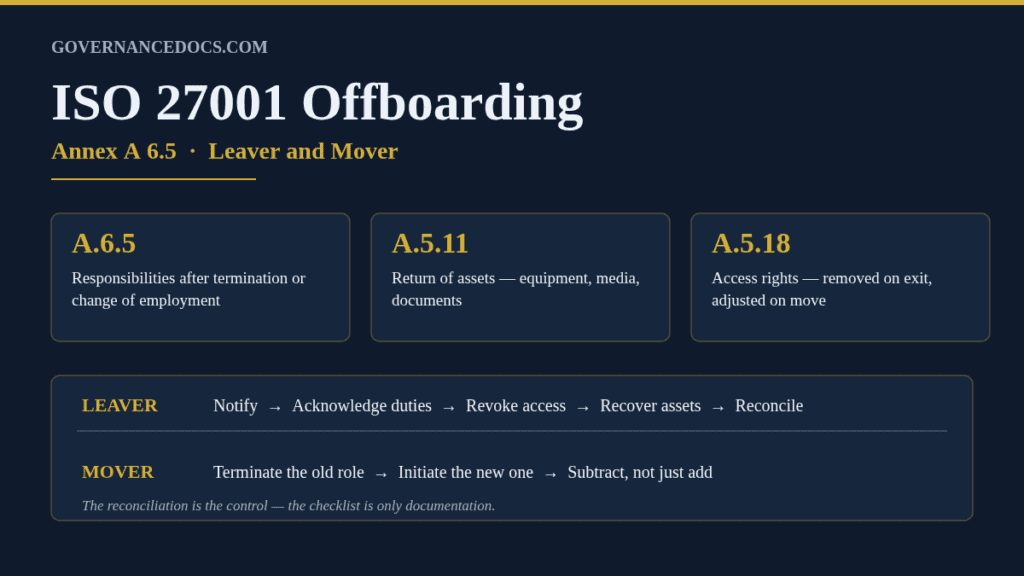
ISO 27001 offboarding is the one process every ISMS has on paper and almost none can evidence end to end. HR treats it as a payroll task, IT treats it as a ticket, and the certification auditor treats it as a control test with a sampling plan. Annex A 6.5 does not ask you to switch off a mailbox. It asks you to define, enforce and communicate the information security duties that remain in force after someone’s last day — and to do the same when a person simply moves to a different role inside the business.
That second half is where most programmes come apart. This guide covers what ISO 27001 offboarding requires under ISO/IEC 27001:2022, the Annex A controls that carry it, a leaver and mover checklist with owners and deadlines, which obligations actually survive the final day, and the evidence an auditor will ask to see.
Free gap assessment
Where do you actually stand against ISO 27001?
Score every management system clause and all 93 Annex A controls, free, and get a prioritised gap list back.
Run the free ISO 27001 gap assessment → or View premium report sample
The requirement sits in Annex A control 6.5, Responsibilities after termination or change of employment. In substance it says that the information security responsibilities and duties which stay valid after employment ends or changes must be defined, enforced and communicated to the people concerned and to other interested parties. The purpose statement in ISO/IEC 27002:2022 is about protecting the organization’s interests while employment or a contract is being changed or ended.
Reduced to its two jobs, ISO 27001 offboarding has to close down everything the person can reach and keep alive everything they still owe you. Three things in the control text are worth slowing down on.
“Defined” means written before you need it. The duties have to exist as a stated set, not as something a manager improvises during an exit conversation. In practice that is a short clause in the contract plus a line in the offboarding procedure, not a separate policy.
“Enforced” is the verb that bites. You can only enforce an obligation you created at hire. A confidentiality reminder invented on the last day has no legal footing. This is why A.6.5 is unimplementable on its own — it depends on A.6.2 (terms and conditions of employment) and A.6.6 (confidentiality or non-disclosure agreements) having been done properly at the start of the relationship. Auditors who understand the control will ask for the hire-date contract, not the exit letter.
“Communicated to relevant personnel and other interested parties” reaches past the leaver. Customers, contractors and third parties who dealt with the departing person may need to be told that the arrangement has changed, so that nobody keeps accepting instructions from someone who no longer works for you. ISO/IEC 27002:2022 also notes that where the person is a contractor, the termination process may be run by the agency responsible for them — which means your supplier agreements have to carry the obligation forward.
A.6.5 is not one of the eleven controls introduced in the 2022 edition. It carries over from A.7.3.1 in ISO/IEC 27001:2013, so a transitioned ISMS should already have something behind it. The edition itself is confirmed on ISO’s own page for ISO/IEC 27001:2022 — edition 3, published October 2022, with one amendment.
No single control covers the whole process. ISO 27001 offboarding is assembled from three controls that do the work and two that make them enforceable. Mapping them before you write the procedure stops you from arguing about scope in the audit.
| Control | Title | What it contributes to offboarding | 2013 origin |
|---|---|---|---|
| A.6.5 | Responsibilities after termination or change of employment | The duties that survive the last day, and the duty to communicate them | A.7.3.1 |
| A.5.11 | Return of assets | Recovery of equipment, media, documents and information in any form | A.8.1.4 |
| A.5.18 | Access rights | Removal of access on termination and adjustment of access on role change | A.9.2.2, A.9.2.5, A.9.2.6 |
| A.6.2 | Terms and conditions of employment | The contractual hook that makes A.6.5 enforceable | A.7.1.2 |
| A.6.6 | Confidentiality or non-disclosure agreements | The surviving confidentiality duty and its defined period | A.13.2.4 |
A.6.4, the disciplinary process, sits alongside rather than inside this set. It applies to violations; A.6.5 applies to departures. An involuntary exit can trigger both, which is a reason to classify departures at the point of notice rather than treat every leaver identically. For the wider picture of how these fit the four themes, see our guide to the ISO 27001 Annex A controls.
Free ISO 27001 risk assessment
Which of your risks sit above your appetite line?
Set your own risk criteria, pick from 61 information security risk scenarios, rate likelihood and impact, and decide how to treat each one. You get a heat map, a process score and the findings an auditor would raise, free.
Run the free risk assessment → or View premium report sample
Read the control title again: termination or change of employment. The internal mover is in scope, and almost every ISO 27001 offboarding checklist published online ignores them completely. That is the single most common finding in this area.
ISO/IEC 27002:2022’s guidance for 6.5 is explicit about how to handle it: a change of responsibility should be managed as the termination of the responsibility that is ending combined with the initiation of the new one. Two events, not one. A mover is an ISO 27001 offboarding event in its own right, not a provisioning ticket with extra steps. And A.5.18 is built the same way — access rights are removed on termination of employment and adjusted on change of role, where “adjusted” has to mean subtraction as well as addition.
What organisations actually do is append. Someone moves from support to finance, their new permissions are granted, and nobody ever takes the old ticketing and customer-data access away. Five years and three moves later that account can reach everything, and the person holding it has no idea. The access review catches it eventually; a correctly built mover process would never have created it. If you are relying on periodic review to clean this up, read our guide to the user access review and note how much of its workload is actually uncleared mover debt.
NIST’s catalogue makes the split visible in a way ISO does not. In NIST SP 800-53 Rev. 5, termination is PS-4 and transfer is PS-5 — two separate controls, each with its own organisation-defined time period. ISO folds both into one control title, and a team reading quickly implements half of it. If your Statement of Applicability justification for A.6.5 talks only about leavers, you have documented the gap yourself.
ISO 27001 states no timeframe anywhere for revoking access — not in Annex A, not in 27002’s guidance. You set the clock; the control is that you meet the clock you set. The deadlines below are typical of what certification bodies see accepted, not requirements of the standard. Use the table as the spine of your ISO 27001 offboarding procedure and change the numbers to ones you can actually hit.
| # | Step | Owner | Typical deadline | Evidence |
|---|---|---|---|---|
| 1 | Notify IT and security that a departure or role change is confirmed | HR | Within 1 business day of notice | Dated ticket or workflow record |
| 2 | Classify the departure: voluntary, involuntary, or elevated risk | HR with line manager | At notice | Classification field on the record |
| 3 | Issue the written reminder of surviving obligations and obtain signature | HR | Before the last working day | Signed exit acknowledgement |
| 4 | Hold the exit security briefing | Line manager | Final week | Briefing record or agenda sign-off |
| 5 | Hand over data ownership: risk owners, asset owners, approvals, shared drives | Line manager | Before the last working day | Updated asset and risk registers |
| 6 | Revoke privileged, administrative and remote access | IT | Immediately for elevated-risk exits, otherwise at end of last working day | Timestamped deprovisioning log |
| 7 | Revoke standard application and SaaS access, including tools IT did not procure | IT | End of last working day | Per-system removal record |
| 8 | Rotate shared, service and vendor-portal credentials the person knew | IT | Within 1 business day of exit | Credential rotation record |
| 9 | Revoke and collect physical access: badges, fobs, keys, parking, lockers | Facilities | Last working day | Badge system log and receipt |
| 10 | Recover assets: laptop, phone, tokens, removable media, paper files | IT asset owner | Last working day, or an agreed return date for remote staff | Signed asset return form against the inventory |
| 11 | Deal with copies on personal devices and personal cloud accounts | IT | Last working day | Attestation plus device wipe or container removal record |
| 12 | Reconcile the HR leaver and mover list against the access removal log | Information security | Monthly, or within 5 business days of each exit | Reconciliation record with exceptions closed |
Step 12 is the control. Steps 1 to 11 are a procedure, and a procedure is only documentation until something independently proves it ran every time. If you build one thing from this list, build the reconciliation — it is the artefact that converts an ISO 27001 offboarding process from a claim into evidence.
Remote and hybrid staff change the shape of steps 9 to 11 rather than removing them. A courier-returned laptop with a tracked delivery receipt is accepted evidence; “they said they posted it” is not. Our guide to ISO 27001 remote working covers the asset-custody side in more depth.
A.6.5 requires you to say which duties remain valid. Most organisations have never written that list down, which makes the exit acknowledgement vague and the obligation hard to enforce. The durations below are typical commercial practice, not positions of the standard, and enforceability varies considerably between jurisdictions — have the clauses reviewed by a lawyer qualified where your staff are employed.
| Surviving obligation | Where it comes from | Typical duration | What makes it enforceable |
|---|---|---|---|
| Confidentiality of information learned in the role | Employment contract plus NDA (A.6.2, A.6.6) | A defined period, commonly 2 to 5 years; indefinite for trade secrets | Signed at hire, with a stated period and a defined scope of information |
| Assignment of intellectual property created in the role | Employment contract (A.6.2) | Permanent | Clause present from the start date |
| Return of all organisational information in any form | A.5.11 | Immediate and continuing | Signed return form referencing the asset inventory |
| No further use of credentials, systems or data | Acceptable use policy accepted at hire | Permanent | Dated acceptance record, re-stated at exit |
| Cooperation with investigations and incident enquiries | Employment contract | A defined period after exit | Explicit clause; cannot be imposed later |
| Non-solicitation or restraint of trade | Employment contract, where lawful | Jurisdiction-limited, often 6 to 12 months | Local legal review; unenforceable in some jurisdictions |
Two of these touch other controls directly. Intellectual property sits with A.5.32, covered in our guide to ISO 27001 intellectual property rights, and the no-further-use undertaking is only as strong as the policy the person accepted — see ISO 27001 acceptable use policy for how that acceptance should be recorded.
Every piece of ISO 27001 offboarding evidence that an auditor accepts has a date on it, and that is the quickest test of whether yours will hold. Stage 2 auditors sample this control rather than read your procedure. Expect something close to: give me your leaver and mover list for the last six months, I will pick four, and show me each one end to end. Have these ready.
The nonconformity to expect, if there is one, is a reconciliation gap: an account that stayed live for weeks after the last working day, or a mover whose old permissions were never withdrawn. Both are closable with a dated record and a corrected process, so find them yourself first.
If you also report against NIST SP 800-53 Rev. 5 — or you are answering a customer security questionnaire written from it — the mapping is close enough to run one process and evidence both. NIST is more prescriptive in two places that are worth copying even if you never claim the control.
| ISO 27001:2022 | NIST SP 800-53 Rev. 5 | What NIST adds |
|---|---|---|
| A.5.18 (removal on termination) | PS-4a, PS-4b | Access disabled within an organisation-defined time period, and authenticators and credentials explicitly revoked |
| A.6.5 (communicating surviving duties) | PS-4c | An exit interview covering organisation-defined security topics, as a named step |
| A.5.11 (return of assets) | PS-4d | Retrieval of all security-related system property |
| No direct equivalent | PS-4e | Retaining access to information and systems the leaver formerly controlled |
| A.5.18 (adjustment on change of role) | PS-5 | A separate control for transfers: confirm the operational need for current access, modify it, and notify within a defined period |
PS-4e is the one worth stealing outright. It says keep access to what the person controlled — and the instinct during ISO 27001 offboarding is the opposite, to delete the mailbox and reclaim the licence. Deleting it can destroy records you are obliged to retain, break an in-flight investigation, and strand the only copy of a document someone still needs. Disable the account, preserve the data under your retention schedule, and release the licence afterwards. Deletion when the retention period expires belongs to a different control — see ISO 27001 secure disposal.
These are the ISO 27001 offboarding failures that show up repeatedly in gap assessments.
Most of these are process design faults rather than tooling faults, and none of them need a new platform to fix. They do need someone to own the reconciliation, which is usually the step nobody has been given.
No. Clause 7.5 mandates a specific set of documented information and this is not on it — see our list of ISO 27001 mandatory documents. A.6.5 says the surviving duties must be defined, enforced and communicated, and it does not use the phrase “available as documented information”. In practice you still need something written, because “defined” and “communicated” are both hard to evidence verbally, but it can live inside an existing HR procedure rather than as a standalone policy.
The standard sets no deadline. Neither does ISO/IEC 27002:2022, which talks about timeliness without putting a number on it. You define the target and the audit tests whether you hit it. Common targets are immediate revocation for privileged and elevated-risk cases, end of the last working day for standard accounts, and a reconciliation within five business days. Any defensible number you actually meet beats an aggressive number you miss, and an ISO 27001 offboarding target of two business days that is always met is stronger evidence than a four-hour target that is not.
Yes. A.6.5 reaches relevant personnel and other interested parties, and ISO/IEC 27002:2022 notes that for a contractor the process may be carried out by the agency responsible for them. Outsourcing the mechanics of ISO 27001 offboarding is allowed; outsourcing the accountability is not. That does not transfer the obligation — it means your supplier and agency agreements have to require it and you have to be able to show evidence from them.
A.6.4 is the disciplinary process and applies when someone breaches the rules while employed. A.6.5 is about the duties that outlive the employment relationship. An involuntary termination may invoke both, and the sequencing matters: the disciplinary record is evidence for A.6.4, and the signed acknowledgement of surviving duties is evidence for A.6.5.
Disable the account, preserve the data. Deletion is governed by your retention schedule and by any legal hold, not by the exit date. PS-4e in NIST SP 800-53 states the requirement plainly — retain access to the information the person formerly controlled — and it is sound practice under ISO 27001 even though Annex A does not say it in those words.
HR owns the trigger and the acknowledgement, IT owns deprovisioning and asset recovery, the line manager owns handover and the exit briefing, and information security owns the reconciliation. Written down that way, the control has four named owners and no gaps. Written down as “HR offboards leavers”, it has one owner who cannot perform most of the steps, and that single-owner model is the root cause of most failed ISO 27001 offboarding audits. Role clarity here is also what makes the awareness side work — see ISO 27001 security awareness training.
Build it in this order: contract clauses first, because nothing downstream is enforceable without them; then the mover path, because it is the gap your auditor will probe; then the reconciliation, because it is the only part that generates evidence on its own. The checklist comes last and is the easiest piece. A functioning ISO 27001 offboarding process is roughly two pages of procedure, one acknowledgement form, one asset return form and a monthly reconciliation — not a platform purchase.
Our ISO 27001 Toolkit provides 165 templates mapped to ISO/IEC 27001:2022, including the HR security procedure, asset return and exit acknowledgement forms, the access control and asset management policies these steps reference, and the Statement of Applicability where A.6.5, A.5.11 and A.5.18 have to be justified. It is $99 as a one-time purchase, with lifetime updates and no subscription.

October 22, 2026
October 21, 2026
October 21, 2026
October 20, 2026
October 20, 2026
