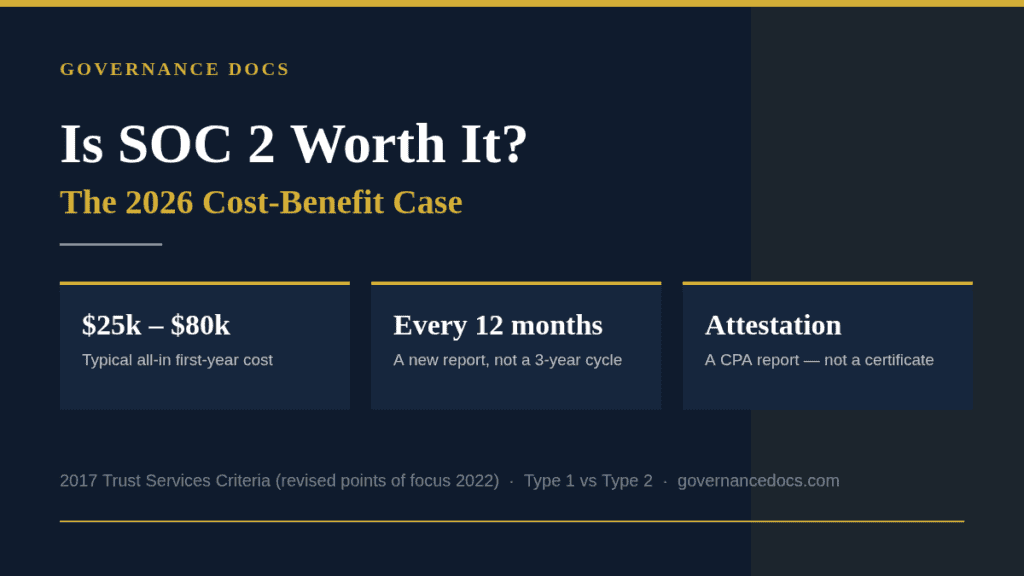
Is SOC 2 worth it? For most B2B software companies the answer is yes — but only once a real buyer has asked for it, and only if you budget for a bill that repeats every year rather than a one-off project. SOC 2 is not a certification you earn and hang on the wall. It is an attestation report, issued by a licensed CPA firm, covering a window of time that has already closed. When that window ends, the clock starts on the next one.
That structural difference is what makes this cost-benefit case unusual. An ISO certificate runs for three years with lighter surveillance audits in between. A SOC 2 Type 2 report is generally treated as current for twelve months, after which customers ask for a fresh one. So when founders ask is SOC 2 worth it, the real question is not whether they can afford the audit. It is whether the report unlocks enough revenue to justify paying for it indefinitely.
This guide prices the whole programme over three years so you can answer is SOC 2 worth it with your own numbers, shows where the return actually comes from, and is blunt about the situations where the answer is no. For the wider picture, start with our complete guide to SOC 2 compliance.
Free gap assessment
How much of your SOC 2 report can you already evidence?
Score yourself against the Trust Services Criteria, free, before an auditor charges you to find out.
The decision is rarely about security maturity in the abstract. It is about whether a specific commercial door stays shut without the report. Find your situation in the table below.
Your situation
Verdict
Why
An enterprise prospect has named SOC 2 in a contract or security questionnaire
Yes — start now
The report is a gate. Alternative evidence rarely reopens it, and the observation period means you cannot produce a Type 2 on demand.
You sell to US mid-market and larger, and keep stalling at the security review
Yes
SOC 2 is the default expectation in US B2B procurement. Every sales cycle without one repeats the same friction.
You sell mainly outside the US, or to regulated European buyers
Look at ISO 27001 first
Non-US buyers recognise an accredited certificate more readily than a US attestation report.
Pre-revenue, or selling only to small businesses
Not yet
Nobody is asking. Keep control hygiene cheap and spend the money on the product.
You already hold ISO 27001
Yes, and it will cost less
The control overlap is substantial, so most readiness work is done. You are buying the report, not the programme.
You handle regulated health or payment data
Yes, but it is not sufficient
SOC 2 does not discharge HIPAA or PCI DSS obligations. It sits alongside them.
What SOC 2 really costs across three years
Published 2026 pricing from audit firms and compliance platforms clusters into reasonably consistent bands for a company of roughly ten to fifty employees. Treat the figures below as typical ranges rather than quotes — scope, the number of Trust Services Criteria in play, and your starting readiness all move them significantly. Our SOC 2 cost and timeline breakdown covers the drivers behind each line.
Line item
Year 1 (typical)
Each year after
CPA audit fee — Type 2
$15,000–$40,000
$12,000–$35,000
CPA audit fee — Type 1 (optional first step)
$7,500–$20,000
Not repeated
Readiness or gap assessment
$0–$15,000
$0–$5,000
Compliance automation platform
$7,000–$25,000
$7,000–$25,000
Penetration test
$5,000–$15,000
$5,000–$15,000
Policy and evidence documentation
Internal time, or a templated toolkit
Refresh only
Internal staff time
Roughly 200–400 hours
Roughly 100–200 hours
Realistic cash total
$25,000–$80,000
$25,000–$70,000
Three things in that table wreck a naive budget. First, the CPA fee is commonly only about a third of the real spend — the platform, the penetration test and the readiness work make up the rest, and founders who budget for the audit quote alone are routinely out by a factor of three. Second, a Type 2 typically runs 30% to 50% above a Type 1, because the auditor is testing whether controls actually operated across an observation period of three to twelve months rather than whether they were designed on paper. If you are unsure which to buy first, our comparison of SOC 2 Type 1 and Type 2 sets out the trade-off. Third, almost nothing in the right-hand column ever falls to zero.
A realistic three-year figure for a small SaaS company therefore lands somewhere between $75,000 and $200,000. That is the number the return has to beat, and it is the only fair basis on which to ask is SOC 2 worth it.
Free ISO 27001 risk assessment
Which of your risks sit above your appetite line?
Set your own risk criteria, pick from 61 information security risk scenarios, rate likelihood and impact, and decide how to treat each one. You get a heat map, a process score and the findings an auditor would raise, free.
Is SOC 2 worth it for a small business? Run the arithmetic
Do not argue this one on principle. Do it on your own pipeline, because the answer changes entirely with deal size.
Take a mid-band first year of about $45,000. If a single enterprise contract worth $60,000 a year closes because the report existed, SOC 2 paid for itself before the ink dried, and every subsequent renewal is protecting recurring revenue at roughly half the original cost. On those numbers the case is not close.
Now run it on an $8,000 average contract. You need six new customers, each genuinely attributable to the report rather than to your product, just to break even in year one — and then you need them again the following year. At that deal size, is SOC 2 worth it? Usually not until either the price point or the buyer profile moves upmarket.
The honest test takes ten minutes: list every open opportunity where SOC 2 appeared in writing — in an RFP, a questionnaire, a redlined contract or a security review email. Multiply the total by a realistic close rate. If that figure does not clear your first-year band, the answer is “not yet”, and “not yet” is a perfectly good answer.
What you actually get back for the money
Four returns show up consistently. Only the first of them is large enough, on its own, to settle whether SOC 2 is worth it — but the other three are what stop the renewal feeling like pure overhead.
A door into enterprise procurement
This is the whole return for most companies. Vendor security reviews at larger buyers work from a checklist, and in US B2B that checklist very often names SOC 2 explicitly. Without a report you are asking a procurement team to make an exception, which costs weeks and frequently fails. With one you send a PDF under NDA and move on. The value is not that the report makes you secure — it is that it removes a veto.
Questionnaires stop eating your week
Before the report, every prospect sends a bespoke spreadsheet of 150 to 300 questions and someone senior loses days answering it. After the report, a large share of those questions are answered by the document itself. For a team doing several enterprise deals a quarter, that reclaimed time is a genuine line item in the return, not a soft benefit.
A control baseline you were going to need anyway
Access reviews, change management, vendor risk, incident response, logging, onboarding and offboarding — the Trust Services Criteria push you to operate the things that a growing company needs regardless. Buying them under audit pressure is more expensive than building them early, but it does at least force them to exist and to be evidenced.
A cheaper route to your second framework
Once the control set is running and evidenced, adding ISO 27001, HIPAA alignment or a customer-specific framework is substantially less work than starting cold. Firms that treat SOC 2 as the first layer rather than the only layer get the most out of the spend. Our side-by-side on ISO 27001 versus SOC 2 shows where the overlap sits.
When SOC 2 is not worth it
An auditor who only ever says yes is not being useful. In these five situations, is SOC 2 worth it? No — and the money is better spent elsewhere:
No buyer has asked. Pursuing SOC 2 speculatively, before a single prospect has named it, is the most common expensive mistake in early-stage compliance.
Your buyers are outside the US. A European or Gulf enterprise buyer will more often want an accredited ISO 27001 certificate. Read our equivalent case for ISO 27001 before committing.
You cannot sustain it. A lapsed report is worse than none: it tells buyers you started and stopped. If the annual cost is not durably in the budget, wait.
You are chasing the logo, not a criterion. Scoping all five Trust Services Criteria when customers only ask about Security multiplies the audit cost for no commercial gain. Security alone is a complete, common scope.
The real obligation is legal. If your exposure is HIPAA, GDPR or PCI DSS, SOC 2 does not satisfy it. Fix the obligation first.
Is SOC 2 worth it compared with ISO 27001?
These are not rivals so much as different products sold to different buyers. The comparison that matters is structural.
Dimension
SOC 2
ISO 27001
What you receive
An attestation report from a licensed CPA firm
An accredited certificate from a certification body
Criteria
2017 Trust Services Criteria, with revised points of focus issued in 2022
93 Annex A controls in four themes — 37 organizational, 8 people, 14 physical, 34 technological
Mandatory core document
A description of the system
The Statement of Applicability, required by clause 6.1.3
Cycle
A new report roughly every 12 months
Three-year certificate with annual surveillance audits
Shareability
Restricted-use report, normally released under NDA
Public certificate you can publish
Strongest recognition
United States
International
The practical read: if your revenue is American, SOC 2 first. If it is international or public sector, ISO 27001 first. If you are selling into both, most companies end up holding both — which is precisely why sequencing them to reuse the same controls matters so much.
How to make the return larger
The audit fee is the part you cannot negotiate away. The rest is largely under your control, and three moves do most of the work — each one shifts the answer to is SOC 2 worth it further towards yes by shrinking the denominator.
Scope tightly. Pick only the Trust Services Criteria your customers ask about, and draw the system boundary around the product that is actually being bought. Every extra criterion and every extra system is more controls to evidence and more auditor hours. The AICPA publishes the criteria in full — the 2017 Trust Services Criteria with revised points of focus (2022) — and reading them before your scoping call is the cheapest hour you will spend.
Do not author policies from scratch. Documentation is the largest controllable cost and the one most often underestimated. Writing thirty-odd policies, procedures and evidence templates internally takes months of senior time; starting from a mapped set and editing takes weeks.
Plan the observation window backwards. Decide when you need the report in a buyer’s hands, subtract the observation period, and subtract readiness from that. Companies that skip this step discover in March that their report cannot exist before September. If a deal cannot wait, a bridge letter can cover a short gap between reports, but it cannot invent a period you never observed.
If documentation is your bottleneck, our SOC 2 Toolkit ($99) gives you the policy, procedure and evidence templates mapped to the Trust Services Criteria in editable Word and Excel format — the part of the programme where internal time disappears fastest.
Frequently asked questions
Is SOC 2 worth it if only one customer is asking?
Compare that customer’s annual contract value against your first-year band. One $60,000 account justifies it outright; one $10,000 account does not, and the better move is to offer that customer a security questionnaire, a recent penetration test summary and a remediation commitment instead.
How long is a SOC 2 report valid?
A report does not technically expire, but it covers a fixed historical period and buyers generally treat it as current for twelve months from issuance. In practice that means an annual Type 2, with a bridge letter covering the gap between the period end and your next report.
Can I get SOC 2 without a CPA firm?
No. A SOC 2 examination must be performed by an independent licensed CPA firm working to AICPA attestation standards. Compliance automation platforms and consultants can prepare you, and often introduce you to auditors, but they cannot issue the report.
Should I start with Type 1 to save money?
Only if a buyer needs evidence before your Type 2 observation period can finish. A Type 1 is a point-in-time opinion on design, so many enterprise buyers accept it only as an interim step. If your timeline allows, going straight to Type 2 avoids paying two audit fees within a year.
Is SOC 2 worth it for a company that already has ISO 27001?
If you sell into the US, usually yes — and it is the cheapest version of the project, because your controls already operate and are evidenced. You are effectively paying an audit fee to have an existing programme reported on under a different set of criteria.