
CART
No products in the cart.
ISO Compliance Insights & Best Practices
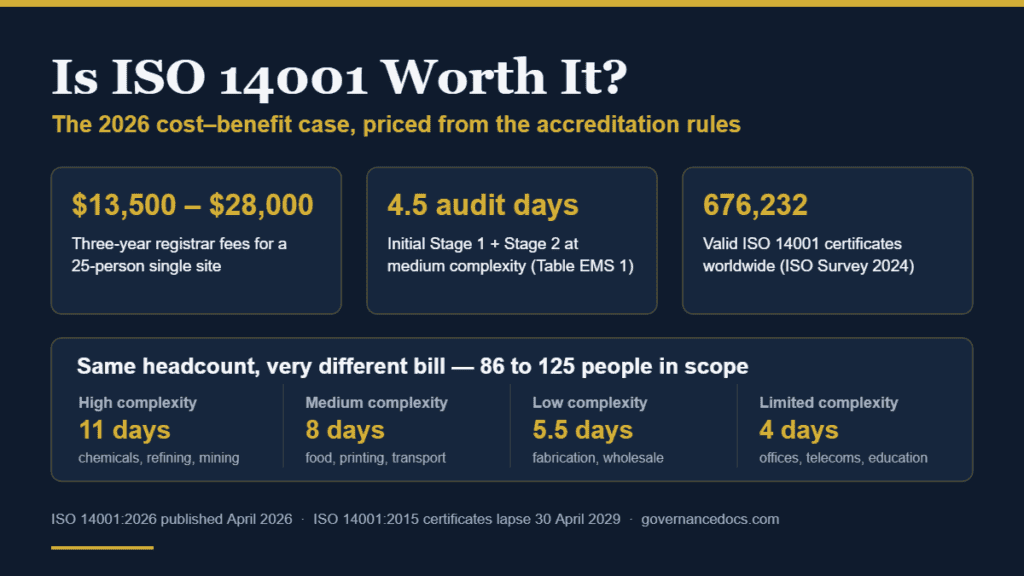
Is ISO 14001 worth it? If a customer, a tender or a parent company names the certificate, yes — the three-year registrar bill of roughly $13,500 to $28,000 for a mid-sized single site buys market access you cannot obtain any other way. If you run an office-based service business, no client has ever asked, and your largest environmental aspect is the recycling bin, no. Most guidance refuses to draw that line, because the people writing it sell certification.
People asking is ISO 14001 worth it are really asking two separate questions: what the certificate costs, and who is paying you to hold it. This page prices both from the documents certification bodies are actually bound by, not from brochures. Audit duration for an environmental management system comes out of Global ACI-TECH-3-004 (M) version 1.0 — issued 10 July 2026, implementation 28 August 2026 — which replaced IAF MD 5 when the International Accreditation Forum ceased operations. You can run its table yourself before you speak to a registrar.
Free gap assessment
Are you ready for the 2026 edition of ISO 14001?
Score every clause of the new edition, free, including the aspects, life cycle and compliance evaluation work that carries most of the findings.
Run the free ISO 14001 gap assessment → or View premium report sample
| Your situation | Verdict | Why |
|---|---|---|
| Customers, tenders or a parent company name ISO 14001 | Yes, and the cost analysis is secondary | The certificate is a gate. Unqualified bids are screened out before anyone reads your price. |
| Manufacturing or processing with permits, discharges or waste streams | Usually yes | The system forces you to hold a compliance obligations register you probably need anyway. |
| You already hold ISO 9001 or ISO 45001 | Usually yes | An integrated audit trims the marginal audit time, and the build reuses clauses 4 through 10. |
| Office-based services, no client demand | Rarely | Your audit is cheap because complexity is limited, but so is everything you get back. |
| What you need is a carbon number or a sustainability disclosure | No — wrong purchase | ISO 14001 certifies that you manage environmental issues systematically. Quantifying emissions is ISO 14064. |
| You need a certificate inside six months to win one bid | No | Six to twelve months is the realistic build, and auditors want monitoring records that already exist. |
A certificate is valid for three years, so pricing the initial audit alone is the standard budgeting mistake. Global ACI-TECH-3-004 sets the ratios: surveillance runs at about one third of the initial audit time each year, and recertification at approximately two thirds of a fresh initial audit.
Figures below are for a single site of about 25 people at medium environmental complexity. Audit days come from Table EMS 1; the fee ranges are typical 2026 quotes from accredited certification bodies — a budgeting starting point, not a quote.
| Stage | Audit days | Typical fee |
|---|---|---|
| Initial assessment, Stage 1 + Stage 2 | 4.5 | $7,500 – $16,000 |
| Surveillance, year 2 | ~1.5 | $3,000 – $6,000 |
| Surveillance, year 3 | ~1.5 | $3,000 – $6,000 |
| Recertification, start of cycle two | ~3 | $5,000 – $10,500 |
| Three-year registrar total | ~7.5 | $13,500 – $28,000 |
Four things sit outside that invoice and routinely double the real number:
So is ISO 14001 worth it at $13,500 to $28,000 of registrar fees plus a few hundred internal hours? Only if the next section moves your complexity category down or the section after it names a customer who is asking. Our full ISO 14001 certification cost breakdown takes each of those lines apart.
This is the single biggest lever you control, and almost no cost guide explains it. Unlike the quality management system table, the environmental table is two-dimensional: audit days depend on effective personnel and on the complexity category of your environmental aspects.
| Effective personnel | High | Medium | Low | Limited |
|---|---|---|---|---|
| 1 – 5 | 3 | 2.5 | 2.5 | 2.5 |
| 16 – 25 | 5.5 | 4.5 | 3.5 | 3 |
| 86 – 125 | 11 | 8 | 5.5 | 4 |
| 426 – 625 | 16 | 12 | 9 | 6 |
Read the 86 to 125 row again. A hundred-person chemical works buys 11 audit days; a hundred-person telecoms office buys 4. Same headcount, nearly triple the bill. Table EMS 2 maps sectors to categories: mining, oil refining, chemicals, primary metals, coal-fired generation, civil construction and demolition, waste incineration and effluent processing at high; food processing, printing, transport and healthcare at medium; hotels, metal fabrication and wholesale at low; corporate headquarters, telecoms, education and general business services at limited.
Two consequences. The certification body is explicitly permitted to place you lower than your sector’s default when your activities justify it, and the text requires it to document every case where it has done so — asking is legitimate, and it is worth days rather than hours. And if you are a bank, a local authority, a nuclear operator or you store large quantities of hazardous material, you fall into the special category, which Table EMS 1 does not cover at all. Your audit time is justified individually, so no published table will budget it for you.
Is ISO 14001 worth it purely as a sales asset? For anyone bidding into industrial, construction or public-sector supply chains, that is usually the entire case. The ISO Survey 2024 counted 676,232 valid ISO 14001 certificates covering 1,176,389 sites, second only to ISO 9001’s 1,474,118 and roughly seven times the ISO 27001 population. Procurement teams recognize it without explanation, and a recognized certificate is faster than a questionnaire. One caution: the 2024 survey changed basis, drawing data directly from IAF CertSearch, so older counts in the 300,000 range are still circulating and are not comparable.
Clause 6.1 makes you identify the environmental legal and other requirements that apply to you, and clause 9.1.2 makes you evaluate compliance with them on a schedule. For many organizations that register is the real return: the first honest pass through it tends to surface a lapsed permit condition, an unmonitored discharge or a waste carrier whose license expired. That finding is worth more than the certificate.
Savings come from measuring aspects and then acting, not from the certificate. The Standards Council of Canada’s April 2026 launch note cites Premier Foods in the UK sending zero waste to landfill since 2016 and recycling 100% of site waste, and Metrolinx in Canada doubling its waste diversion rate from 30% to 60% in three years under ISO 14001. Those are outcomes of sustained programs the management system organized — what is possible, not what certification delivers.
Every competitor page is now quoting one statistic: preliminary research from the Standards Council of Canada, covering 83 countries over more than two decades, finds that a 1% increase in ISO 14001 certifications is associated with a 0.14% reduction in greenhouse gas emissions per unit of GDP. That is a real finding. It is also national-level, explicitly described as an association rather than causation, and the full report is only to be published after peer review. It supports policy. It does not price your business case, and anyone using it to sell you a certificate is overreaching.
Run the arithmetic for a 20-person metal fabricator at low complexity. Table EMS 1 gives 3.5 audit days initially, so $7,500 to $12,000 is a realistic quote, with surveillance at $3,000 to $6,000 a year. Documentation is either a consultant at $8,000 to $15,000 or a template set plus your own time. First-year all-in without a consultant: roughly $9,000 to $20,000.
The test is simple. If one contract or framework worth more than about $30,000 a year requires the certificate, the first cycle pays for itself in year one and the decision is not close. If nothing requires it, you are paying $13,500 or more over three years for a management discipline — and you can have most of that discipline by implementing the standard and self-declaring conformity, which is legitimate, costs no audit fee, and wins no tenders. Be honest about which of those you are buying.
Is ISO 14001 worth it for an office-based business nobody has asked? Almost never — and the answer is no more often than the industry admits. Walk away, or wait, if:
Do not wait — but do not let a certification body sell you the outgoing edition either. ISO 14001:2026 was published in April 2026 as the fourth edition, 36 pages, and both ISO 14001:2015 and its climate amendment Amd 1:2024 are now withdrawn. Global ACI published the accreditation milestones in September 2026:
| Date | What happens |
|---|---|
| 31 October 2026 | Accreditation bodies expected to be ready to assess against ISO 14001:2026 |
| 31 January 2027 | Certification bodies submit transition declarations and supporting information |
| 30 April 2027 | Accreditation body transition decisions to be completed |
| 31 October 2027 | New and initial accredited certifications may only be issued to ISO 14001:2026 |
| 30 April 2029 | End of the transition — ISO 14001:2015 certificates lapse |
The trap sits in the gap. Certify before 31 October 2027 and a registrar may still legitimately issue a 2015 certificate, which then needs a transition audit before April 2029 — paying twice for no benefit. Put the edition in the contract. What changed is modest but real: the new clause 6.3 planning of changes, climate considerations built into the clause 4 context requirements instead of bolted on by amendment, more weight on the life cycle perspective, operational control extended to externally provided processes, products and services, a restructured management review, and expanded Annex A guidance. Our guide to the ISO 14001:2026 transition walks the changes clause by clause, and the certification timeline shows where they land in a build.
Is ISO 14001 worth it, then? Yes when somebody is paying you to hold it or your aspects are genuinely significant; no when the recycling bin is the biggest thing you manage. Either way, most of the internal hours in that budget go on documentation rather than on environmental thinking, which is the part worth your attention. Our ISO 14001 Toolkit ships 65+ templates already written to the 2026 edition — policy, aspects and impacts register, compliance obligations register, procedures and audit forms — for $99, which is less than one hour of consultant time.
No. ISO 14001 is not law in any jurisdiction and no regulator requires it. Your environmental permits, discharge consents and waste duty-of-care obligations are mandatory; the certificate is a commercial choice that helps you manage them.
Six to twelve months from kickoff to certificate for a single site. The spread is driven by whether you already run ISO 9001 or ISO 45001, how long the aspects and compliance registers take, and how quickly you can accumulate three to six months of monitoring records for the auditor to sample.
Sometimes it is taken into account in underwriting, particularly for environmental liability cover, but there is no published discount and no insurer commits to one. Do not put a premium reduction in the business case you take to your board.
Yes. ISO 14001 is a standalone management system standard and certifying it requires no other certificate. Holding ISO 9001 already reduces the marginal build effort and can trim up to 20% of the combined audit time, but it is not a prerequisite.
Yes, and for some organizations that is the right answer. The standard permits self-determination and self-declaration of conformity: you get the compliance register, the aspects analysis and the operational controls, and you skip the registrar fees. You also skip the tender access, which is usually the reason people certify.
For the mechanics of the audit itself — stages, nonconformity grades and what auditors sample — start with our guide to how ISO 14001 certification actually works. The standard itself is at iso.org/standard/14001, the audit-time rules are in Global ACI-TECH-3-004 (M), and the new research is summarized by the Standards Council of Canada.

October 19, 2026
October 19, 2026
October 18, 2026
October 18, 2026
October 15, 2026
