

Data Governance Policy Template 2026: A Practical Fill-In Guide
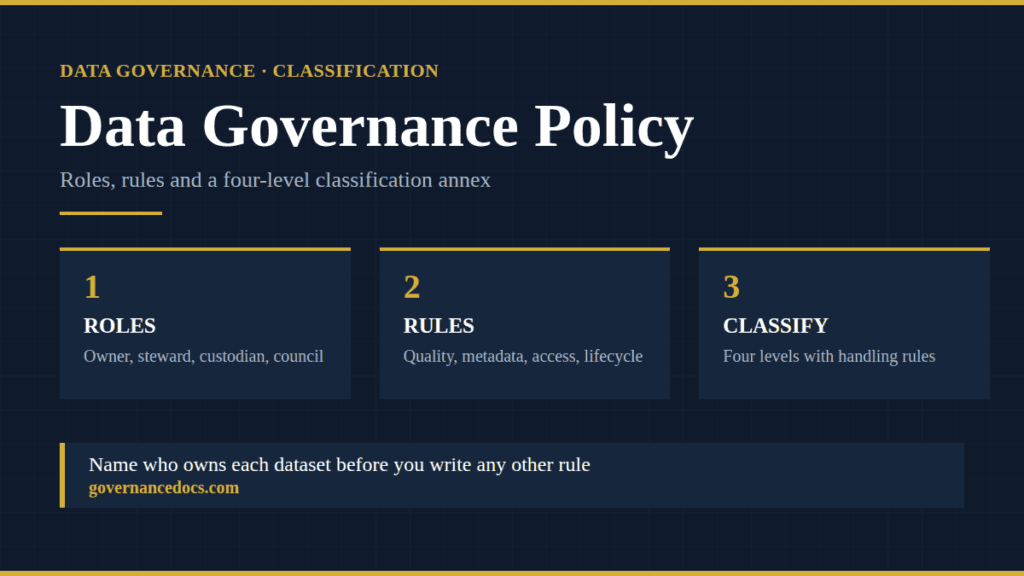
A data governance policy template gives you the bones of the one document that decides who owns your data, who may change it, and what “good” data means in your organization. Without it, every team invents its own rules and nobody can say who signs off on a definition, a fix or a deletion.
This guide gives you a section-by-section data governance policy template with example wording, sample clauses you can lift, and a short data classification policy you can bolt on as an annex. It is written for the person who has to get a first version approved this quarter, not for a theory exam.
Free gap assessment
How mature is your data management, area by area?
Score all eleven DAMA knowledge areas, free, plus the ethics, AI and organisational change chapters that sit off the wheel.
Run the free data governance maturity assessment → or View premium report sample
What a data governance policy does (and what it leaves to other documents)
The NIST glossary, citing CNSSI 4009-2022, describes data governance as a set of processes that ensures data assets are formally managed throughout the enterprise. The policy is where you state that authority in writing.
Keep the policy short and principle-level. It names roles, decision rights and minimum rules. The detail lives below it: data quality standards, metadata standards, the retention schedule, access procedures. The wider operating model (programs, maturity, tooling) belongs in your data governance framework, which the policy points to.
A useful test: if a clause would change every few months, it belongs in a standard or procedure, not the policy.
Roles your data governance policy template must define
Most failed programs fail on roles, not on rules. Name each role, what it is accountable for, and who typically holds it. Titles vary; the split of accountability should not.
| Role | Accountable for | Typical holder |
|---|---|---|
| Data governance council | Approves policy and standards, settles cross-domain disputes, sets priorities | Senior leaders from business, IT, risk and legal |
| Data governance lead (or CDO) | Runs the program, maintains the policy, reports to the council | Chief data officer, head of data, or a governance manager |
| Data owner | Business accountability for a data domain: classification, access approval, quality targets | Head of the business function that creates the data (e.g., VP Sales for customer data) |
| Data steward | Day-to-day definitions, quality rules, issue triage within a domain | Subject-matter expert inside the business team |
| Data custodian | Technical safekeeping: storage, backups, access controls, implementing retention | IT, platform or database team |
| Data users | Using data within approved purposes and reporting issues | All staff and contractors with data access |
The council needs a charter with membership, quorum and escalation rules. Our guide to setting up a data governance council covers that charter in detail.
Data governance policy template: section by section
Copy this data governance policy template into your document control format. Replace bracketed text. The example wording is deliberately plain so legal and audit reviewers can approve it quickly.
| Section | What to write | Example wording |
|---|---|---|
| 1. Purpose | Why the policy exists, in two sentences | “This policy establishes how [Organization] manages data as a business asset so that it is accurate, secure, available to authorized users and handled lawfully.” |
| 2. Scope | Data, systems, people and locations covered | “Applies to all structured and unstructured data created, received or stored by [Organization], in any system or location, and to all employees, contractors and third parties who handle it.” |
| 3. Definitions | Terms used in the policy | “Data domain: a logical grouping of data with a single accountable data owner (e.g., Customer, Product, Finance, Employee).” |
| 4. Principles | Five to seven short commitments | “Every data domain has one named owner. Data is defined once and reused. Access follows least privilege.” |
| 5. Roles and responsibilities | The role table above | “Data owners approve access requests for their domain within [5] business days.” |
| 6. Governance council | Authority, membership, meeting cadence | “The Data Governance Council meets [monthly] and approves all data standards and policy exceptions.” |
| 7. Data quality | Who sets targets, how issues are logged | “Data owners set measurable quality targets for critical data elements. Stewards log and track quality issues in [tool].” |
| 8. Metadata and glossary | Business glossary and data catalog rules | “Critical data elements must have an approved business definition, owner and source system recorded in the data catalog before use in reporting.” |
| 9. Data lifecycle | Creation, retention and disposal | “Data is retained according to the Records Retention Schedule and disposed of securely when its retention period ends, unless subject to a legal hold.” |
| 10. Access | Approval and review of access | “Access to Confidential and Restricted data requires owner approval and is reviewed [quarterly].” |
| 11. Classification | Levels and handling (see annex below) | “All data is classified under the Data Classification Annex at creation or receipt.” |
| 12. Issue escalation | Path from steward to council | “Disputes not resolved by stewards within [10] business days escalate to the data owners, then to the Council.” |
| 13. Exceptions | How to request a deviation | “Exceptions must be documented, risk-assessed, approved by the Council and time-limited to a maximum of [12] months.” |
| 14. Compliance and monitoring | Metrics, audits, consequences | “The governance lead reports quality, access review and exception metrics to the Council [quarterly].” |
| 15. Review | Owner, frequency, approval | “This policy is reviewed at least annually and after significant regulatory or organizational change.” |
Fifteen sections sounds like a lot. In practice the finished policy runs four to eight pages, because each section is one to three paragraphs.
Data governance policy examples: sample clauses you can adapt
These data governance policy examples cover the clauses reviewers most often push back on. Adjust the numbers to your size and risk appetite.
Ownership clause
“Each data domain listed in the Data Domain Register has a single data owner at [Director] level or above. Where ownership is disputed, the Council assigns an owner within [30] days. A domain may not go without an owner; if the owner leaves, their line manager is the interim owner.”
Data quality clause
“Critical data elements are measured against completeness, accuracy, validity, timeliness and uniqueness. Quality scores below the target set by the data owner are logged as issues, assigned to a steward and tracked to closure.”
Metadata clause
“No report or dashboard used for external disclosure, regulatory filing or board reporting may use a data element that lacks an approved definition in the business glossary.”
Data sharing clause
“Data classified Confidential or above may be shared with a third party only under a written agreement approved by the data owner and Legal, with security requirements proportionate to the classification.”
New uses and analytics clause
“Using existing data for a new purpose, including training or testing analytics and AI models, requires data owner approval and, where personal data is involved, a privacy review before work begins.”
Data classification policy template (annex)
Many organizations run classification as a separate document. For a small or mid-sized organization, an annex to your data governance policy template is easier to maintain and keeps ownership in one place.
What is data classification policy in plain terms?
A data classification policy sets a small number of sensitivity levels, explains how to decide which level applies, and states the handling rules for each level: where the data may be stored, how it may be sent, who may see it and how it is destroyed. It turns “be careful with sensitive data” into rules people can follow.
Classification levels
Four levels suit most organizations. Fewer than three tends to lump everything into one bucket; more than five and people stop choosing correctly.
| Level | Definition | Examples |
|---|---|---|
| Public | Approved for release; no harm if disclosed | Published marketing material, press releases, public price lists |
| Internal | For staff use; minor impact if disclosed | Internal procedures, org charts, non-sensitive project documents |
| Confidential | Significant harm to the organization or individuals if disclosed | Customer lists, contracts, most personal data, unreleased financials |
| Restricted | Severe harm, legal or regulatory exposure if disclosed | Health data, payment card data, credentials, M&A plans, special category personal data |
Labelling rules
Sample wording: “Documents and messages classified Confidential or Restricted must carry the classification in the header or footer, or in the subject line for email. Systems holding Restricted data must record the classification in the data catalog. Unlabelled data is treated as Internal until classified.”
Handling rules
| Activity | Internal | Confidential | Restricted |
|---|---|---|---|
| Storage | Approved company systems | Approved systems with access control | Approved systems with encryption at rest and named-user access |
| Transmission | Company email and collaboration tools | Encrypted in transit; external sharing approved by owner | Encrypted end to end; no personal email or removable media |
| Printing | Permitted | Collect immediately | Only where essential; secure print release |
| Disposal | Standard deletion | Secure deletion or shredding | Verified secure deletion or destruction, recorded |
Public data needs no handling controls beyond approval before release. For level definitions, labelling examples and how classification feeds access control, see our longer guide to data classification.
How data governance policies line up with DAMA-DMBOK
DAMA International’s Data Management Body of Knowledge (DAMA-DMBOK) is the reference most data governance policies borrow from. The current edition is DMBOK2, with a revised edition released in 2024, and DAMA has a DMBOK 3.0 project under way. Its “DAMA Wheel” shows 11 knowledge areas, with data governance at the center and the other 10 around it, including data architecture, data quality, metadata, data security and reference and master data.
That layout is a good check on a draft data governance policy template. Sections 7 to 11 of the template map to the quality, metadata, lifecycle, security and classification parts of the wheel, while sections 5 and 6 describe the governance hub that oversees them. DMBOK is guidance, not a certifiable standard, so “aligned with DMBOK” is a design claim, not an audit result.
Rolling out your data governance policy template
- Pick three to five data domains first. Customer, product and finance are common starting points. Name an owner for each before drafting.
- Draft from the template. Fill sections 1 to 6 first; they are the ones leadership must agree.
- Test against real cases. Walk three recent data incidents or disputes through the draft. If the policy would not have settled them, fix it.
- Approve through the council. Record the approval, version and effective date.
- Publish with training. A 20-minute session for owners and stewards does more than a long policy nobody reads.
- Measure and review. Track owner coverage, open quality issues and exceptions, and review the policy at least annually.
If you hold ISO/IEC 27001 certification, the classification annex also supports Annex A control 5.12 (classification of information) and 5.13 (labelling of information), so you can reference one document from both management systems.
Related reading: data governance metrics.
Data governance policy template FAQ
How long should a data governance policy be?
Four to eight pages is typical when you use a data governance policy template like the one above. Anything longer usually means standards and procedures have crept into the policy. Move them into separate documents that the policy references.
Who should approve the data governance policy?
The data governance council, or the executive committee if no council exists yet. The approver must have authority over every business function the policy assigns duties to, otherwise owners can ignore it.
Do I need a separate data classification policy template?
Not necessarily. An annex works well for smaller organizations. Split it out when classification has a different owner, such as the CISO, or when auditors expect a standalone security document.
What is the difference between a data owner and a data steward?
The owner is accountable and makes decisions: who gets access, what quality target applies, which classification fits. The steward does the daily work of maintaining definitions and fixing issues on the owner’s behalf.
Our Data Governance Toolkit provides 91 editable DMBOK-aligned templates, including a data governance policy, a data classification policy and data governance council terms of reference, for $99.
When a standard changes, know first
One email a month: edition changes, new deadlines, and what they mean for documentation you already have. No sales sequence.

Governance Docs
Governance Docs LLC
Recent Posts

November 26, 2026

November 26, 2026

November 26, 2026

November 26, 2026

November 26, 2026