CART
The travel rule for crypto-assets in the EU is Regulation (EU) 2023/1113 — the recast Transfer of Funds Regulation adopted alongside MiCA — and it has applied since 30 December 2024 with no de minimis threshold: every transfer of crypto-assets in which the originator’s or the beneficiary’s crypto-asset service provider is established in the Union must be accompanied by a defined set of originator and beneficiary information, submitted in advance of or simultaneously with the transfer, verified before it is executed, and retained for five years. Transfers to or from self-hosted addresses are not exempt; the CASP must obtain and hold the same information, and above €1,000 must assess whether the self-hosted address is owned or controlled by its own customer. The EBA’s travel rule Guidelines of 4 July 2024 specify how CASPs detect missing information and what to do when it is missing. This guide sets out the scope, the exact Article 14 data set, the originator, beneficiary and intermediary duties, the self-hosted address rules, the missing-information procedure, the record-keeping and data-protection requirements, and how the EU rule compares with the FATF standard it implements.
| Provision | What it says | Consequence |
|---|---|---|
| Article 2(1) | Applies to transfers of crypto-assets, including those executed by crypto-asset ATMs, where the CASP of the originator or of the beneficiary is established in the Union | One EU CASP on either end brings the transfer in |
| Article 2(4) | Does not apply to person-to-person transfers carried out without the involvement of a CASP | Wallet-to-wallet transfers between individuals are outside; anything a CASP touches is in |
| Article 2(4) | E-money tokens are treated as crypto-assets under the Regulation | Stablecoin transfers are covered |
| No threshold | The Regulation sets no minimum amount for crypto-asset transfers | Unlike the FATF’s optional USD/EUR 1,000 threshold, every transfer carries the data |
| Article 40 | Applies from 30 December 2024 | The same day as MiCA Title V |
Our guide to CASP authorisation covers the MiCA licence that makes an entity a CASP; the travel rule then applies to it as an AML obligation supervised under the amended Directive (EU) 2015/849.
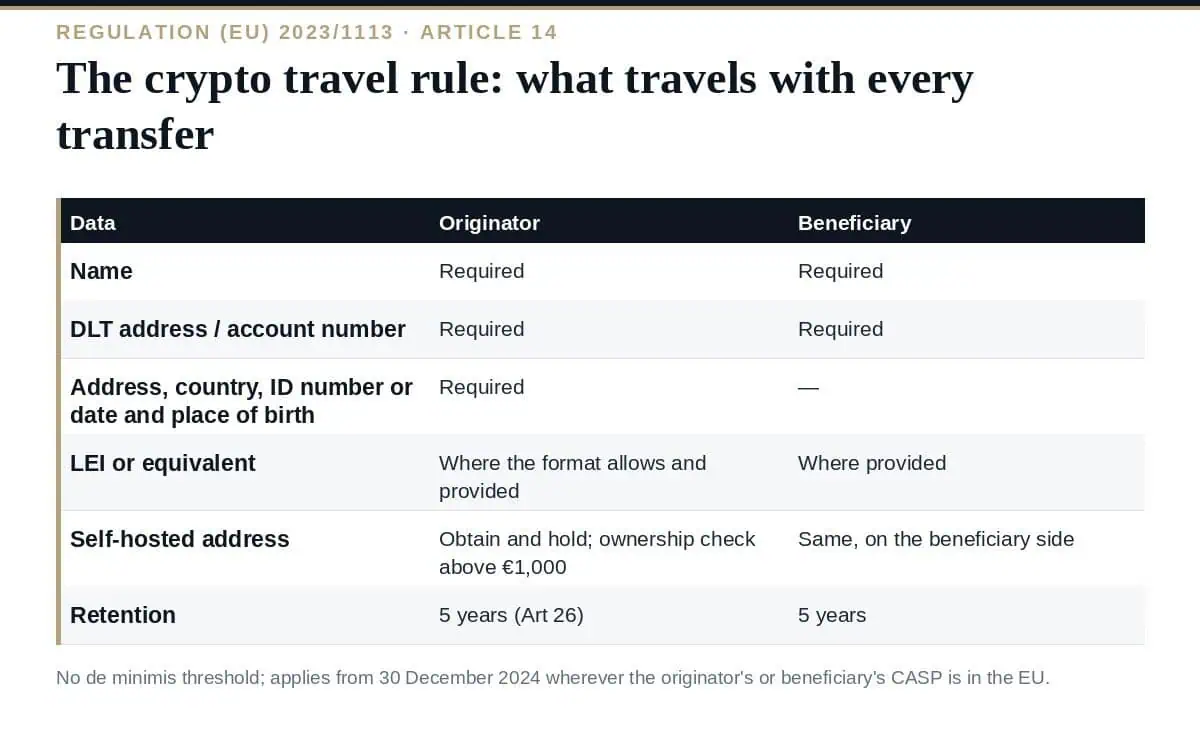
| Originator (Article 14(1)) | Beneficiary (Article 14(2)) | |
|---|---|---|
| Name | (a) The name of the originator | (a) The name of the beneficiary |
| Ledger address / account | (b) The distributed ledger address where the transfer is registered on a DLT network, and the crypto-asset account number where one exists and is used; (c) the account number where the transfer is not on a DLT network | (b) and (c) — the same for the beneficiary |
| Identity data | (d) Address including country, official personal document number and customer identification number — or, alternatively, date and place of birth | Not required |
| Identifier | (e) The current LEI or equivalent official identifier, where the message format has the field and the originator provided it | (d) The same, where provided |
| No DLT and no account | Article 14(3): a unique transaction identifier | The same |
Article 14(4) requires the information to be submitted in advance of, or simultaneously or concurrently with, the transfer, in a secure manner and in accordance with the GDPR — and states that it need not be attached to or included in the on-chain transfer itself. That is what makes the industry’s off-chain messaging protocols the compliance mechanism. Article 14(6)–(7) require the originator’s CASP to verify the originator information from a reliable and independent source before transferring, with verification deemed done where the customer was identified under Article 13 of the AML Directive and the records kept. Article 14(8): no transfer may be initiated or executed before full compliance.
| Role | Articles | Duties |
|---|---|---|
| Originator’s CASP | 14–15 | Collect the full data set; verify the originator; submit before or with the transfer; for batch files from one originator, the batch carries the data and each transfer carries the address, account or identifier |
| Beneficiary’s CASP | 16–17 | Effective procedures, including monitoring during or after transfers, to detect whether the data is included or follows; verify the beneficiary information; risk-based procedures to execute, reject, return or suspend a transfer lacking data; request missing data or reject or return without undue delay; on repeated failure by a counterparty CASP, warn and set deadlines, then reject future transfers or restrict or terminate the relationship — and report the failure to the competent authority |
| Intermediary CASP | 19–21 | Transmit all received originator and beneficiary information with the transfer; retain records; detect whether the Article 14(1)(a)–(c) and 14(2)(a)–(c) data has been submitted, including for self-hosted transfers; risk-based procedures for transfers lacking it |
| All CASPs | 26 | Retain the Article 14–16 records for five years, delete personal data on expiry unless national law provides otherwise, and retain no longer than strictly necessary |
| Direction | Provision | Requirement |
|---|---|---|
| Transfer to a self-hosted address | Article 14(5) | The originator’s CASP obtains and holds the Article 14(1)–(2) information and ensures the transfer can be individually identified; above €1,000, takes adequate measures to assess whether the address is owned or controlled by the originator |
| Transfer from a self-hosted address | Article 16(2) | The beneficiary’s CASP obtains and holds the same information and ensures the transfer can be individually identified; above €1,000, assesses whether the address is owned or controlled by the beneficiary |
| Risk measures | Article 19b of Directive (EU) 2015/849 (as amended) | Specific risk-mitigating measures for self-hosted transfers, without prejudice to the above |
The EBA Guidelines describe the ownership-verification methods CASPs may use — including cryptographic signing of a message from the self-hosted address, a micro-transaction, and other technical proofs — and the risk factors for unverified addresses. The point for design is that “self-hosted” is not an exit from the rule; it is a variant in which the CASP fills in both sides of the data set itself.
| EU Regulation 2023/1113 | FATF Recommendation 16 / VASP guidance | |
|---|---|---|
| Threshold | None for crypto-asset transfers | Countries may set a de minimis of USD/EUR 1,000, below which only names and addresses/accounts are required |
| Originator data | Name, DLT address/account, address with country, document and customer ID number or date and place of birth, LEI where available | Name, account/wallet, and one of: address, national identity number, customer ID, date and place of birth |
| Beneficiary data | Name, DLT address/account, LEI where available | Name and account/wallet |
| Self-hosted | Obtain and hold both sides’ data; ownership assessment above €1,000 | Obtain originator/beneficiary information; risk-based measures for unhosted wallets |
| Timing | In advance of or simultaneously with the transfer; verified before execution | Immediately and securely |
| Retention | Five years | At least five years |
| Enforcement | Article 111-style AML sanctions under national law; EBA Guidelines apply from 30 December 2024 | FATF mutual evaluations; national implementation varies |
The EU implementation is stricter than the FATF baseline on the threshold and on self-hosted transfers, which matters for CASPs that also operate under regimes following the FATF text more closely. Our guide to the MiCA Regulation covers the parallel regime, and MiCA compliance checklist places the travel rule among the CASP’s obligations.
What is the crypto travel rule in the EU?
Regulation (EU) 2023/1113, applying from 30 December 2024, which requires the originator’s CASP to send a defined set of originator and beneficiary information with every transfer of crypto-assets, the beneficiary’s CASP to detect and act on missing information, intermediaries to transmit and retain it, and all of them to keep records for five years.
Is there a minimum amount below which the travel rule does not apply?
No. Unlike the FATF’s optional USD/EUR 1,000 de minimis, the EU Regulation sets no threshold for crypto-asset transfers; the €1,000 figure appears only in the self-hosted ownership check under Articles 14(5) and 16(2).
Does the travel rule apply to self-hosted wallets?
Yes. The CASP must obtain and hold the full originator and beneficiary information for transfers to or from a self-hosted address, ensure the transfer can be individually identified, and above €1,000 assess whether the address is owned or controlled by its customer.
Does the information have to go on-chain?
No. Article 14(4) requires it to be submitted in advance of or simultaneously with the transfer, securely and in accordance with the GDPR, and states it need not be attached to or included in the transfer itself — off-chain messaging between CASPs is the mechanism.
What must a beneficiary CASP do if data is missing?
Under Article 17, on a risk-sensitive basis and without undue delay, reject or return the transfer or request the missing information before making the assets available; on repeated failure by a counterparty CASP, warn and set deadlines, then reject future transfers or restrict or end the relationship, and report the failure to the competent authority.
Run the travel rule as a data-and-counterparty discipline: generate the Article 14 fields from KYC, send them off-chain before the transfer, know every counterparty CASP and its escalation status, treat self-hosted transfers as a workflow with an ownership check above €1,000, act on missing data without undue delay, and keep everything for five years — because from 30 December 2024 there is no threshold and no exemption for the wallet at the other end.
The Travel Rule Procedure, the Article 14 data-set specification, the counterparty CASP register with the Article 17(2) escalation ladder, the self-hosted address ownership-check record and the five-year retention schedule are in the MiCA Toolkit, or start with the free templates.

October 12, 2026

October 12, 2026

October 12, 2026
October 12, 2026

October 12, 2026

