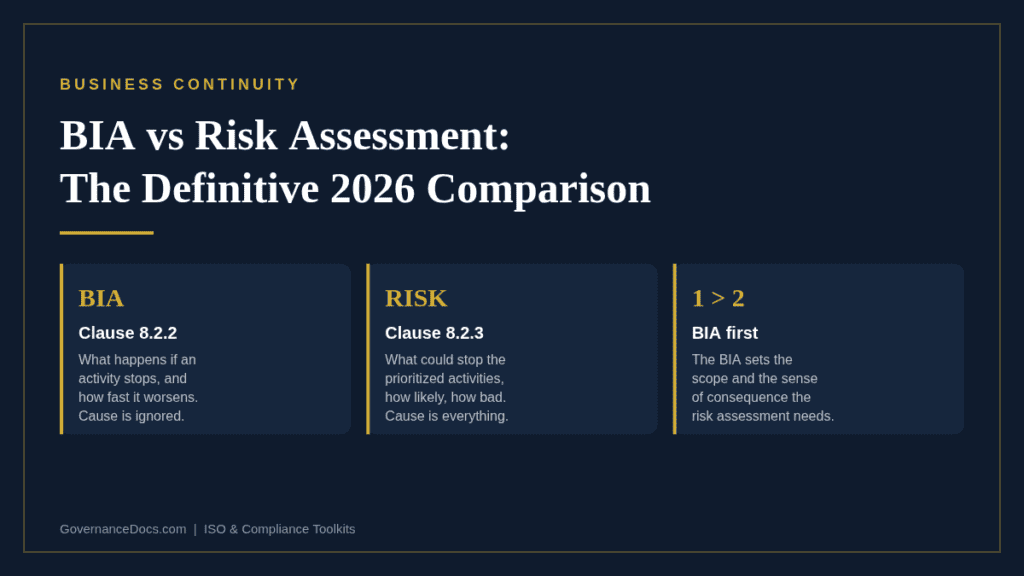
BIA vs risk assessment is one of the most common points of confusion in business continuity, and it matters because teams that blur the two end up with one spreadsheet that does neither job. A business impact analysis (BIA) asks what happens to the business if an activity stops, however it stops. A risk assessment asks what could make it stop, and how likely that is. ISO 22301 requires both, in a specific order, for a reason.
This guide sets the two side by side, shows how each one feeds the other, and covers where an ISO 27001 risk assessment fits in, since many organizations run all three.
BIA vs risk assessment at a glance
Business impact analysis
Risk assessment
Question it answers
What happens if this activity stops, and how fast does it get worse?
What could stop it, how likely is that, and how bad would it be?
Starting point
The activities that deliver your products and services
Threats and vulnerabilities affecting the prioritized activities and their resources
Cause of disruption
Ignored on purpose
The whole focus
Likelihood
Not considered
Central, alongside consequence
Main outputs
MTPD, RTO, minimum capacity, prioritized activities, resources and dependencies
Rated risks, a decision on which need treatment, and a treatment plan
ISO 22301 clause
8.2.2
8.2.3
Feeds
Continuity strategies, recovery sequence, the risk assessment’s scope
Preventive controls, risk treatment, and strategy choices
Typical input from
Activity owners and business managers
Security, facilities, IT and operations specialists
The short version of BIA vs risk assessment: the BIA tells you what to protect and how quickly it must come back. The risk assessment tells you what to protect it from.
Free business impact analysis
How long can each activity really be down?
Rate the impact of an outage over time, set RTOs and maximum tolerable periods of disruption, map the people, systems and suppliers behind each activity, and get a recovery sequence back, free.
ISO 22301:2019 clause 8.2.2 requires the organization to define impact types and criteria, identify the activities that support its products and services, assess the impacts of disrupting them over time, and set the time frame within which not resuming becomes unacceptable. From that come prioritized time frames for resuming each activity at a minimum acceptable capacity, which most organizations record as a recovery time objective (RTO), and the list of prioritized activities with their resources and dependencies.
The defining feature is that the BIA does not care why the activity stopped. A flood, a ransomware attack and a key supplier going bust all produce the same question: how long can dispatch be down before the damage becomes unacceptable? That indifference to cause is what makes the BIA useful. It prepares you for disruptions nobody predicted, which is most of them.
Clause 8.2.3 requires a process that identifies the risks of disruption to the prioritized activities and the resources they need, analyzes and evaluates those risks, and determines which ones require treatment. It follows the general risk assessment sequence in ISO 31000 (identification, analysis, evaluation), applied to disruption.
Free business continuity risk assessment
What could stop your most important activities?
List your prioritized activities and what they depend on, pick from 32 disruption scenarios, rate them and choose continuity measures for each. Built to ISO 22301 clause 8.2.3, and free.
Here, cause is everything. A single warehouse, a single courier, one administrator who knows the payroll process: each is a risk with a likelihood and a consequence, and each can be treated by reducing the likelihood, reducing the consequence, or accepting it with eyes open. The treatment decisions then feed back into the continuity strategies under clause 8.3. For the full method, see our ISO 22301 risk assessment guide.
Why the BIA comes before the risk assessment
The order is not a convention. Clause 8.2.3 scopes the risk assessment to the prioritized activities and their resources, and those only exist once the BIA has identified them. Run the risk assessment first and you have no principled way to decide which risks matter most, so every threat to every system gets the same attention.
The BIA also gives the risk assessment its sense of consequence. A four-hour outage of a system whose activity has a one-week MTPD is an inconvenience. The same outage for an activity with a one-day MTPD is a serious risk. Without the BIA, both look the same on a heat map.
Information then flows back the other way. Risks the assessment finds, such as a vendor whose restore commitment is slower than the RTO it supports, become inputs to the next BIA review, which clause 8.2.1 requires at planned intervals and when significant changes occur.
BIA vs risk assessment on the same activity
Seeing BIA vs risk assessment applied to one activity makes the split concrete. Take dispatch at a fictional parts distributor, the company from our worked example.
The BIA says: dispatch hits a Major impact after one day, because factory customers start moving orders to competitors. So the MTPD is one day, the RTO is eight hours, and the minimum acceptable capacity is orders for the top 20 accounts. Dispatch depends on the warehouse management system, 12 of 30 warehouse staff, and one courier.
The risk assessment then asks what could take each of those dependencies away. The cloud warehouse system could fail, and the vendor only commits to restoring it within 24 hours, three times longer than the RTO. The courier could suffer its own outage, and there is no second carrier. Both are rated, both exceed the risk criteria, and both are treated: a manual picking fallback for the first, a standby carrier agreement for the second.
Neither analysis could have produced that result alone. Without the BIA, a 24-hour vendor restore time looks reasonable. Without the risk assessment, nobody looks at the vendor contract at all.
Where an ISO 27001 risk assessment fits
Organizations running an ISMS already have an information security risk assessment under ISO 27001 clause 6.1.2, built around loss of confidentiality, integrity and availability. It is tempting to treat its availability risks as a stand-in for continuity work. It is not a substitute for either BIA or continuity risk assessment:
It assesses risks to information, not the impact of losing a business activity over time.
It does not produce an MTPD or RTO, so it cannot tell IT how fast anything has to come back.
Its scope is information assets, while a continuity risk assessment also covers people, premises and suppliers.
The two do connect. ISO 27001 Annex A control 5.30, ICT readiness for business continuity, expects ICT continuity to be planned from business continuity objectives, and the supporting ISO/IEC 27002 guidance points to a business impact analysis as the source of those requirements. Many organizations share the risk criteria and scales between the two risk assessments so that results can be compared on one register. For the ISMS side, see our ISO 27001 risk assessment guide.
BIA vs risk assessment: common mistakes
Merging them into one sheet. A single table with columns for impact, likelihood and RTO usually ends up with RTOs driven by how likely a threat seems. That is backwards: an activity’s tolerance for disruption does not change with the odds of any particular cause.
Adding likelihood to the BIA. Once likelihood enters, unlikely scenarios get low scores and the activities they would hit get deprioritized. The BIA should assume the disruption has happened.
Assessing risk to everything. Without the BIA’s prioritized list, the risk assessment spreads effort evenly across activities that can wait a month and activities that cannot wait a day.
Letting either go stale. A new site, system or major customer changes the BIA, and a changed BIA changes which risks matter. Review them together.
Frequently asked questions
Is a BIA a type of risk assessment?
No. Both sit under clause 8.2 of ISO 22301, but they are separate processes with separate outputs. The BIA measures impact over time without considering cause or likelihood. The risk assessment is built on cause and likelihood.
Which comes first, the BIA or the risk assessment?
The BIA. The risk assessment in clause 8.2.3 is scoped to the prioritized activities and resources the BIA identifies.
Do small organizations really need both?
Yes, if the goal is ISO 22301 conformity, because clause 8.2 requires both. The effort scales down: a small company’s BIA may cover eight activities in a few pages, and its risk assessment may be one register. The BIA vs risk assessment split still matters at that size, because it is what stops the RTOs being set by gut feel.
Can the same team run both?
Yes, and in small organizations it usually does. What matters is that the inputs come from the right people: activity owners for the BIA, and people who understand the threats (IT, facilities, security, procurement) for the risk assessment.
Does ISO 27001 require a business impact analysis?
Not by name. ISO 27001 requires an information security risk assessment, and control 5.30 requires ICT readiness for business continuity. In practice, meeting 5.30 credibly means knowing your recovery requirements, which is what a BIA produces.
Where this leaves you
BIA vs risk assessment is not a choice between two options. You need both, the BIA first, and the connection between them is what makes a continuity program hold up in an audit. For the fuller method behind the BIA side, read our business impact analysis guide.
The ISO 22301 Toolkit includes a Business Impact Analysis Tool, a risk assessment and opportunity table, and a completed worked example of each for the same fictional organization, so you can see how one feeds the other, for $149.