CART
Key Takeaways
The NIST Framework has become a cornerstone for organizations seeking to strengthen their cybersecurity posture while making smart, cost-effective investments. In today’s rapidly evolving digital landscape, cyber threats are more sophisticated and frequent than ever, and businesses must prioritize their defenses to safeguard sensitive data, maintain regulatory compliance, and protect their reputations. Leveraging the NIST Framework effectively can guide companies in making informed decisions about where and how to allocate resources for maximized cybersecurity benefits.
In this comprehensive guide, we’ll explore everything you need to know about the NIST Framework and how it serves as an invaluable tool for making best-in-class cybersecurity investments.
—
Developed by the National Institute of Standards and Technology (NIST), the Cybersecurity Framework (CSF) provides a voluntary, risk-based approach to managing cybersecurity risks. Initially published in 2014 and periodically updated, the framework is designed to help organizations of all sizes and sectors enhance their cybersecurity practices systematically.
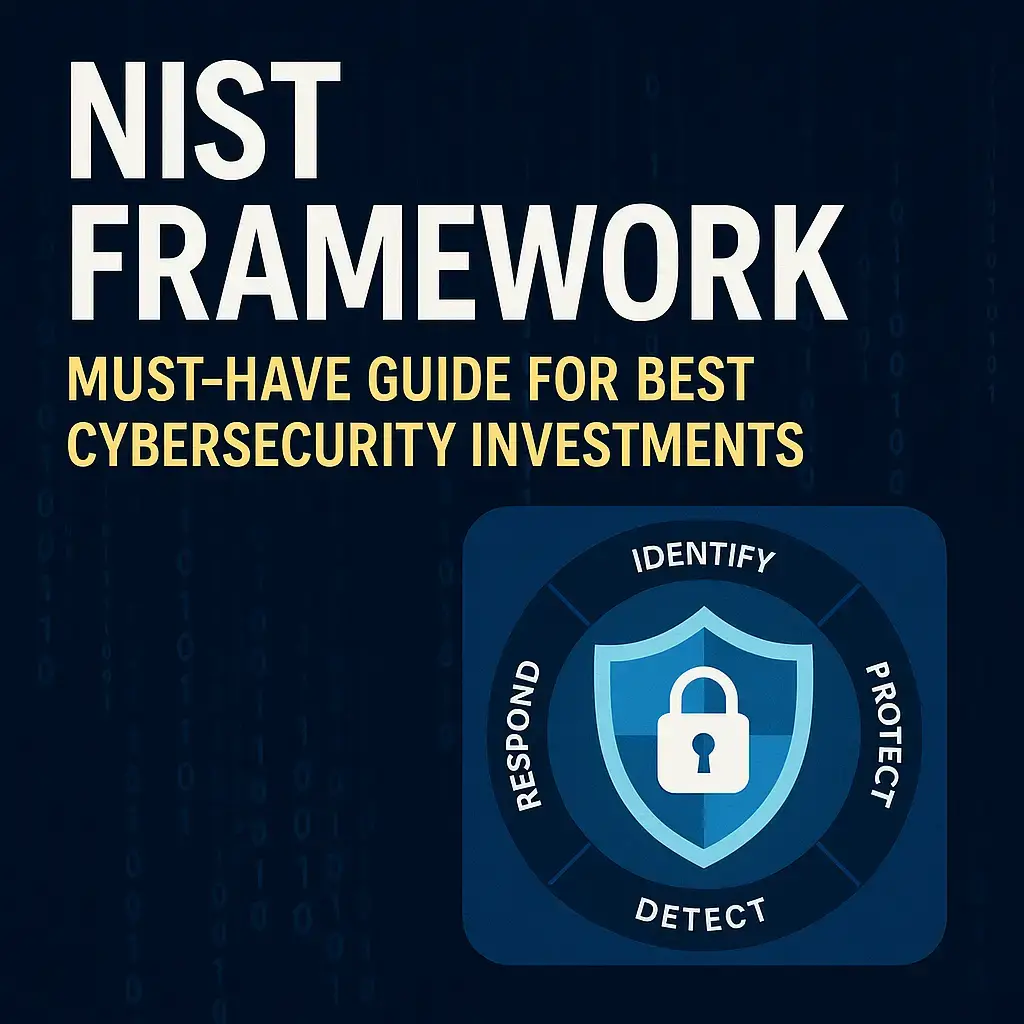
The framework is built around six core functions. Version 2.0, published in February 2024, added Govern to the five that came before it:
1. Govern – Establish and monitor the organisation’s cybersecurity risk management strategy, expectations and policy.
2. Identify – Understand and manage cybersecurity risks to systems, assets, data, and capabilities.
3. Protect – Develop and implement safeguards to limit or contain the impact of potential cybersecurity events.
4. Detect – Develop and implement activities to identify the occurrence of cybersecurity events promptly.
5. Respond – Take action regarding a detected cybersecurity event to minimize its impact.
6. Recover – Restore capabilities or services impaired due to a cybersecurity event.
Each function encompasses categories and subcategories that provide detailed outcomes and associated informative references to standards, guidelines, and practices.
—
When budgets are tight, and cybersecurity threats loom large, deciding where to invest can be daunting. The NIST Framework addresses this challenge by offering a structured approach to prioritize cybersecurity activities based on risk and business objectives.
One of the framework’s strengths is its focus on risk management. Organizations first assess where their vulnerabilities lie and which assets are most crucial to security and business continuity. This enables prioritization of investments where they’re needed most, avoiding the pitfall of spending on unnecessary or redundant controls.
By linking cybersecurity efforts to business processes and objectives, the framework helps ensure investments support overall organizational priorities. Additionally, many actions recommended by the framework assist with regulatory compliance—an increasingly important factor as governments tighten data protection laws worldwide.
Unlike prescriptive standards, the NIST Framework is adaptable, allowing organizations to scale their cybersecurity programs according to their size and industry-specific risks. This increases the return on investment because efforts are customized and relevant rather than blanket solutions that might under- or over-serve the organization.
—
Understanding the framework is just the first step; the real value comes from applying it to decision-making. Here’s a practical approach to leveraging the NIST Framework when planning cybersecurity spending.
Begin by using the framework to analyze your organization’s existing cybersecurity capabilities. This involves reviewing policies, technologies, personnel skills, incident response plans, and more for each of the six core functions.
The goal is to identify strengths, weaknesses, and gaps. For example, you might find your “Detect” function is underdeveloped, leaving your organization vulnerable to undetected breaches. Or your recovery plans may be outdated, risking prolonged downtime after an incident.
Next, establish the desired cybersecurity outcome aligned with your risk tolerance and business objectives. The Target Profile represents the ideal state for each function and category based on what your organization wants to achieve and the resources available.
This helps clarify where to invest effort and money to move from the current state to this target level.
Compare the current profile against the target to highlight gaps. These gaps reveal priority areas for investment. For instance, if your protection controls lag behind expectations, investing in advanced firewalls, endpoint security, or employee training may be necessary.
Based on the gap analysis, create a roadmap that outlines specific initiatives, timelines, and budgets. Since resources are finite, prioritize high-impact, feasible projects first.
Cybersecurity is dynamic, so continuously track progress against your plan and adjust investments as threats evolve or new opportunities emerge.
—
While all six core functions are important, organizations often focus investments on particular areas depending on their current posture.
Before spending a single dollar, organizations need a clear picture of what needs protection. Investments in asset management, risk assessment tools, and governance can yield immediate insights that inform all other functions.
Examples of Investments:
– Inventory and classification tools
– Risk management software
– Security policy development and training programs
This is the most visible area of investment, encompassing solutions such as firewalls, encryption, access controls, and security awareness training.
Examples of Investments:
– Multi-factor authentication systems
– Endpoint detection and response (EDR) platforms
– Regular cybersecurity training for employees
– Network segmentation and data loss prevention tools
Investing here means acquiring technologies and processes that allow your team to identify threats quickly, reducing dwell time and possible damage.
Examples of Investments:
– Security information and event management (SIEM) platforms
– Intrusion detection systems (IDS)
– Continuous monitoring and threat intelligence services
Being prepared to act swiftly and effectively during an incident can significantly reduce damage. Investments focus on incident response plans, communication protocols, and tools.
Examples of Investments:
– Incident response playbook development
– Forensics and investigation tools
– Crisis communication systems
Restoration is crucial for business continuity. Adequate investments here ensure rapid recovery with minimal loss.
Examples of Investments:
– Backup and disaster recovery solutions
– Redundant infrastructure
– Recovery plan testing and exercises
—
Effective cybersecurity investment means balancing costs with expected benefits—both tangible and intangible.
– Reducing the Likelihood of Breaches: Strong preventive controls reduce costs associated with data breaches, including fines, remediation, reputation damage, and lost revenue.
– Compliance Avoidance Costs: Meeting regulatory requirements through framework-aligned controls helps avoid hefty penalties.
– Operational Efficiency: Improved cybersecurity can increase confidence in technology and digital initiatives, enabling smoother operations and innovation.
– Risk of Downtime: Backup and recovery investments minimize productivity loss from cyber incidents.
By linking cybersecurity investments with measurable business outcomes, the NIST Framework helps justify spend to executive decision-makers.
—
Case Study 1: A Financial Services Firm
Facing increasing cyber threats and compliance demands, this firm first used the NIST Framework to assess current capabilities, identifying significant gaps in detect and respond functions. By investing in a SIEM system and training its incident response team, the firm saw a 40% reduction in the time to detect and respond to attacks. Their compliance audits also improved, avoiding costly fines.
Case Study 2: A Mid-Sized Manufacturing Company
The company had limited cybersecurity measures and was anxious about ransomware risks. After using the framework’s identify and protect categories, they prioritized investments in network segmentation and endpoint protection. Coupled with employee phishing simulations, these initiatives reduced successful ransomware attacks by 75% within a year.
—
– Gain Executive Buy-in: Leaders must understand the framework’s value and support cybersecurity investments.
– Establish Cross-Functional Teams: Cybersecurity affects all departments; collaboration ensures comprehensive risk understanding.
– Use Continuous Assessment: Cybersecurity threats change quickly—regularly revisit and update your NIST Framework alignment.
– Leverage Automation and Tools: Automate monitoring, reporting, and analysis where possible for efficiency.
– Train Personnel: Human error remains a top cybersecurity risk. Regular training aligned with the framework principles strengthens protection.
—
The NIST Framework is more than a checklist—it’s a strategic guide that empowers organizations to make smart, prioritized cybersecurity investments. By understanding current capabilities, setting clear objectives, and focusing spending where it will have the greatest impact, businesses can enhance their defenses without wasteful expenditure.
In an era where cyber risks continue to escalate, adopting a structured, risk-based approach like the NIST Framework is the must-have strategy for sustainable cybersecurity success. This enables organizations not only to protect critical assets but also to build resilience, trust, and competitive advantage in the digital age.
Skip the blank page. Download auditor-written, fully editable Comprehensive NIST SP 800-53 Security Controls documentation templates and adapt them to your organization in minutes.
View the Comprehensive NIST SP 800-53 Security Controls Toolkit – 38 Templates →
Further reading: For authoritative guidance, see the NIST Cybersecurity Framework.
No. There is no certification scheme, no accredited auditor and no certificate. The framework is voluntary guidance, and organisations self-assess, publish a profile or commission a third-party readiness review. If you need something a customer can verify, ISO 27001 or a SOC 2 report is the route — many organisations use the CSF to organise the work and one of those to prove it.
Released on 26 February 2024, version 2.0 added a sixth function, Govern, which sits alongside Identify, Protect, Detect, Respond and Recover and covers strategy, roles, policy and oversight — including supply-chain risk management. It also broadened the framework’s stated audience from US critical infrastructure to organisations of any size in any sector, and added implementation examples and quick-start guides.
A current profile records the outcomes you are achieving today; a target profile records those you intend to achieve, given your risk appetite, obligations and resources. The difference between them is your gap analysis, and it converts directly into a prioritised action plan. This profile mechanism, rather than any control list, is what makes the CSF useful for justifying budget.
No. The CSF is a high-level framework of cybersecurity outcomes and is deliberately short. SP 800-53 is a detailed catalogue of security and privacy controls, primarily for US federal information systems, and runs to hundreds of controls. The CSF maps to it, so a common pattern is to use the CSF to decide what matters and SP 800-53 to specify how it will be implemented.
The framework itself is free to download from NIST, along with its reference tool, implementation examples and quick-start guides. That is a genuine difference from ISO standards, where the requirements text is copyrighted and sold. Your costs are implementation and any external assessment, not licensing.
If you are ready to move from reading to implementing, the NIST SP 800-53 Toolkit gives you every policy, procedure and record template mapped to the standard — auditor-written, fully editable and ready to download from $99. Not sure it is the right fit? Our Which ISO Toolkit Do I Need? buyer’s guide compares options by goal and industry.
A consultant can be invaluable for complex or high-risk programmes, but they typically charge $150–$400 per hour and take days to weeks to engage. A documentation toolkit delivers 80–90% of the same NIST documentation instantly, for a one-time $99–$199 — and many teams buy the toolkit first, then use a consultant only for a final gap review or audit preparation. See our full toolkit vs. consultant comparison.

September 8, 2026
September 8, 2026
September 8, 2026

September 8, 2026
September 8, 2026