CART
Key Takeaways
Free gap assessment
Are you ready for the 2026 edition of ISO 14001?
Score every clause of the new edition, free, including the aspects, life cycle and compliance evaluation work that carries most of the findings.
Run the free ISO 14001 gap assessment → or View premium report sample
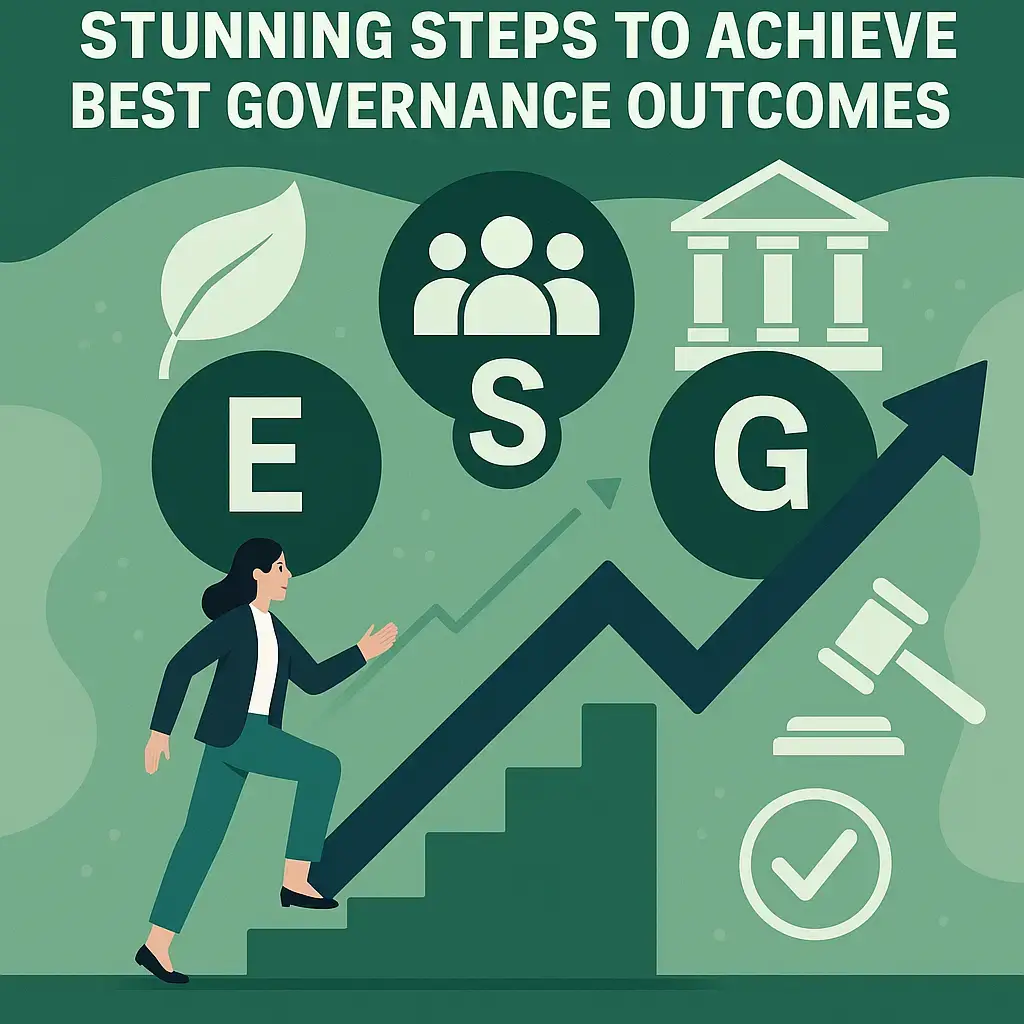
Environmental, Social, and Governance (ESG) commitments have become the cornerstone for organizations striving to build sustainable and responsible business practices. In particular, governance—the “G” in ESG—is critical in ensuring transparency, accountability, and ethical management, which ultimately drives long-term value creation. Best ESG governance outcomes are not merely about compliance but embody a strategic approach that fosters trust among stakeholders, mitigates risks, and supports sustainable development.
This article delves into the stunning steps that organizations can take to achieve the best ESG governance outcomes as part of their ESG commitments. By exploring actionable practices, frameworks, and the importance of strong governance structures, this piece aims to provide valuable insights for companies looking to refine their governance strategies to meet today’s rigorous expectations.
—
ESG commitments reflect an organization’s pledge to operate responsibly concerning environmental impact, social responsibility, and corporate governance. Governance refers to the system of rules, practices, and processes by which a company is directed and controlled. It encompasses the mechanisms through which companies, and their leadership, are held accountable for their actions and decisions.
Strong governance ensures ethical conduct, robust risk management, transparency in decision-making, and alignment of stakeholder interests, all of which are vital to sustainability and long-term business resilience. Given the rising expectations from investors, regulators, customers, and society, organizations increasingly recognize the need to embed governance excellence into their ESG frameworks.
—
Achieving stellar ESG governance outcomes requires a multi-faceted approach that goes beyond traditional compliance. Below are some of the most impactful steps organizations can take:
A company’s board is crucial in steering governance practices. A well-composed board includes diverse expertise, experience, and perspectives. It fosters insightful oversight and decision-making.
– Diversity and Inclusion: Boards should reflect diversity in gender, ethnicity, background, and skill sets, enabling broader perspectives and innovative solutions.
– Continuous Education: Regular training ensures that board members stay informed about evolving governance standards, ESG trends, and regulatory requirements.
– Independence: Having independent directors helps prevent conflicts of interest and promotes unbiased supervision of management.
Ethics form the backbone of governance. Developing clear, enforceable codes of conduct sets behavioral expectations and guides employees and leadership.
– Transparency: Codes of ethics should promote honesty in reporting and discourage fraudulent practices.
– Whistleblower Policies: Providing safe channels for reporting unethical behavior ensures early detection and remediation of governance breaches.
– Leadership Commitment: Senior executives and board members must exemplify ethical behavior to create a culture of integrity.
Effective governance requires proactive identification and mitigation of risks, including financial, regulatory, reputational, and operational threats.
– Integrated Risk Framework: ESG risks—such as climate change or social unrest—must be embedded into the overall risk management framework.
– Internal Audits: Regular audits ensure compliance with policies and uncover potential governance gaps.
– Transparency in Reporting: Transparent disclosures about risks and how they are managed build stakeholder confidence.
Engaging stakeholders—investors, customers, employees, regulators—helps companies understand expectations and build trust.
– Active Dialogue: Hold regular meetings, surveys, and feedback sessions with diverse stakeholder groups.
– Transparent Reporting: Publish comprehensive ESG reports aligning with standards like GRI, SASB, or TCFD that clearly articulate governance practices.
– Responsiveness: Actively respond to stakeholder concerns and integrate feedback into governance improvements.
Compensation policies are powerful tools to incentivize responsible behavior. Linking leadership pay to ESG performance ensures commitment at the highest levels.
– Performance Metrics: Define clear ESG-related key performance indicators (KPIs) such as diversity goals, ethics compliance, or environmental targets.
– Balanced Incentives: Avoid emphasizing short-term financial gains to encourage long-term sustainable decision-making.
– Transparency: Disclose executive compensation structures to allow stakeholders insight into governance priorities.
Modern governance benefits greatly from technology that improves transparency, compliance, and efficiency.
– Governance, Risk, and Compliance (GRC) Software: Integrate systems that streamline risk assessments, policy management, and regulatory tracking.
– Data-Driven Insights: Use analytics to monitor governance performance, detect anomalies, and forecast risks.
– Cybersecurity Measures: Protect sensitive governance data through robust cybersecurity protocols, enhancing trust and regulatory compliance.
Governance is not static. Organizations should adopt a mindset of continuous learning and improvement.
– Regular Assessments: Conduct governance health checks and benchmark against best practices.
– Remediation Plans: Implement corrective actions promptly when governance lapses occur.
– Accountability Mechanisms: Hold individuals accountable for governance failures, reinforcing commitment across all levels.
—
Some organizations are going further by adopting innovative governance structures that enhance ESG integration:
– Integrated Boards: Combining ESG committees with audit and risk committees to enhance oversight and coherence.
– Stakeholder Councils: Including external stakeholder representatives in governance discussions to enrich perspectives.
– Benefit Corporations: Legal structures that mandate consideration of social and environmental impact alongside profit.
These models illustrate how governance innovation can deepen the impact of ESG commitments.
—
Research consistently shows that strong governance leads to superior business outcomes, including:
– Enhanced Reputation: Transparent and ethical governance builds brand loyalty and stakeholder trust.
– Risk Mitigation: Identifying and managing risks reduces costly fines, scandals, or operational disruptions.
– Attracting Investment: Investors increasingly favor companies with demonstrated governance excellence.
– Long-Term Value Creation: Sustainable governance underpins resilient business strategies that prosper amid uncertainty.
Thus, governance should be seen not as an obligation but as a driver of competitive advantage.
—
While the benefits are clear, organizations face challenges such as:
– Complex Regulatory Environments: Keeping pace with evolving local and global governance regulations requires agility and expertise.
– Cultural Resistance: Embedding ethics and transparency may face pushback in entrenched organizational cultures.
– Resource Constraints: Developing robust governance frameworks can be resource-intensive.
To overcome these hurdles, companies can:
– Invest in governance-focused training and capacity building.
– Engage external experts for compliance and audit support.
– Foster open leadership that champions governance reforms.
—
With global calls for responsible business intensifying, governance will remain a key pillar of ESG efforts. Organizations that excel in governance not only comply with regulations—they inspire confidence, innovation, and sustainability. The stunning steps outlined here provide a roadmap for businesses aspiring to outstanding governance outcomes, reinforcing their broader ESG commitments for the benefit of all stakeholders.
—
Governance within ESG commitments is fundamental to building resilient, ethical, and transparent organizations. By embracing a comprehensive approach that includes diverse boards, ethical codes, robust risk management, stakeholder engagement, aligned incentives, technology adoption, and a focus on continuous improvement, companies can achieve best governance outcomes. These outcomes are crucial not only for mitigating risks and regulatory compliance but also for enhancing reputation, attracting investors, and ensuring sustainable, long-term success.
Implementing these stunning steps empowers organizations to lead confidently into an era where strong governance is synonymous with responsible and future-ready business practices.

Skip the blank page. Download auditor-written, fully editable Comprehensive Data Governance documentation templates and adapt them to your organization in minutes.
View the Comprehensive Data Governance Toolkit – 85 DMBOK-Aligned Templates →
Further reading: For authoritative guidance, see the Global Reporting Initiative.
Not to “ESG” as a whole — there is no single certifiable ESG standard. What you can certify is the governance machinery underneath it: ISO 37301 for compliance management, ISO 14001 for environmental management, ISO 45001 for occupational health and safety, and ISO 37001 for anti-bribery. Reporting frameworks such as GRI and the ISSB standards are disclosure regimes, not certifications, so they are assured rather than certified.
Accountability belongs at board level, with delivery sitting in a cross-functional group. The pattern that works is a named board sponsor, a steering committee drawing on finance, legal, HR, operations and sustainability, and a single owner for data quality. ESG programmes usually fail not because nobody cares but because the environmental data lives in operations, the social data in HR, and nobody reconciles them.
At minimum: an ESG or sustainability policy, a materiality assessment showing which topics matter and why, defined metrics with owners and calculation methods, a stakeholder engagement record, a risk register covering ESG risks, and board minutes evidencing oversight. Assurance providers test the calculation method behind a number far more aggressively than the number itself, so document how each metric is derived.
Claim only what you can evidence, and state the boundary of every claim. Most greenwashing findings come from unqualified language — “carbon neutral”, “sustainable”, “eco-friendly” — used without a defined scope, baseline or verification method. Say which entities and which emissions scopes a figure covers, name the methodology, and disclose what is excluded. A narrower claim you can defend is worth more than a broad one you cannot.
Start with a materiality assessment and a governance structure, not with data collection. Identify the handful of ESG topics that genuinely affect your business and your stakeholders, assign board accountability, then instrument only those. Companies that begin by trying to measure everything usually produce a large dataset nobody uses and no decisions change.
If you are ready to move from reading to implementing, the Data Governance Toolkit gives you every policy, procedure and record template mapped to the standard — auditor-written, fully editable and ready to download from $99. Not sure it is the right fit? Our Which ISO Toolkit Do I Need? buyer’s guide compares options by goal and industry.
A consultant can be invaluable for complex or high-risk programmes, but they typically charge $150–$400 per hour and take days to weeks to engage. A documentation toolkit delivers 80–90% of the same governance documentation instantly, for a one-time $99–$199 — and many teams buy the toolkit first, then use a consultant only for a final gap review or audit preparation. See our full toolkit vs. consultant comparison.

October 11, 2026
October 11, 2026

October 11, 2026

October 11, 2026

October 11, 2026

