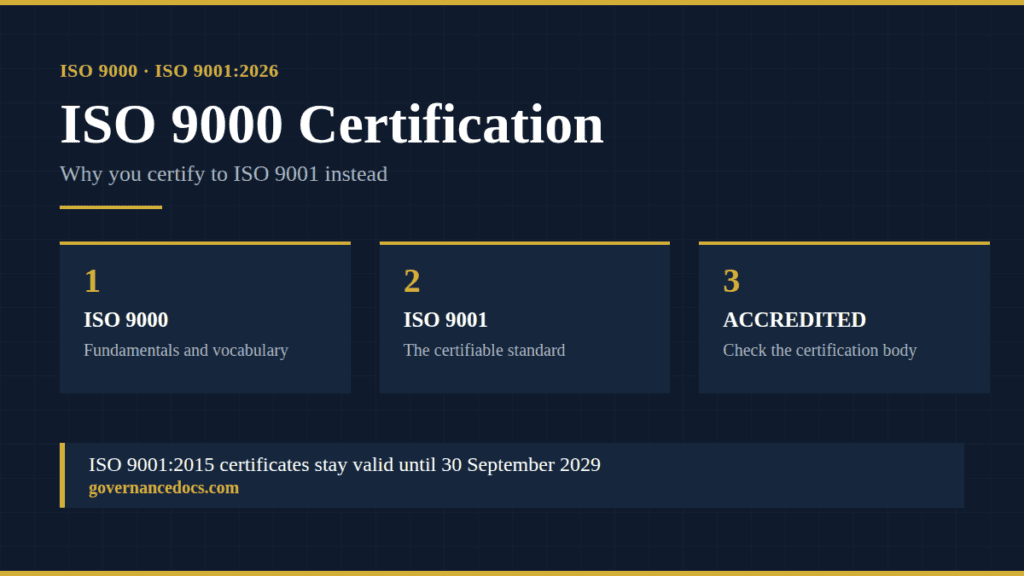
There is no such thing as ISO 9000 certification. ISO 9000 is the vocabulary and fundamentals standard for quality management, and no certification body audits against it. When people ask for ISO 9000 certification, what they need is ISO 9001 certification.
The mix-up is understandable. “ISO 9000” is also the name of the whole family of quality standards, and older marketing used it loosely. This guide untangles the names, explains certification versus accreditation, and shows how to check that a certificate is genuine.
Free gap assessment
Are you ready for the 2026 edition of ISO 9001?
Score yourself against the new edition, free, including the risk and opportunity split and the clause 10 renumbering that breaks converted checklists.
ISO 9000:2026, published in May 2026, is titled “Quality management: Fundamentals and vocabulary.” It defines terms such as “quality,” “nonconformity” and “corrective action,” and explains the concepts behind them. It contains no requirements, so there is nothing to audit.
ISO 9001 is the requirements standard. It uses “shall” statements that an auditor can test, which is why it is the only standard in the family you can be certified to. The current edition is ISO 9001:2026, published in September 2026. It points back to ISO 9000 for its quality terms.
So when a customer’s tender asks for ISO 9000 certification, read it as ISO 9001. If you are unsure, ask. Most buyers will confirm that ISO 9001 is what they meant.
Answering a tender that asks for ISO 9000 certification
Requests for ISO 9000 certification still appear in purchase orders, supplier questionnaires and public tenders. Answer them precisely rather than ignoring the wording, so nobody can later claim you did not meet the requirement.
A short reply that works:
“ISO 9000 certification is not issued by any certification body; ISO 9000 is the vocabulary standard of the ISO 9000 family.”
“We hold ISO 9001 certification, certificate number [number], issued by [certification body], accredited by [accreditation body].”
“Our certificate covers [scope] at [sites] and is valid until [date].”
Attach the certificate and, if asked, the accreditation body’s directory entry for your certification body.
If you are a buyer, fix the wording in your own templates. Asking for ISO 9000 certification signals an outdated questionnaire; ask for “accredited ISO 9001 certification” and state the scope you need.
The ISO 9000 family at a glance
Standard
What it is
Can you certify to it?
ISO 9000:2026
Fundamentals and vocabulary for quality management
No
ISO 9001:2026
Requirements for a quality management system
Yes
ISO 9004:2018
Guidance on achieving sustained success
No
ISO 19011:2026
Guidelines for auditing management systems
No
ISO 9004 helps a mature system go beyond the minimum. ISO 19011 is the guidance your internal auditors follow. Neither is certifiable, and neither is required for ISO 9001 certification.
ISO 9000 vs ISO 9001: the practical difference
The cleanest way to frame ISO 9000 vs ISO 9001 is dictionary versus rulebook. ISO 9000 tells you what the words mean. ISO 9001 tells you what your quality management system must do: understand its context, set a quality policy and objectives, address risks and opportunities, control operations, measure performance and improve.
You will use both. Your quality manual and procedures should use ISO 9000 definitions so that auditors and staff read terms the same way. But your certificate, your audits and your nonconformities all refer to ISO 9001 clauses. For the full picture of what ISO 9001 asks, see our ISO 9001 explained guide.
Certification vs accreditation: who issues what
The second confusion is between certification and accreditation. Searches for “ISO accreditation 9001” usually mean ISO 9001 certification. The two words describe different relationships.
Term
What it means
Who issues it
ISO 9001 certification
Independent confirmation that your quality management system meets ISO 9001
A certification body (also called a registrar)
Accreditation
Confirmation that a certification body is competent to certify, assessed against ISO/IEC 17021-1
A national accreditation body, such as UKAS (UK), ANAB (US) or DAkkS (Germany)
Global ACI recognition
Mutual recognition among accreditation bodies, so an accredited certificate is accepted across borders
Global Accreditation Cooperation Incorporated (Global ACI), through its Multilateral Recognition Arrangement
ISO standard
The published text, ISO 9001:2026
ISO, which writes standards but does not certify anyone
The chain runs from bottom to top. Your company is certified by a certification body. The certification body is accredited by a national accreditation body. The accreditation body is a signatory to the Global ACI arrangement. That chain is what makes a certificate “accredited.”
Global ACI took over this role when the International Accreditation Forum (IAF) ceased operations on 1 January 2026. Older guides that cite the IAF are describing the same system under its former name.
Accredited vs unaccredited ISO 9001 certification
Nothing stops a company from issuing ISO 9001 certificates without accreditation. Those certificates are legal, but many customers, tenders and regulators will not accept them. Some unaccredited issuers sell certificates with little or no audit.
Before you sign with anyone, confirm that the certification body is accredited for ISO 9001 and for your industry sector. Our guide to choosing an ISO 9001 certification body covers the questions to ask.
How to check an ISO 9001 certificate is accredited
Use this checklist on your own certificate, or on a supplier’s:
Standard and edition. It should say ISO 9001:2015 or ISO 9001:2026. A certificate for “ISO 9000” is a warning sign.
Scope. The activities and sites listed should match what the company actually does.
Dates. Check the issue date, the expiry date and, for 2015 certificates, the transition deadline below.
Certification body. The issuing body should be named, with a certificate number you can look up.
Accreditation mark. Look for the accreditation body’s mark, then confirm in that body’s online directory that the certification body is accredited for ISO 9001.
Database check. Search the certification body’s online register, or IAF CertSearch, the accredited-certificate database that still runs under its original name. Not every certificate is listed there, so a missing entry is a reason to ask, not proof of fraud.
If any step fails, ask the supplier for evidence before you rely on the certificate.
The ISO 9001:2026 transition: dates that affect your certificate
Global ACI’s mandatory transition document, Global ACI-TECH-3-TR 2029-09-30 (M), sets a three-year transition. These are the dates that matter to certified companies:
Date
What happens
30 September 2027
Deadline for accreditation bodies to complete transition decisions for certification bodies
31 March 2028
After this date, new and initial certifications must be to ISO 9001:2026 only
30 September 2029
ISO 9001:2015 certificates are no longer valid
Certification bodies can issue accredited ISO 9001:2026 certificates only after their own accreditation has been transitioned. If you plan to certify in 2027, ask your certification body when it expects that to happen.
Existing certificates move across through a transition audit. It can be combined with a surveillance or recertification audit or held as a special audit, and it may be done remotely. The certification body decides whether extra audit time is needed.
If you decide not to transition, your 2015 certificate expires at the end of the transition period, even if its printed expiry date is later. Our ISO 9001:2026 transition guide covers the clause changes.
How ISO 9001 certification works
Once you are clear that ISO 9001 certification is the goal, the route is standard:
Build and document your quality management system against ISO 9001:2026.
Run it long enough to produce records, including an internal audit and a management review.
Choose an accredited certification body and agree the scope.
Pass the Stage 1 audit, which checks documentation and readiness.
Pass the Stage 2 audit, which checks that the system works in practice.
Close any nonconformities and receive a certificate for a three-year cycle, with annual surveillance audits.
If you are starting today, build to ISO 9001:2026. A certification body may still offer a 2015 audit until 31 March 2028. But that certificate would need a transition audit soon after, and it cannot outlast 30 September 2029.
If you already hold a 2015 certificate, plan the transition into your next surveillance or recertification audit. That avoids paying for a separate special audit.
ISO 9000 certification FAQ
Can a company be ISO 9000 certified?
No. ISO 9000 contains definitions and concepts, not requirements, so no certification body audits against it. A company that claims ISO 9000 certification is almost always certified to ISO 9001 and using an outdated label.
Is ISO 9001 certification the same as ISO accreditation?
No. Your company is certified; the certification body is accredited. Accreditation is the check that the certifier is competent, carried out by a national accreditation body.
Who issues ISO 9001 certificates?
Certification bodies do. ISO publishes the standard but does not issue certificates. For an accredited certificate, choose a certification body accredited by a signatory of the Global ACI arrangement.
Is my ISO 9001:2015 certificate still valid?
Yes, until it expires or until 30 September 2029, whichever comes first. To keep certification after that date, you need a transition audit to ISO 9001:2026.
Our ISO 9001 Toolkit provides 84 editable templates built for ISO 9001:2026 — including a Quality Manual, an ISO 9001 2015 to 2026 Transition Guide and a Certification Audit Readiness Checklist — for $89.
When a standard changes, know first
One email a month: edition changes, new deadlines, and what they mean for documentation you already have. No sales sequence.