

GDPR and AI: The Essential 2026 Compliance Guide
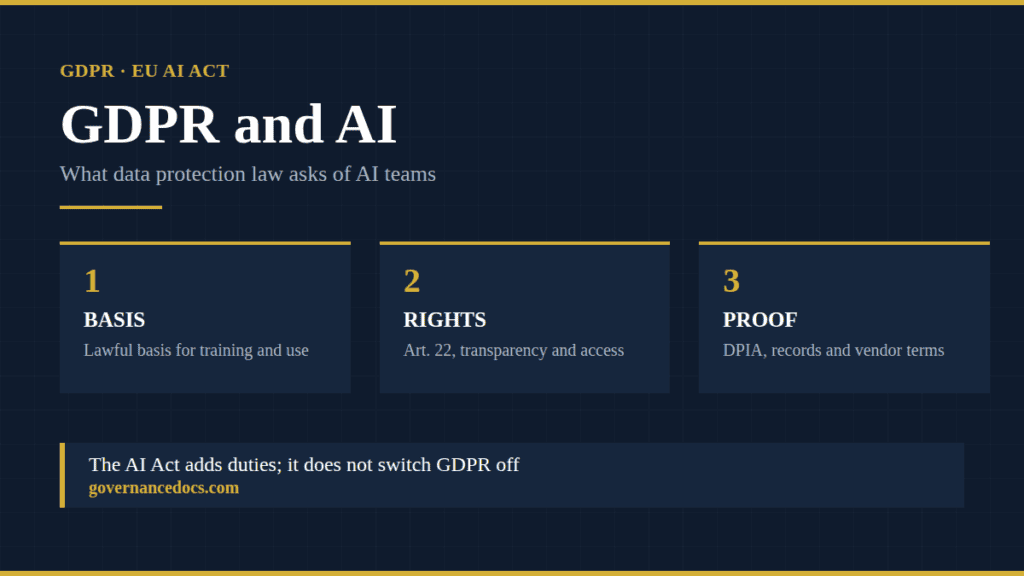
GDPR and AI meet the moment personal data touches a model, whether you train one, fine-tune one or paste customer records into a vendor’s chatbot. The GDPR has no AI chapter, yet almost every article applies.
This guide walks through the GDPR AI compliance requirements in the order you will hit them: model status, lawful basis, principles, transparency, automated decisions, DPIAs, rights, vendors, transfers and the EU AI Act. It ends with a requirement-by-requirement table and a 10-item checklist.
Free gap assessment
Could you demonstrate GDPR compliance today?
Score yourself against what a supervisory authority actually asks for, free — the records, not the policy.
Run the free GDPR gap assessment → or View premium report sample
GDPR and AI: does the Regulation apply to the model itself?
Training data that identifies people is personal data, so GDPR applies to collecting and preparing it. The harder question is whether the trained model still holds personal data.
The European Data Protection Board answered that in Opinion 28/2024 on AI models, adopted on 18 December 2024. It found that models trained on personal data cannot, in all cases, be considered anonymous.
A model is anonymous only if two likelihoods are insignificant: extracting training data directly from the model, and obtaining it through queries. Supervisory authorities assess anonymity claims case by case, using the documentation you provide.
Practical upshot: assume your model is in scope unless you have tested and documented otherwise.
Lawful basis for training and for deployment
In GDPR and AI projects, every processing activity needs an Article 6 lawful basis. Training and deployment are usually separate purposes, so assess each one rather than relying on a single basis for the whole lifecycle.
Most organizations rely on legitimate interests for AI. The EDPB opinion confirms there is no hierarchy between legal bases and restates the three-step test:
- Legitimate interest. The interest must be lawful, clearly articulated, and real and present, not speculative.
- Necessity. The processing must actually serve the interest, and there must be no less intrusive way to achieve it. The volume of personal data is judged against data minimisation.
- Balancing. The interest must not be overridden by people’s rights and freedoms. Reasonable expectations weigh heavily, including whether data was public and where it was collected.
Our worked guide to the legitimate interests balancing test shows how to document each step. Special category data, such as health or biometric data, also needs an Article 9 condition; legitimate interests alone will not cover it.
Deployers of third-party models carry a duty too. The EDPB expects a controller deploying a model to assess, as part of accountability, whether it was developed by unlawfully processing personal data.
Free AI risk assessment
Which of your AI systems could harm people, or you?
List your AI systems, models and data, pick from 54 AI risk scenarios, including the attacks on AI described in ISO 27090, rate them for the people affected and for you, and plan treatment with ISO 42001 Annex A controls. You get a heat map, a process score and the findings an auditor would raise, free.
Run the free AI risk assessment → or View premium report sample
Article 5 principles applied to AI
- Purpose limitation: data collected to run a service is not automatically available for training. Check compatibility before reuse.
- Data minimisation: strip fields the model does not need, and pseudonymise where you can.
- Accuracy: outputs about people, such as scores or generated text, are personal data and must be accurate for their purpose.
- Storage limitation: set retention for training sets, prompts and logs, not just for source systems.
- Integrity and confidentiality: protect against extraction, inversion and prompt-based data leakage.
For a fuller treatment of each principle, see our guide to the seven GDPR principles.
Transparency under Articles 13 and 14
People must be told how their data is used, including for training. Article 14 applies when data comes from another source, such as scraped or purchased datasets. Its disproportionate-effort exception is narrow and still requires measures such as making the information public.
Where Article 22 automated decision-making is involved, notices must give meaningful information about the logic involved and the likely consequences. The same information is available through a subject access request under Article 15(1)(h).
In Dun & Bradstreet Austria (C-203/22, 27 February 2025), the EU Court of Justice held that the explanation must let people understand which of their data was used to reach a result. Disclosing the algorithm itself is not required, but trade secrets do not justify refusing all information.
Article 22: automated decisions
Article 22 restricts decisions based solely on automated processing that produce legal or similarly significant effects, such as credit, hiring or insurance outcomes. They are allowed only where necessary for a contract, authorised by law, or based on explicit consent.
Even then, you must offer at least human intervention, a chance for the person to express their view, and a way to contest the decision. The Court’s 2023 SCHUFA ruling (C-634/21) held that a credit score can itself be a decision when it plays a determining role in a third party’s choice.
A human who rubber-stamps model outputs does not take a decision outside Article 22. Reviewers need authority, time and information to overturn the model, and you should record when they do.
DPIAs for AI under Article 35
Most AI projects involving personal data need a data protection impact assessment. Article 35(3)(a) makes one mandatory for systematic and extensive automated evaluation, including profiling, that leads to legal or similarly significant effects.
We cover scope, risks and mitigations in detail in our guide to running a DPIA for AI systems, so we won’t repeat it here.
Data subject rights against models
Access, rectification, erasure and objection apply to training data, prompts, logs and outputs. If the model itself is not anonymous, requests may reach the model too.
Plan the mechanics before launch. Typical measures include removing records from training sets before the next run, output filters that suppress a person’s data, and a documented position on when retraining is proportionate.
Where you rely on legitimate interests, Article 21 lets people object. You must stop unless you show compelling legitimate grounds that override their interests.
Controller and processor roles with AI vendors
Vendor contracts are where GDPR and AI risk most often slips. When you send personal data to an AI provider to process on your instructions, the provider is normally your processor and needs an Article 28 contract.
Check whether the vendor uses your inputs to train or improve its own models. If it does, it is likely deciding purposes for that use and acting as a controller, which needs its own lawful basis. Where you and a vendor decide purposes together, Article 26 joint controller terms apply.
International transfers
Many AI services process data outside the EEA. Chapter V (Articles 44 to 49) requires an adequacy decision, such as the EU-US Data Privacy Framework for certified US companies, or safeguards such as standard contractual clauses with a transfer impact assessment.
Switzerland follows a similar logic. The revised Federal Act on Data Protection has applied since 1 September 2023 and covers AI processing like any other, including duties on automated individual decisions.
How GDPR and AI Act duties fit together
The EU AI Act does not replace GDPR. Where an AI system processes personal data, both apply, and a GDPR compliant AI system can still breach the AI Act, and vice versa.
Bias testing is the clearest overlap. Article 10(5) of the AI Act lets high-risk providers process special category data where strictly necessary to detect and correct bias, under safeguards. Regulation (EU) 2026/1744 added Article 4a, extending a similar permission to providers and deployers of other AI systems and models, with conditions including deletion once the bias is corrected.
The same regulation lets deployers who must run a fundamental rights impact assessment cross-refer to their DPIA instead of duplicating it. Our ISO 42001 vs EU AI Act comparison shows where each regime adds work.
Dates matter. The original Article 5 prohibitions and AI literacy duty have applied since 2 February 2025 and were not postponed. New prohibitions apply from 2 December 2026, Annex III high-risk obligations from 2 December 2027, and Annex I high-risk obligations from 2 August 2028.
GDPR AI compliance requirements table
| GDPR requirement | Article | What it means for AI | Evidence to keep |
|---|---|---|---|
| Lawful basis | 6, 9 | Separate basis for training and deployment; Article 9 condition for special category data | Lawful basis register, legitimate interests assessment |
| Principles | 5 | Purpose compatibility, minimised datasets, accurate outputs, retention for logs | Dataset records, retention schedule |
| Transparency | 13, 14 | Tell people about training use and automated decisions | Privacy notices, version history |
| Access to logic | 15(1)(h) | Explain which data drove a result | Explanation template, request log |
| Automated decisions | 22 | Valid exception plus human review and contest route | Decision register, review records |
| Privacy by design | 25 | Minimisation and safeguards built into the pipeline | Design review records |
| Vendor contracts | 26, 28 | Processor terms; no vendor training without a basis | Signed DPAs, vendor assessments |
| Records of processing | 30 | Each AI use case listed as a processing activity | Updated RoPA |
| DPIA | 35 | Required for high-risk AI processing | Completed DPIA, sign-off |
| Transfers | 44–49 | Adequacy or safeguards for non-EEA AI services | SCCs, transfer impact assessment |
10-point checklist for GDPR compliant AI
Use this list to test GDPR and AI readiness before each launch. Any “no” is a gap to close first.
- List every AI use case in your records of processing.
- Record a lawful basis for training and for deployment separately.
- Complete and file a legitimate interests assessment where you rely on it.
- Remove unnecessary fields and special category data from training sets.
- Update privacy notices to cover training and automated decisions.
- Identify Article 22 decisions and give reviewers real authority to overturn them.
- Run a DPIA before launch and repeat it on material change.
- Test and document how you handle access, erasure and objection requests.
- Sign Article 28 terms with AI vendors and confirm whether they train on your data.
- Document the transfer mechanism for every non-EEA AI service.
For broader programme steps beyond AI, our GDPR compliance tips cover the foundations.
GDPR and AI FAQ
Can we train AI on customer data?
Sometimes. You need a lawful basis for training, a purpose compatible with why you collected the data, and notices that tell customers. Legitimate interests can work if you pass the three-step test and minimise the data.
Is a trained AI model personal data?
It can be. The EDPB says a model trained on personal data is anonymous only if extraction and query-based disclosure are both insignificant. Treat GDPR and AI models as connected unless you can document anonymity.
Do we need consent to use AI tools?
Not usually. Consent is one of six lawful bases and is often hard to manage for AI. Explicit consent matters mainly for Article 22 decisions or special category data where no other condition applies.
Does the EU AI Act replace GDPR for AI?
No. Both apply, and the AI GDPR overlap is mostly in bias testing, impact assessment and transparency. Build one evidence set that serves both where you can.
Our GDPR Toolkit provides 100+ editable templates for meeting GDPR and AI obligations, including the Legitimate Interest Assessment Form, the Data Protection Impact Assessment Tool, Records of Processing Activities and the Data Processing Agreement, for $99.
When a standard changes, know first
One email a month: edition changes, new deadlines, and what they mean for documentation you already have. No sales sequence.

Governance Docs
Governance Docs LLC
Recent Posts

November 26, 2026

November 26, 2026

November 26, 2026

November 26, 2026

November 26, 2026