

FADP vs GDPR: The Complete 2026 Swiss Data Protection Guide
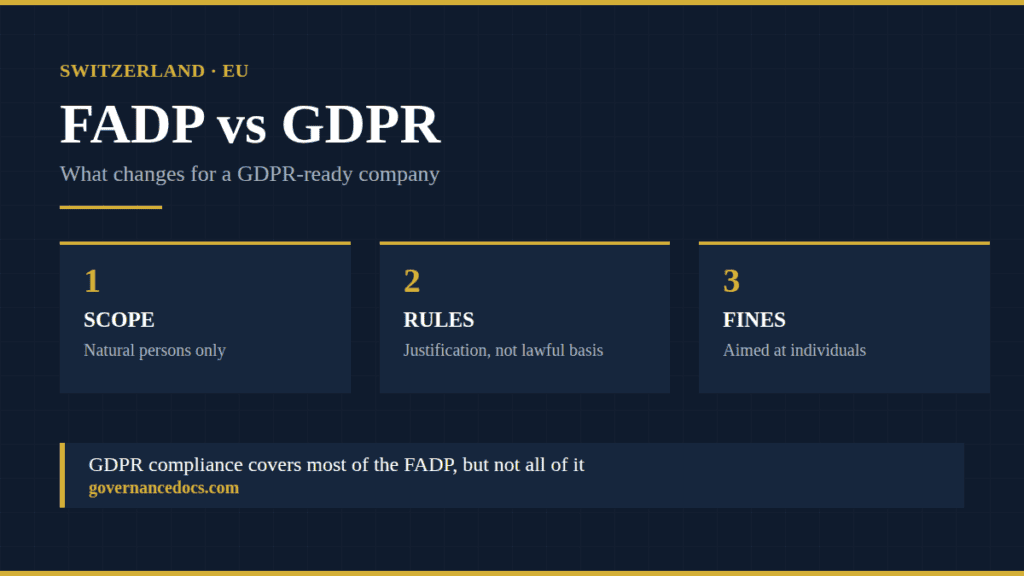
The short answer to FADP vs GDPR is that Switzerland’s law follows the same principles as the EU regulation but asks for less paperwork in some places and more in others. If your company already runs a GDPR program, you are most of the way there, but not all of the way.
Switzerland’s revised Federal Act on Data Protection (FADP, often called the nFADP or revFADP) took effect on 1 September 2023. This FADP vs GDPR guide compares the two laws topic by topic and ends with a gap list.
Free gap assessment
Could you demonstrate GDPR compliance today?
Score yourself against what a supervisory authority actually asks for, free — the records, not the policy.
Run the free GDPR gap assessment → or View premium report sample
Swiss data protection law vs GDPR at a glance
Use this table as your gap checklist. The right-hand column is what a GDPR-compliant company usually has to add or adjust for Switzerland.
| Topic | GDPR | Swiss FADP | What to change |
|---|---|---|---|
| Who is protected | Natural persons | Natural persons only (Art. 1-2) | Nothing, if you already exclude company data |
| Legal basis | One of six lawful bases needed (Art. 6) | No general lawful-basis rule; justification needed only for a breach of personality (Art. 30-31) | Keep your bases; check the three breach triggers |
| Sensitive data | Art. 9 categories, criminal data in Art. 10 | Adds administrative proceedings, sanctions and social assistance measures (Art. 5) | Extend your sensitive-data tags |
| DPO | Mandatory in some cases (Art. 37) | Optional “data protection officer” (Art. 10) | Decide; notify the FDPIC if you appoint one |
| Records of processing | Art. 30; small-firm exemption is narrow | Art. 12; firms under 250 staff exempt unless high risk | Add a destination-country column |
| DPIA | Art. 35 | Art. 22, with FDPIC consultation if high risk remains | Reuse your DPIA template |
| Breach notification | 72 hours to the authority | “As quickly as possible” to the FDPIC | Add the FDPIC to your playbook |
| Access requests | One month, extendable | Generally 30 days, free of charge | Align your clock |
| Automated decisions | Right not to be subject (Art. 22) | Duty to inform and allow human review (Art. 21) | Add the notice and review route |
| Transfers | EU adequacy list, SCCs | Federal Council list (Annex 1), FDPIC-recognized clauses | Add Swiss wording to your SCCs |
| Sanctions | Administrative fines on the company | Criminal fines up to CHF 250,000 on individuals | Brief your managers |
Scope: natural persons and Swiss effects
Both laws protect people, not companies. The old Swiss act of 1992 also protected data about legal entities; the revised FADP dropped that.
Territorial reach works differently. The FADP applies to circumstances that have an effect in Switzerland, even if they were initiated abroad (Art. 3). The GDPR uses establishment and targeting tests.
A foreign controller needs a Swiss representative only when its processing meets all four conditions in Art. 14: linked to offering goods or services or monitoring behavior, large scale, regular, and high risk.
Free privacy risk assessment
Which privacy risks would hurt the people whose data you hold?
List your personal data and processing, pick from 38 privacy risk scenarios, rate them for the people concerned and for you, and plan treatment with ISO 27701 controls. You get a heat map, a process score and the findings an auditor would raise, free.
Run the free privacy risk assessment → or View premium report sample
Legal basis: the biggest FADP vs GDPR difference
Under the GDPR, every processing activity needs one of six lawful bases. In the FADP vs GDPR comparison, this is where Switzerland departs most: there is no such rule for private companies. Processing is allowed as long as it follows the principles in Art. 6: lawful, in good faith, proportionate, purpose-bound and accurate.
You need a justification only when processing breaches someone’s personality rights. Art. 30 names three typical breaches:
- Processing that ignores the principles in Art. 6 or the data security duty in Art. 8.
- Processing against the person’s express wishes.
- Disclosing sensitive personal data to third parties.
A breach is justified by consent, an overriding private or public interest, or the law (Art. 31). Your GDPR lawful-basis register already holds that reasoning, so keep it.
Consent, where you rely on it, must be informed and voluntary. It must be explicit for sensitive data and for high-risk profiling by a private company (Art. 6(6)-(7)).
Sensitive data, profiling and high-risk profiling
The FADP list of sensitive personal data overlaps with GDPR Article 9. It also includes data on administrative and criminal proceedings or sanctions, and data on social assistance measures (Art. 5(c)).
The FADP also adds high-risk profiling: profiling that matches data to assess essential aspects of a person’s personality (Art. 5(g)). It requires explicit consent where consent is the justification, and it removes the small-company record-keeping exemption.
DPO, records of processing and DPIAs
Data protection officer: optional, but useful
Private controllers may appoint a data protection officer, often called a data protection advisor in Swiss practice (Art. 10). It is never mandatory for private companies, unlike the GDPR’s Article 37 DPO duty.
The reward: after a DPIA with high residual risk, you may consult your officer instead of the FDPIC, if the officer meets the independence and expertise conditions in Art. 10(3) and the contact details are published and notified (Art. 23(4)).
Records of processing activities
Controllers and processors must keep records (Art. 12). The Data Protection Ordinance (DPO) exempts companies with fewer than 250 employees on 1 January of the year. The exemption falls away if they process a large volume of sensitive data or carry out high-risk profiling (DPO Art. 24).
Compare this with the GDPR’s Article 30(5) exemption, which is narrower in practice. If you already keep a GDPR record, make sure it states the destination country and the transfer safeguard for every disclosure abroad (FADP Art. 12(2)(g)).
Data protection impact assessment
A DPIA is required before processing likely to result in a high risk, such as large-scale processing of sensitive data (Art. 22). If high risk remains after your measures, ask the FDPIC for its opinion; it has two months to object (Art. 23). Your GDPR DPIA template will usually work with minor edits.
Breach notification in FADP vs GDPR: no 72-hour clock
The FADP requires the controller to notify the FDPIC “as quickly as possible” of a breach of data security that is likely to lead to a high risk (Art. 24). There is no fixed hour count. The GDPR threshold is lower: notify where feasible within 72 hours, unless the breach is unlikely to result in a risk.
The report must give the type of breach, the data and people affected, the consequences, the measures taken and a contact person (DPO Art. 15). Document every breach and keep the records for at least two years from the report (DPO Art. 15(4)). Tell affected people when it is needed for their protection, or when the FDPIC asks.
Data subject rights and automated decisions
The right of access is close to the GDPR version. Answers are generally due within 30 days and must be free of charge (Art. 25). Data portability exists for data provided under consent or a contract (Art. 28). Correction and deletion are enforced mainly through civil actions to protect personality (Art. 32).
Automated decisions are handled differently. The GDPR gives people a right not to be subject to solely automated decisions with legal or similarly significant effects. The FADP instead requires you to inform the person and, on request, let them give their view and ask for human review (Art. 21). Exceptions apply where the person explicitly consented, or the decision concerns their contract and grants their request.
Cross-border transfers and the Swiss-US Data Privacy Framework
Swiss transfer rules mirror GDPR Chapter V. Personal data may go abroad freely to countries listed by the Federal Council in Annex 1 of the Data Protection Ordinance (FADP Art. 16). That list includes the EU and EEA states, the United Kingdom, and countries such as Canada, Israel, New Zealand, Argentina and Uruguay.
The United States is listed only for organizations certified under the Swiss-US Data Privacy Framework. That listing has been in force since 15 September 2024. Before you rely on it, check that the recipient’s certification is active and covers the Swiss framework.
For any other destination, you need a safeguard such as standard clauses approved, issued or recognized by the FDPIC, or binding corporate rules (Art. 16(2)). The FDPIC recognized the EU’s 2021 standard contractual clauses in August 2021, provided they are adapted for Swiss law. If you run a GDPR transfer program, add the Swiss wording to the clauses rather than signing a second set.
Transfers from the EU are simple. The European Commission found Switzerland adequate in 2000 and confirmed it in its January 2024 review.
Sanctions: individuals, not companies
On penalties the FADP vs GDPR contrast is sharpest. GDPR fines are administrative and land on the company. FADP sanctions are criminal fines of up to CHF 250,000, imposed on the responsible individuals for wilful violations (Art. 60-63).
Offences include giving false information to data subjects, unlawful transfers abroad, and ignoring the minimum data security requirements. Cantonal prosecutors handle the cases (Art. 65).
A company pays only in a narrow case: a fine of up to CHF 50,000 where finding the responsible person would take disproportionate effort (Art. 64).
Switzerland data privacy law and AI
Do AI services in Switzerland need a separate law? The FDPIC’s answer is that the FADP already applies directly to AI-supported processing, because it is drafted to be technology-neutral. The FDPIC restated this position in May 2025, after Switzerland signed the Council of Europe AI Convention.
For a company deploying AI tools, that means three things:
- Explain the purpose, functioning and data sources of AI processing.
- Tell users when they are talking to a machine, and whether their input trains the system.
- Run a DPIA for high-risk uses. The FDPIC says uses such as comprehensive real-time facial recognition or social scoring are prohibited.
If you already apply GDPR rules to AI systems, the same DPIA and notice work will carry over. Add the Art. 21 notice where AI makes decisions about people.
What a GDPR-compliant company must add for Switzerland
Work through this FADP vs GDPR gap list once and record the result in your compliance file:
- Confirm whether your processing has an effect in Switzerland, and whether Art. 14 requires a Swiss representative.
- Extend your sensitive-data categories to cover administrative and criminal sanctions and social assistance data.
- Flag any high-risk profiling and confirm explicit consent where consent is your justification.
- Add destination countries and transfer safeguards to your records of processing.
- Add the FDPIC and its “as quickly as possible” rule to your breach playbook, and keep breach records for two years.
- Update privacy notices to name the countries data goes to and the safeguard used (Art. 19(4)).
- Add an automated-decision notice and a human review route under Art. 21.
- Adapt your EU SCCs for Swiss law, and check Swiss-US DPF certification for US recipients.
- Decide whether to appoint a data protection officer and notify the FDPIC if you do.
- Brief managers that FADP fines can be personal.
For the GDPR side of this work, start with our GDPR compliance guide. The English translation of the Federal Act on Data Protection (SR 235.1) on Fedlex is for information only; the German, French and Italian texts are binding.
FADP vs GDPR FAQ
Does the GDPR apply in Switzerland?
Not as Swiss law, because Switzerland is outside the EU and the EEA. A Swiss company still falls under the GDPR if it offers goods or services to people in the EU or monitors their behavior there. Many Swiss firms therefore run one program that covers both sides of FADP vs GDPR.
Does the Swiss data privacy law require a DPO?
No. Private companies may appoint a data protection officer but are never required to. Appointing one that meets the Art. 10 conditions lets you consult the officer instead of the FDPIC after a high-risk DPIA.
Can the FDPIC fine my company like an EU regulator?
No. The FDPIC investigates and can issue binding rulings, but it cannot impose fines. Criminal fines of up to CHF 250,000 are imposed by cantonal authorities on responsible individuals, with a company fine of up to CHF 50,000 only in limited cases.
Our GDPR Toolkit provides 100+ editable templates that adapt to Swiss rules with minor adjustments — including Records of Processing Activities, a Data Protection Impact Assessment Report and a Personal Data Breach Notification Procedure — for $99.
When a standard changes, know first
One email a month: edition changes, new deadlines, and what they mean for documentation you already have. No sales sequence.

Governance Docs
Governance Docs LLC
Recent Posts
November 27, 2026

November 27, 2026

November 26, 2026
November 26, 2026

November 26, 2026