

Vulnerability Management Policy Template: Complete 2026 Guide
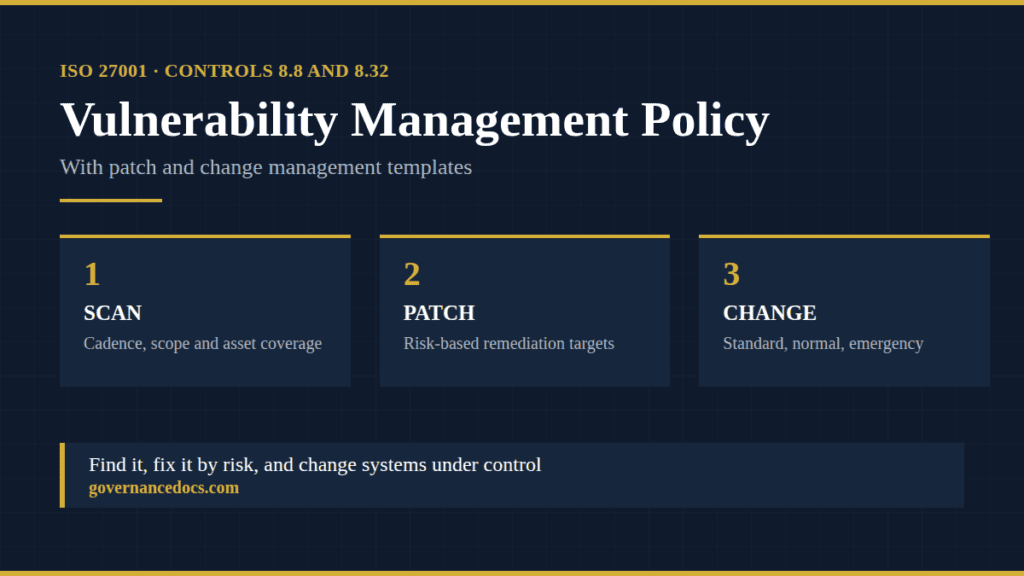
A vulnerability management policy template saves you from writing the same three IT-operations rules from scratch: how you find weaknesses, how fast you fix them, and how you push fixes into production without breaking things. This guide gives you all three as fill-in sections you can adapt today.
In ISO/IEC 27001:2022 terms, that means Annex A control 8.8 (management of technical vulnerabilities) and control 8.32 (change management). Patch management sits between them. Most auditors expect to see the three working together, so this vulnerability management policy template treats them as one policy set.
Why Vulnerability, Patch and Change Policies Belong Together
A scan finds a critical flaw. A patch fixes it. A change record proves the patch was tested, approved and deployed. Break any link and the auditor finds a gap: open findings with no owner, patches applied outside change control, or emergency changes with no review.
ISO 27001 clause 5.2 requires a top-level information security policy, and control 5.1 expects topic-specific policies beneath it. A vulnerability management policy is one of those topic-specific policies. You can publish the three as separate documents or as one IT operations security policy with three sections. Either works if ownership and review dates are clear.
For the control-by-control detail behind this page, read our ISO 27001 vulnerability management guide.
The Three Policies Compared
Before you fill in the vulnerability management policy template, decide which document owns which rule. This table is the split most ISO 27001 auditors are used to seeing.
| Aspect | Vulnerability management policy | Patch management policy | Change management policy |
|---|---|---|---|
| Core question | What weaknesses do we have and how fast must we fix them? | How do vendor updates get tested and deployed? | How is any production change approved and recorded? |
| ISO 27001:2022 control | A.8.8 Management of technical vulnerabilities | Supports A.8.8 and A.8.19 (software on operational systems) | A.8.32 Change management |
| Typical owner | Security lead or CISO | IT operations manager | Change manager or head of IT |
| Key artifacts | Scan reports, vulnerability register, exception log | Patch schedule, deployment reports, rollback notes | Change requests, CAB minutes, post-implementation reviews |
| Main metric | Findings closed within target, by severity | Patch compliance percentage per asset group | Change success rate, emergency change ratio |
Vulnerability Management Policy Template (Fill-In)
Replace the bracketed text with your own details. Keep each section short. An auditor reads the policy for commitments, then samples records to see if you meet them.
| Section | What to write | Example wording |
|---|---|---|
| 1. Purpose | Why the policy exists | “[Company] identifies, evaluates and remediates technical vulnerabilities to reduce the risk of exploitation of its information systems.” |
| 2. Scope | Assets, environments, third parties | “This policy covers all servers, endpoints, network devices, cloud workloads, containers and applications in production and staging, including systems hosted by [cloud provider].” |
| 3. Roles | Who scans, who fixes, who accepts risk | “The Security Lead runs scans and triages findings. Asset owners remediate. The [CISO/CTO] approves exceptions.” |
| 4. Asset inventory | Link to your asset register | “Only assets recorded in the asset inventory may connect to production. Unknown assets found by scans are investigated within [5] business days.” |
| 5. Scanning cadence | Frequency per asset type | “Authenticated internal scans run [weekly]. External perimeter scans run [weekly] and after significant changes. Application testing runs before each major release and at least [annually].” |
| 6. Severity rating | Scoring method plus context | “Findings are rated using CVSS base scores, adjusted for exploitability, exposure and asset criticality.” |
| 7. Remediation targets | Timeframes by severity | See the example targets table below. |
| 8. Exceptions | Risk acceptance process | “Findings that cannot be fixed within target require a documented exception with compensating controls, an expiry date of no more than [90] days and approval by the risk owner.” |
| 9. Verification | How fixes are confirmed | “Remediation is verified by rescanning. A finding is closed only when the rescan confirms it.” |
| 10. Threat intelligence | Sources you monitor | “The Security Lead reviews vendor advisories and the CISA Known Exploited Vulnerabilities catalog [weekly].” |
| 11. Metrics and reporting | What management sees | “Open findings by severity and age are reported to [management review] [monthly].” |
| 12. Review | Owner and frequency | “This policy is reviewed at least annually and after major incidents.” |
Example Remediation Targets (Adapt to Your Risk Appetite)
ISO 27001 does not set remediation deadlines. You set them, then prove you meet them. The figures below are examples only, a common starting point for small and mid-sized teams. Severity bands follow the CVSS qualitative scale in the FIRST CVSS v4.0 specification, first published in November 2023.
| Severity (CVSS score) | Example target: internet-facing | Example target: internal |
|---|---|---|
| Known exploited (any score) | Example: 72 hours | Example: 7 days |
| Critical (9.0–10.0) | Example: 7 days | Example: 14 days |
| High (7.0–8.9) | Example: 30 days | Example: 30 days |
| Medium (4.0–6.9) | Example: 60 days | Example: 90 days |
| Low (0.1–3.9) | Example: next maintenance cycle | Example: next maintenance cycle |
A note for US federal suppliers. CISA’s BOD 22-01, which set fixed due dates for Known Exploited Vulnerabilities, was revoked and superseded by BOD 26-04, issued 10 June 2026. It applies to federal civilian executive branch agencies, uses risk-based timelines, and its shortest tier is three days. If your contracts pass these duties down to you, mirror them in section 7.
Whatever targets you pick, measure them. Our guide to vulnerability management metrics covers mean time to remediate, SLA compliance and aging reports.
Patch Management Policy Template
The patch management policy template below turns the remediation targets from your vulnerability management policy template into a routine. Keep it operational: who patches what, when, and how you roll back.
1. Patch sources and approval
“Patches are obtained only from vendor or official repository sources. IT Operations reviews new releases [weekly] and classifies each by the severity of the vulnerabilities it fixes.”
2. Testing
“Patches for production servers are applied first to [a test group or staging environment] and monitored for [48 hours] before wider rollout. Workstation patches deploy in rings: IT staff first, then a pilot group, then all users.”
3. Deployment windows
“Routine patches deploy during the approved maintenance window [Tuesday 22:00–02:00]. Patches for known exploited vulnerabilities may deploy outside the window as emergency changes.”
4. Rollback and unsupported software
“Each server patch has a rollback method recorded before deployment. Software that no longer receives security updates is removed, isolated or covered by a time-limited exception approved by the [CISO].”
5. Compliance reporting
“Patch compliance per asset group is reported [monthly]. Assets below [95%] compliance are escalated to the asset owner.”
Change Management Policy Template
A change management policy controls every change to production, not just patches. ISO 27001 control 8.32 expects changes to information processing facilities and systems to follow change management procedures. Most organizations use three change types, borrowed from ITIL practice.
| Change type | Definition | Approval | Example |
|---|---|---|---|
| Standard | Low-risk, repeatable, pre-approved procedure | Pre-approved once; logged each time | Monthly workstation patch rollout |
| Normal | Any change that is not standard or emergency | Risk assessed; approved by change manager or CAB | Firewall rule change, database upgrade |
| Emergency | Must be made urgently to restore service or close an active threat | Emergency approver; retrospective CAB review | Hotfix for an actively exploited flaw |
Use this change management policy template wording for the core sections:
- Scope: “All changes to production infrastructure, applications, configurations and security controls require a change record.”
- Request content: “Each change record states the reason, affected systems, risk assessment, test evidence, implementation plan, rollback plan and planned window.”
- Change Advisory Board (CAB): “The CAB meets [weekly] and includes IT operations, security, development and a business representative. It approves normal changes rated [medium] risk or higher.”
- Segregation of duties: “The person who approves a change does not implement it. Code changes are peer reviewed before merge.”
- Emergency changes: “Emergency changes are approved by [the on-call IT manager], documented within [24 hours] and reviewed at the next CAB.”
- Post-implementation review: “Failed changes and all emergency changes receive a review recording root cause and lessons learned.”
For how auditors test A.8.32 records in practice, see our ISO 27001 change management guide.
How Auditors Test a Vulnerability Management Policy
A certification auditor reads your policy, then asks for evidence that matches each commitment. Expect requests like these:
- The last three months of scan reports, with dates matching your stated cadence.
- A sample of critical and high findings, with open and close dates compared to your targets.
- The exception log, with approvals and expiry dates.
- Change records for recent patches, including at least one emergency change and its review.
- Evidence the policy was approved, communicated and reviewed on schedule.
The most common finding is not a missing policy. It is a policy promising targets the team never meets. Set targets you can hit, then tighten them as tooling improves. A vulnerability management policy template is only useful once the numbers in it match how your team actually works.
Common Mistakes When Adapting a Vulnerability Management Policy Template
- Copying federal deadlines blindly. Government timelines suit agencies with large teams. Pick targets that fit your staff and risk.
- Scoring by CVSS alone. A medium flaw on an internet-facing login page can matter more than a critical one on an isolated lab server. Write context into section 6.
- Ignoring cloud and containers. Scope must cover images, serverless functions and managed services, not just virtual machines.
- No exception expiry. Open-ended risk acceptance turns into permanent risk.
- Patches outside change control. Make routine patching a standard change so it is logged without slowing down.
Vulnerability Management Policy Template FAQ
Does ISO 27001 require a separate vulnerability management policy?
No. Control 8.8 requires you to manage technical vulnerabilities, and control 5.1 expects topic-specific policies where you need them. Many organizations cover it in a combined IT operations security policy. What matters is that the rules are documented, approved and followed.
What remediation timeframes should a vulnerability management policy template include?
There is no universal standard for private companies. Set targets by severity and exposure, as in the example table above, and make known exploited vulnerabilities the fastest tier. Customer contracts or regulators may impose stricter deadlines, so check those first.
Should I use CVSS v3.1 or CVSS v4.0?
Both use the same qualitative bands (Low, Medium, High, Critical). Many scanners and vulnerability databases still publish v3.1 scores alongside v4.0. Write your vulnerability management policy template to use “the CVSS score provided by the scanner or vendor” so it stays valid as tools change.
Who should approve emergency changes?
Name a small group of emergency approvers, such as the on-call IT manager and the security lead. Require documentation within a set time and a retrospective review at the next CAB. Auditors look for that review more than for the speed of approval.
Our ISO 27001 Toolkit provides 165 editable templates for building and certifying your ISMS — including a vulnerability management policy, a change management policy and a vulnerability assessment procedure — for $99.
When a standard changes, know first
One email a month: edition changes, new deadlines, and what they mean for documentation you already have. No sales sequence.

Governance Docs
Governance Docs LLC
Recent Posts

November 26, 2026

November 26, 2026

November 26, 2026

November 26, 2026
November 26, 2026