
CART
No products in the cart.
ISO Compliance Insights & Best Practices
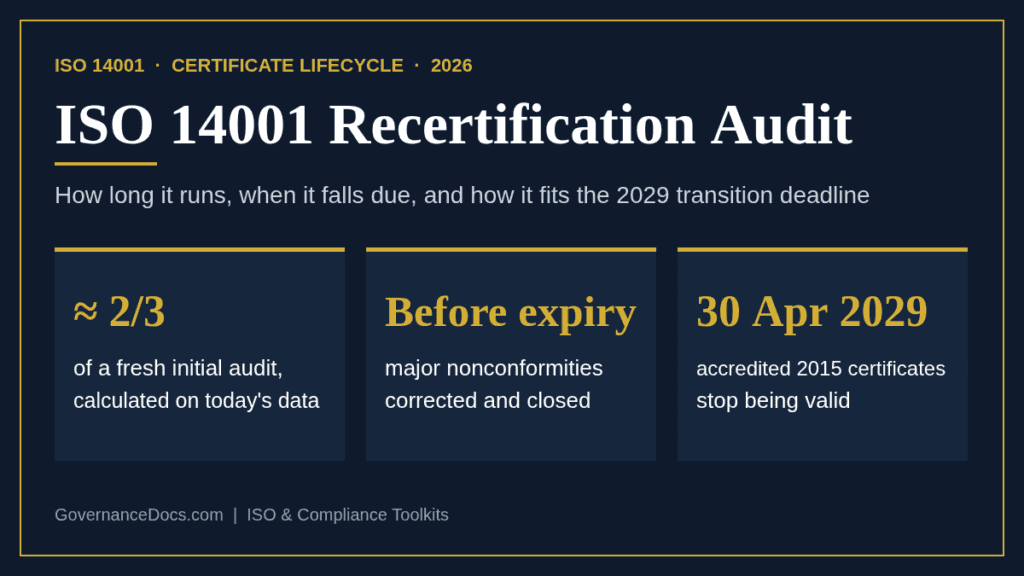
An ISO 14001 recertification audit is the on-site audit in the third year of your certification cycle that decides whether your certificate is renewed for another three years, and between now and 2029 it carries a second question: which edition you renew to. ISO 14001:2015 is withdrawn, accredited 2015 certificates stop being valid after 30 April 2029, and whether your renewal is the right moment to move depends entirely on your expiry date.
This guide covers what the rules require, how long the audit should take for an environmental management system, how to place it against the transition deadline, and what happens if the certificate expires first. The clause numbers come from ISO/IEC 17021-1:2015, IAF MD 5 and Global ACI’s transition requirements. The last two are free to read, and the source links are at the end.
Free gap assessment
Are you ready for the 2026 edition of ISO 14001?
Score every clause of the new edition, free, including the aspects, life cycle and compliance evaluation work that carries most of the findings.
Run the free ISO 14001 gap assessment → or View premium report sample
ISO/IEC 17021-1 clause 9.6.3.1.1 gives it one job: confirm the continued conformity and effectiveness of the management system as a whole, and do so in time for the certificate to be renewed before it expires. Clause 9.6.3.2.1 then requires an on-site audit that addresses three things:
Clause 9.6.3.1.2 adds that the recertification activity includes a review of previous surveillance reports. So the auditor arrives with three years of history, and a finding that came up twice is already on their list.
An ISO 14001 recertification audit is not a repeat of your initial certification. Stage 1 is normally skipped. Clause 9.6.3.1.3 says one may be needed where there have been significant changes, naming the management system and legislation as examples. That second trigger matters more for environmental systems than for most others, because a new permit regime or a changed emissions rule can arrive during the cycle whether or not you changed anything yourself.
The two audits sit in the same cycle and are often confused. If you have just been through an ISO 14001 surveillance audit, expect a noticeably longer visit with a wider remit.
| Point of difference | Surveillance audit | ISO 14001 recertification audit |
|---|---|---|
| When | Years 1 and 2 of the cycle; the first within 12 months of the certification decision (9.1.3.3) | Year 3, in time for renewal before expiry (9.1.3.2, 9.6.3.1.1) |
| Audit time | About 1/3 of the initial audit (MD 5 clause 5) | About 2/3 of a fresh initial audit calculated today (MD 5 clause 6) |
| Coverage | Not necessarily the full system; eight set review areas (9.6.2.2) | Effectiveness across the whole scope of certification (9.6.3.2.1) |
| Stage 1 | Not part of the audit | Only where significant change calls for it (9.6.3.1.3) |
| Major nonconformities | Time limits come from the certification body’s procedure | Corrected and corrective action completed before expiry (9.6.3.2.2) |
| Result | Certification maintained | A new certification decision and a new three-year cycle |
The first cycle begins at the certification decision, and later cycles begin at the recertification decision (clause 9.1.3.2). The rules set no fixed number of months between an ISO 14001 recertification audit and expiry. What they require is “due time”: the audit has to happen early enough for everything after it to finish before the printed date.
Everything after it is more than people plan for: the report, correction of any major finding, verification of that correction, the independent review, and the decision. Our working rule is to hold the ISO 14001 recertification audit at least three months before expiry. That is planning advice, not a requirement, and your certification body may already have a booking window of its own. Finishing early costs you nothing on the calendar, because clause 9.6.3.2.3 lets the new expiry date be based on the existing one. The issue date simply has to be on or after the recertification decision.
IAF MD 5 clause 6 sets the proportion at approximately 2/3 of the time an initial stage 1 and stage 2 audit would need “if such an initial audit were to be carried out at the time of recertification”. The document then says plainly that this does not mean 2/3 of the original time spent. The note adds that a duration under one audit day is unlikely.
That wording decides most disputes over an ISO 14001 recertification audit quote. Say you certified with 30 people in a medium-complexity sector: 5.5 initial days under Table EMS 1. Three years later you have 130 people. Your baseline is now 9 days, so the recertification figure is about 6 days, not the 3.5 you would get from your original audit.
Table EMS 1 in MD 5’s Annex B has separate columns by environmental complexity. Table EMS 2 assigns sectors to them: chemicals, mining and waste processing are high; food processing, transport and healthcare are medium; hotels, retail and electronics assembly are low; head offices, general business services and education are limited. The initial figures below are published in Table EMS 1. The recertification figures are our arithmetic, adjusted to the nearest half day as clause 2.2.3 directs.
| Effective personnel | High: initial / recert | Medium: initial / recert | Low: initial / recert | Limited: initial / recert |
|---|---|---|---|---|
| 1–5 | 3 / 2 | 2.5 / 1.5 | 2.5 / 1.5 | 2.5 / 1.5 |
| 16–25 | 5.5 / 3.5 | 4.5 / 3 | 3.5 / 2.5 | 3 / 2 |
| 26–45 | 7 / 4.5 | 5.5 / 3.5 | 4 / 2.5 | 3 / 2 |
| 46–65 | 8 / 5.5 | 6 / 4 | 4.5 / 3 | 3.5 / 2.5 |
| 86–125 | 11 / 7.5 | 8 / 5.5 | 5.5 / 3.5 | 4 / 2.5 |
| 126–175 | 12 / 8 | 9 / 6 | 6 / 4 | 4.5 / 3 |
| 176–275 | 13 / 8.5 | 10 / 6.5 | 7 / 4.5 | 5 / 3.5 |
Treat these ISO 14001 recertification audit figures as a sanity check. Your certification body owns the calculation and can adjust it, for example under the factors in MD 5 clause 8, and it must record its reasoning. Three further points are worth knowing before you sign a quote:
Audit days multiplied by the day rate gives the fee, and travel sits on top. Our ISO 14001 certification cost breakdown separates those lines.
The three requirements in 9.6.3.2.1 are general. For an environmental system they usually turn into questions like these. This list reflects audit practice rather than wording in the standard.
A well-run ISO 14001 internal audit in the months before the visit should reach the same evidence first.
This is the decision most generic guides miss. The ISO 14001:2026 transition runs for three years. Global ACI-TECH-3-TR 2029-04-30 (M) requires certification bodies to transition certified clients, “including certificate issuance”, before 30 April 2029, and the transition audit may be done with a surveillance audit, with a recertification audit, or as a separate special audit. With roughly 700,000 accredited certificates to move, by the document’s own estimate, capacity late in the window is a reasonable thing to worry about.
Your expiry date determines which route fits best:
| Your current certificate expires | Likely best route | Watch for |
|---|---|---|
| Before your certification body has transitioned (it may issue to the 2026 edition only after its accreditation body’s decision, due by 30 April 2027) | Renew on 2015 if necessary, then transition at a later surveillance audit or special audit | The renewed certificate cannot run past 30 April 2029 without the transition |
| Mid-2027 to late 2028 | Combine the transition with your ISO 14001 recertification audit | Renewing on 2015 instead means paying for a second transition activity within the new cycle |
| Early 2029 up to the deadline | Combine or move earlier, but with little margin | Audit, closure of findings and certificate issuance must all finish before 30 April 2029 |
| After 30 April 2029 | Transition at a surveillance audit or special audit; renewal will usually come too late | Do not assume the printed expiry date protects you, because a 2015 certificate stops being valid at the deadline regardless |
Combining the two has a practical appeal. The transition audit must cover the changed requirements, changes to your context, and the need for any other system changes. Those changes are modest by the document’s own description: new clause 6.3 on planning of changes, new sub-clauses under management review in 9.3, and revised terms and documented-information wording. Extra audit time is listed as “Possibly”, and the certification body has to justify any it adds. The same document notes that additional time may not be needed for a full system audit, so if your renewal quote carries a transition surcharge, ask for the calculation.
The transition audit can also be remote under IAF MD 4 where the objectives can be met that way. Clause 9.6.3.2.1 still requires an on-site element for the ISO 14001 recertification audit itself, so a combined visit will not be entirely remote.
Three edge cases are worth checking now:
Clause 9.6.3.2.2 sets one hard limit: for any major nonconformity, the time limits for correction and corrective action must be defined, and the work completed, before the certification expires. An ISO 14001 recertification audit held two weeks before expiry can therefore fail on the calendar alone.
You may read that major findings must be closed in 90 days. That number is not in ISO/IEC 17021-1. Where you see it, it comes from a certification body’s own procedure, so read the contract for your actual limit. Handling of minor findings is likewise governed by your certification body’s procedure, usually through an accepted corrective action plan, so confirm that plan’s timing when the audit report arrives.
If the ISO 14001 recertification audit does not succeed or the evidence is not there, clause 9.6.3.2.4 is blunt: recertification is not recommended and the certification is not extended, and you must be told.
Clause 9.6.3.2.5 gives you a recovery window, not an extension. After expiry, the certification body can restore certification within six months if the outstanding recertification activities are completed. After that, at least a stage 2 audit is required.
Two consequences are easy to miss. First, the restored certificate’s effective date must be on or after the recertification decision, while its expiry date stays based on the prior cycle. So you get a coverage gap and no extra time. Second, a tender or customer check during that gap will find no valid certificate. Our reading is that this recovery route also closes for a 2015 certificate at the transition deadline, since accredited 2015 certifications are no longer valid after it, so a lapse in early 2029 leaves very little room. Confirm the position with your certification body.
If your documented system is the weak point, our ISO 14001 Toolkit is a set of 67 editable templates written to the 2026 edition, including registers, compliance obligations evaluation, internal audit and management review documents. It is $99 and downloads immediately.
No. Clause 9.6.3.2.1 says it shall include an on-site audit. Parts of the work, including a combined transition audit where its objectives can be met, may use remote methods under IAF MD 4, but the on-site element remains.
Usually not. Clause 9.6.3.1.3 reserves it for situations such as significant changes to the management system or to legislation. If a new site, a major process change or a new legal regime affects your scope, raise it early, because a stage 1 changes the plan and the fee.
Not necessarily. MD 5 clause 6 bases it on what an initial audit would need today, using your current data. If your headcount or complexity has grown, your ISO 14001 recertification audit can exceed 2/3 of the original days. If they have shrunk, it can fall below.
Yes, and the transition period gives many organizations a reason to compare. A transfer depends on a valid, unsuspended certificate and on the new body reviewing your audit history, so start well before expiry rather than treating it as a way out of a failing audit.
Yes, combined audits are common, and MD 5 covers both systems’ audit time. The transition clocks differ, though: ISO 14001:2015 ends on 30 April 2029 and ISO 9001:2015 on 30 September 2029. Our ISO 9001 recertification audit guide covers the quality side, so plan around the earlier date.
An ISO 14001 recertification audit is an on-site, whole-scope audit in year 3, running at about 2/3 of a fresh initial audit calculated on today’s numbers, with major findings closed before the expiry date. Start by looking up that date, then place it against 30 April 2029, because that tells you whether renewal is your transition moment or whether you need a surveillance or special audit instead.
For the wider picture, start with our guide to ISO 14001 environmental management.
Primary sources: ISO 14001:2026 on iso.org, Global ACI-TECH-3-TR 2029-04-30 (M), Transition Requirements for ISO 14001:2026, IAF MD 5:2023, Determination of Audit Time (published by Global ACI as TECH-3-004), and an IAS summary of ISO/IEC 17021-1:2015 Section 9.

November 5, 2026

November 4, 2026

November 4, 2026

November 4, 2026
November 4, 2026
