Incident response roles and responsibilities are the part of an incident response program that fails quietly: nobody notices the gap until a server needs shutting down at night and nobody is sure who is allowed to do it. NIST SP 800-61 Rev. 3 treats this as a governance question. It wants roles documented in policy, authority designated in advance, and third parties covered by contract.
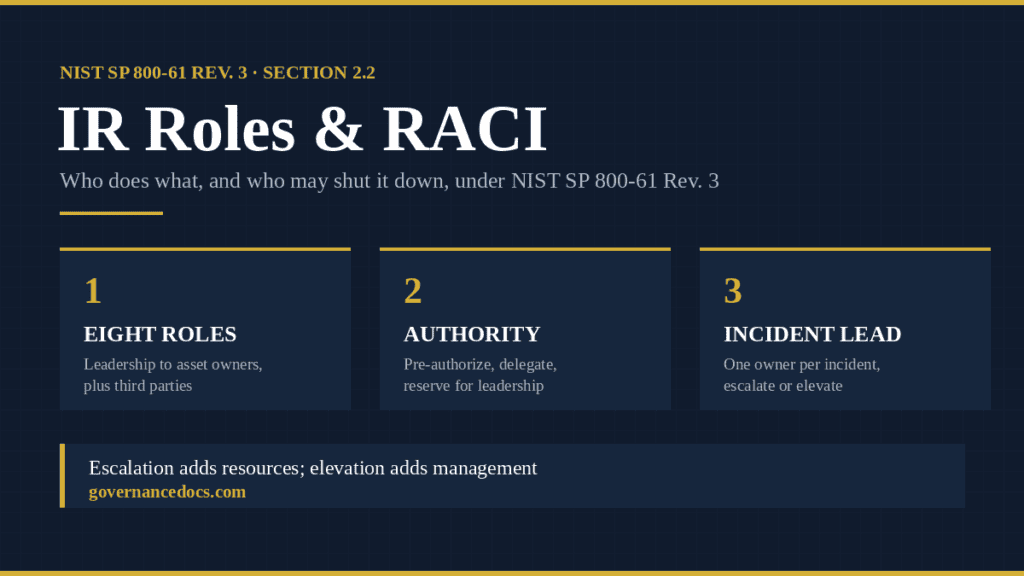
This post walks through the incident response roles and responsibilities Rev. 3 names in Section 2.2, who should hold decision authority for high-impact actions, the incident lead, and the difference between escalation and elevation. It ends with an illustrative RACI table you can adapt.
What Rev. 3 requires for incident response roles and responsibilities
Rev. 3 reorganizes incident response around the CSF 2.0 Functions (our post on the NIST incident response lifecycle covers the mapping). Roles sit in Govern, under the Roles, Responsibilities, and Authorities Category, GV.RR. Three statements carry most of the weight:
GV.RR R1: cybersecurity roles, responsibilities and authorities should include incident response.
GV.RR-02 R1: all roles and responsibilities involving incident response should be documented in the organization’s policies.
GV.RR-02 R2: everyone with an incident response responsibility should be given the authority needed to carry it out.
GV.RR-02 N1 adds that these roles exist throughout an organization and often include third parties under contract. So incident response roles and responsibilities are not a list of security team job titles. They cover legal, communications, HR, facilities, asset owners and suppliers.
The roles NIST names in Section 2.2
Section 2.2 of Rev. 3 describes who is involved in incident response. Here is each role, where Rev. 3 gives it a specific task, and what your documented incident response roles and responsibilities should record for it.
Role
Where Rev. 3 gives it a task
What to write down
Leadership
Oversees incident response, allocates funding, and may hold decision authority on high-impact actions such as shutting down or rebuilding critical services
Named decision-makers and deputies for each high-impact action
Incident handlers
May be on staff, on contract (for example an MSSP-run SOC or a cloud service provider’s IR team), or available when needed
Who handles which incident types, and how to reach contracted handlers
Technology professionals
Named in Section 2.2; they make the technical changes that containment and recovery need
Which teams are on call and what changes they can make without further approval
Legal
Consulted before redirecting an attacker to a sandbox (RS.MI R1)
When legal must be consulted, and who decides on notification
Public affairs and media relations
Media communications procedures (RS.CO-03.R4)
Who approves external statements
Human resources
Notified when malicious insider activity has occurred (RS.CO-03.R3)
When HR joins, such as suspected insider activity
Physical security and facilities management
Named in Section 2.2
Access to rooms, devices and footage
Asset owners
Confirm restoration and return to normal operations (RC.RP-04.R2)
Who can accept downtime on each critical system
Rev. 3 also addresses third parties under a shared responsibility model. The contract should define responsibilities, information flows, coordination and the authority to act, including restrictions. NIST’s example is a provider that may share sanitized incident information with its other customers. If your cloud or managed service contract is silent on these points, your incident response roles and responsibilities have a hole in them.
Decision authority for high-impact actions
Section 2.3 lists “roles, responsibilities, and authorities” as a policy element, with the example of which roles may confiscate, disconnect or shut down technology assets. This is the part of incident response roles and responsibilities that matters most under pressure. A handler who must find a vice president before isolating a host is a handler watching an attacker move.
Sort your actions into three tiers and assign authority to each:
Pre-authorized. Actions any on-duty handler may take without asking: isolating a single endpoint, disabling a user account, blocking an indicator, quarantining a file. Rev. 3’s RS.MI-01.R1 asks you to allow handlers to choose and perform containment actions manually.
Incident lead authority. Actions with business impact but limited scope: isolating a server, forcing password resets for a department, taking a non-critical service offline.
Leadership authority. Shutting down or rebuilding critical services, disconnecting a site, engaging law enforcement, public statements. RS.CO-02.R5 says law enforcement and regulators should be notified based on plan criteria and management approval, by designated individuals.
Name a deputy for every leadership decision. Then write a fallback rule: if no one with authority can be reached within a time you set, the incident lead may act and must document why. An authority nobody can reach is not an authority.
The incident lead
Rev. 3’s RS.MA-01.C1 says to consider designating an incident lead for each incident. It is a Consideration, not a Recommendation, but we would treat it as mandatory for anything above your lowest severity tier. Elsewhere, RS.AN-06 N2 notes that the incident lead is often responsible for safeguarding incident records, which can hold sensitive data about vulnerabilities, breaches and users.
The incident lead owns the incident, not the technical work. In practice that means the lead:
assigns actions and tracks each one’s status and time frame, as RS.MA R3 asks;
decides when escalation or elevation is needed;
keeps the record of decisions and protects it;
runs the status updates and briefs leadership, which RS.CO-03.R2 asks for on major incidents.
Write the incident lead’s duties into your incident response roles and responsibilities so the role means the same thing on every incident. Pick incident leads for judgement and calm, not seniority. Keep a rota so the role is never vacant, and hand over in writing when a lead rotates off a long incident.
Escalation vs elevation
Rev. 3 draws a clear line in RS.MA-04 N1. Escalation means increasing resources or time frames. Elevation means involving a higher level of management. Mixing them up sends the wrong request: an incident goes to the CISO when what it needed was two more analysts and an outside forensics firm.
Escalation
Elevation
What changes
More people, tools, budget or time
A more senior decision-maker is involved
Trigger
Scope exceeds the team’s capacity or skills
A decision exceeds the incident lead’s authority
Example
Calling in the retained IR service provider (RS.MA-01.R2)
Asking leadership to approve shutting down a customer-facing service
Who decides
Incident lead
Incident lead requests; leadership accepts
RS.MA-04.R1 asks you to track and validate the status of all ongoing incidents so that those needing more resources or a change in strategy are spotted quickly. Write escalation and elevation triggers into your severity scheme, and reference them from your incident response roles and responsibilities, so neither depends on someone remembering to ask.
A RACI for incident response roles and responsibilities
A RACI is the fastest way to test whether incident response roles and responsibilities are complete. Rev. 3 does not prescribe one, so this one is illustrative. R is responsible for doing the work, A is accountable for the outcome (one per row), C is consulted and I is informed.
Activity
Leadership
Incident lead
Handlers
Tech teams
Legal
Comms
HR
Asset owner
Declare an incident
I
A
R
I
Set and revise severity
I
A
R
C
Contain a single endpoint
I
A
R
I
Shut down a critical service
A
R
C
R
C
I
C
Collect and preserve evidence
A
R
R
C
Decide on external notification
A
C
R
C
C
Issue public statements
A
C
C
R
Act on insider activity
I
A
R
C
R
I
Initiate recovery
C
A
C
R
R
After-action report
I
A
R
C
C
C
C
A few rows are grounded directly in Rev. 3. RS.CO-03.R3 says to notify human resources when malicious insider activity has occurred. RC.RP-04.R2 says to work with system owners to confirm restoration and the return to normal operations. RC.RP-06.R1 asks for an after-action report covering the incident, the actions taken and lessons learned.
Common gaps in incident response roles and responsibilities
Roles exist only in the plan, not the policy. GV.RR-02 R1 asks for them in policy, which is where authority is granted.
No deputies. Every named decision-maker needs a backup who knows they are the backup.
Suppliers left out. GV.SC-08 asks for suppliers and other third parties to be included in incident planning, response and recovery. Check the contract, not the sales deck.
Two people accountable. If a RACI row has two A’s, nobody owns it.
Never exercised. A tabletop is the cheapest way to find out that two people both think they approve the shutdown.
When you write your plan, place your incident response roles and responsibilities in the roles section. Our incident response plan template post shows where it fits alongside the other plan elements.
Incident response roles and responsibilities FAQ
Does NIST require a dedicated incident response team?
No. NIST SP 800-61 Rev. 3 says incident handlers may be on staff, on contract or available when needed. What it does expect is that roles are documented and authority is designated.
Who should be the incident lead?
Someone trained for the role, with authority to assign work and the judgement to know when escalation or elevation is needed. Seniority is not the test.
Where should incident response roles and responsibilities be documented?
Rev. 3 asks for incident response roles and responsibilities in policy. Put the detail, contacts and RACI in the plan and keep the two consistent.
How do we handle a cloud provider’s role?
Through the contract. Define responsibilities, information flows, coordination and authority to act under the shared responsibility model, including any restrictions.
Our Incident Response Toolkit provides 93 editable templates aligned to NIST SP 800-61 Rev. 3 — including the Incident Response Roles Responsibilities and Authorities document, the Incident Response RACI Matrix and the Incident Lead Handbook — for $99.