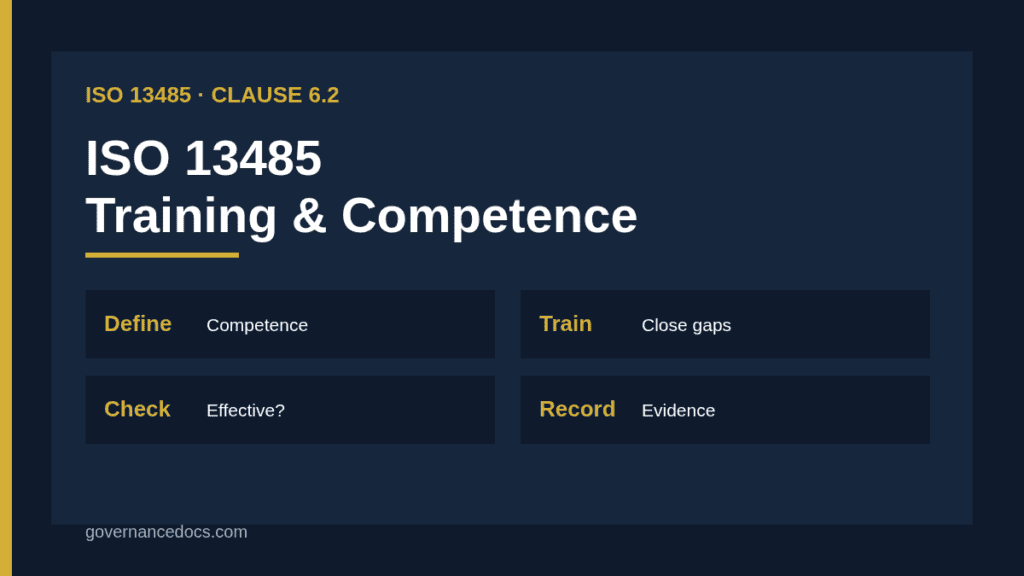
ISO 13485 training and competence is the requirement that everyone whose work affects product quality has the education, training, skills and experience to do it, and that you can prove it. Clause 6.2 sets the rules, and training records are one of the first things an auditor asks to see.
This guide covers the five steps the clause expects, how to build a training matrix, how to check effectiveness and what records to keep. It works alongside internal audits and process validation.
Free gap assessment
How much of ISO 13485 could you evidence today?
Score clauses 4 to 8, free, with the FDA QMSR and EU MDR duties kept separate so you can see what is the standard and what is the regulator.
Clause 6.2 requires that personnel performing work affecting product quality are competent on the basis of appropriate education, training, skills and experience. You must document the processes for establishing competence, providing needed training and ensuring awareness.
The organization must determine the necessary competence, provide training or other action, verify that the action is effective, ensure personnel are aware of the relevance and importance of their activities and maintain records.
The clause covers anyone whose work affects product quality, not just production staff. That includes engineers, quality, regulatory, purchasing, warehouse, service staff and managers.
Temporary workers and contractors are included when they perform relevant tasks. Document how you assess and train them before they start.
List roles in an organization chart, then define competence per role, not per person.
Step 1: define the competence needed
For each role, write the education, skills, experience and training needed. Use job descriptions that link to specific tasks, such as sealing, inspection or complaint evaluation.
Include regulatory knowledge where it matters. A regulatory lead should know the rules for your markets, and production staff should know the basics of hygiene and handling.
Keep descriptions short and factual. They are the reference for every later check. Keep this in mind for every ISO 13485 training and competence.
Step 2: assess the gap
Compare each person’s current qualifications and experience with the role’s requirements. Records can include CVs, certificates, prior employment and demonstrated skills.
Where the gap is small, a short briefing may be enough. Where it is large, plan structured training with sign-off before the person performs the task alone.
Do this at hiring, on role change and when processes or regulations change.
Step 3: provide training
Training can be classroom, on-the-job, e-learning, mentoring or external courses. Choose a method suited to the task and risk.
Use controlled materials, such as approved procedures and work instructions, so everyone learns the current method. Record who delivered the training and when.
For critical tasks, require supervised practice before independent work. This is where a ISO 13485 training and competence is won or lost.
Step 4: verify effectiveness
The standard requires you to verify that training was effective. Attendance alone does not prove it.
Use methods proportional to risk: a short quiz, observation of the task, review of the first outputs or a practical demonstration. For critical tasks, require formal qualification.
Record the result and the person who evaluated it. If someone fails, retrain and recheck.
Step 5: build awareness
Staff must understand the relevance and importance of their activities and how they contribute to quality objectives. This covers the quality policy, patient safety and the effect of their work on the device.
Use a short induction and refresher. Ask people in interviews how their task affects safety, because auditors do.
Link awareness to your objectives so people see the connection. Auditors judge your ISO 13485 training and competence on exactly this point.
Clause 6.2 step
What to do
Record
Determine competence
Define education, skills, experience per role
Job descriptions
Provide training
Deliver training or other action
Training attendance, materials
Verify effectiveness
Test, observe or assess
Evaluation result
Ensure awareness
Explain relevance and importance
Induction records
Maintain records
Education, training, skills, experience
Training matrix and files
Building an ISO 13485 training and competence matrix
A matrix lists roles or people on one axis and procedures or skills on the other, with status and dates. It shows at a glance who is qualified for what.
Include expiry or refresher dates for critical skills. Review the matrix monthly and before every audit.
An up-to-date matrix is the best single answer to an ISO 13485 training and competence question.
Records to keep
Maintain records of education, training, skills and experience: CVs or qualification certificates, training attendance and materials, effectiveness checks and sign-offs.
Keep them for at least the retention period set in your record control procedure, which for device-related records is at least the device lifetime you define and not less than two years from release unless regulations say otherwise.
Store records securely and make them retrievable per person and per role. Treat it as a standing rule for your ISO 13485 training and competence.
Work environment and personnel health
Clause 6.4 requires documented requirements for health, cleanliness and clothing of personnel if contact with product or the work environment could affect product quality. Train staff on these requirements.
Where contamination control matters, such as clean rooms or sterile devices, include gowning training and qualification.
Keep these records with the training file.
Training for regulatory change
When regulations change, update training for affected roles. The FDA Quality Management System Regulation took effect on 2 February 2026 and incorporates ISO 13485:2016, so US-facing teams need to understand how terminology and expectations changed.
Record the briefing, attendees and date, and note who needs further training.
Making ISO 13485 training and competence work for auditors
Process validation requires qualification of personnel. Operators of validated processes need documented training and, for critical steps, demonstrated competence.
Keep a list of qualified operators per process and update it when people join or leave.
This ties directly to the personnel qualification expectations in clause 7.5.6.
Training the auditors
Internal auditors need competence in the standard, audit methods and your processes. A short course, shadow audit and supervised first audit work well.
Keep their qualification records, since independence and competence are both audited. See ISO 13485 internal audit for the rules on objectivity.
Refresh auditor training when the standard or your system changes materially.
Common mistakes
Typical findings are no competence definitions, training records without effectiveness checks, expired qualifications, untrained temporary staff and procedures changed without retraining.
Another is relying on signed read and understood sheets for every change. For critical changes, observation or testing is more convincing.
Review the training system as part of management review to catch trends. Treat ISO 13485 training and competence as a CAPA input.
Linking training to CAPA
When a problem traces to a skills gap, the corrective action often includes training. Verify effectiveness by checking that the problem does not recur.
Do not use retraining as the default fix. If the procedure is unclear, fix the procedure first.
The ISO 13485 CAPA guide shows how to link actions and checks.
Templates and tools
A competence matrix, job description template, training record form, effectiveness check form and induction checklist cover the requirement. The ISO 13485 Toolkit includes templates for these records.
Choose a tool that fits your size, from a controlled spreadsheet to an electronic training system. Validate any software used, as described in software validation.
Pilot the forms with one department before rolling them out company-wide.
Where training fits in your certification plan
Auditors sample training for key roles at stage 1 and stage 2. See the stage 1 audit guide for what they check first.
Add training milestones to your implementation plan so records exist before the audit.
Keeping the matrix current turns audit preparation into a routine check.
A quick example matrix
Take a small manufacturer with an assembler, an inspector and a complaint coordinator. The matrix lists their roles against the assembly procedure, inspection procedure and complaint procedure, with the training date and sign-off.
When a new inspector joins, the matrix shows the gap, the manager schedules supervised inspections and the effectiveness check records the first accurate results.
That small table answers most of the questions an auditor asks about the system.
Keeping the system light
Do not create paperwork for its own sake. Short records that capture who, what, when and the effectiveness result are enough.
Automate reminders where you can, and assign one owner for the matrix. A light system that is always current beats a heavy one that is always late.
Review it twice a year to remove outdated roles and add new ones.
Onboarding in the first week
Give every new starter a checklist covering the quality policy, safety and hygiene rules, document access and the procedures for their role. Sign off each item.
Hold back independent work on critical tasks until the effectiveness check is complete. Record the date the person was released to work alone.
This gives you a clear starting point for the record and protects product from the learning curve.
ISO 13485 training and competence FAQ
Do I need to keep CVs for competence evidence?
Education and experience must be recorded. CVs, certificates or equivalent summaries are common ways to meet that.
How do I prove training was effective?
Use a method proportional to risk, such as a quiz, observation or first-output review, and record the result.
Are contractors covered?
Yes, when they perform work that affects product quality. Assess and train them before they work unsupervised.
How often should staff be retrained?
The standard sets no fixed interval. Define refreshers by risk and by changes in processes or regulations.