Risk scenario analysis is a way of thinking through what would actually happen if a specific, realistic event hit the organization, step by step, rather than rating an abstract risk as “high” or “medium”. A cyber-attack that locks the main system for a week, a key supplier collapsing, a regulatory ban on a product: each can be described, traced through the business and costed. The exercise often reveals dependencies and weaknesses that a heat map never shows.
This guide explains how to choose scenarios, how to build them, how to estimate impact and likelihood, how to test controls, how to use results in decisions and what to avoid. It is general guidance that you should adapt to your organization and the standard you follow.
What risk scenario analysis is
Scenario analysis explores a possible future event in detail. Instead of asking “how likely and how bad is supply chain risk?”, it asks “what happens if our sole supplier of a critical component stops delivering for eight weeks?” The answer traces the effects through production, customers, finances, contracts and reputation.
ISO/IEC 31010 lists scenario analysis among recognised risk assessment techniques, alongside methods such as workshops, bow-tie analysis and Monte Carlo simulation; see ISO/IEC 31010 on risk assessment techniques. It is used across enterprise risk management, business continuity, strategy, climate and financial stress testing, and it is particularly useful for risks that are rare but severe, where historical data is thin.
Why use scenarios alongside risk registers
A risk register lists many risks with ratings, but ratings compress a lot of detail into one label, and risks are considered one at a time. Real crises combine several problems at once: a cyber incident that also hits a supplier during peak season, for example. Scenario analysis shows how risks interact, which the enterprise risk register alone may hide.
It also communicates. Leaders engage with a story about a specific event more readily than with a score, and the discussion of what they would do is often more valuable than the number.
Choose severe but plausible scenarios
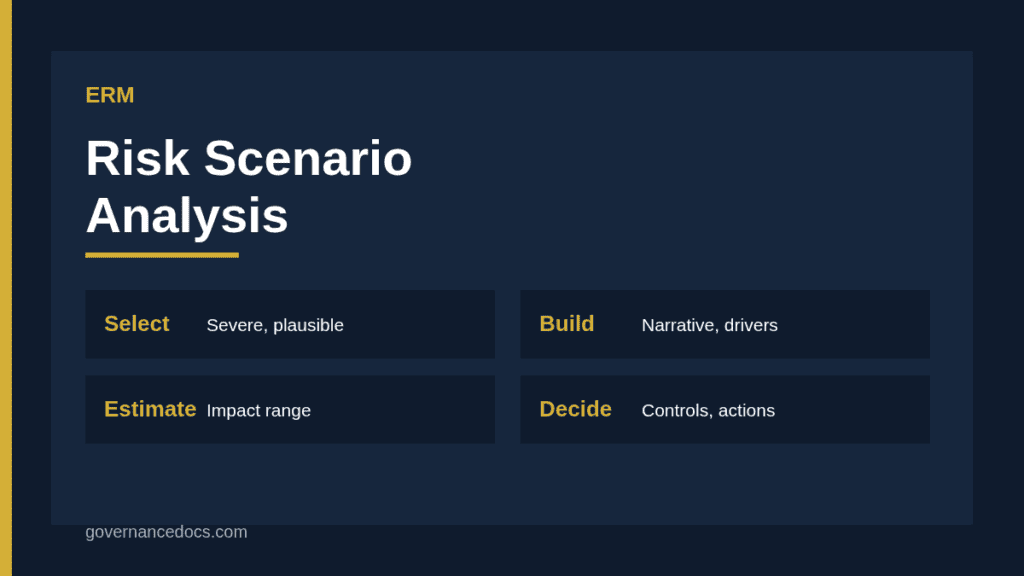
A useful scenario is severe enough to challenge the organization but plausible enough to be taken seriously. Draw candidates from your top risks, past incidents (yours and others’), emerging risks, regulatory stress tests and the concerns of senior leaders. Link each to a strategic objective it could threaten.
Aim for a manageable set, such as five to ten scenarios a year, with a mix of themes: operational, financial, technology, people, external. Include at least one scenario that combines events. Record why each was chosen, and rotate them over time so the organization keeps stretching.
Step
What you do
Output
1. Select
Choose severe but plausible events linked to objectives
Scenario shortlist
2. Build
Describe the event, drivers, timeline and affected areas
Scenario narrative
3. Estimate
Assess impact ranges and likelihood
Loss or impact estimate
4. Test controls
Ask which controls hold and which fail
Control gaps
5. Decide
Agree actions, resilience investment and reporting
Action plan and board paper
Link each scenario to an objective at risk
Use real events and near misses as inspiration
Mix themes and include a compound scenario
Keep the number small enough to do properly
Build the narrative for risk scenario analysis
Write a short narrative: what happens, when, what triggers it, how it develops over days, weeks and months, and which parts of the organization it touches. Define the assumptions, such as duration, scale and external conditions. Involve people who know the operations, since they will spot practical consequences that managers overlook.
Then trace the effects: immediate operational impact, financial impact, customer and stakeholder reaction, legal and regulatory consequences, staffing and reputational effects. Draw a simple map of dependencies so the chain of consequences is clear. Our guide to risk aggregation shows how to combine such effects.
Estimate impact and likelihood
Estimate impact as a range rather than a single number, reflecting uncertainty: for example, lost revenue of between two and five million, remediation costs of between one and two million and possible fines. Use data where you have it, and expert judgement where you do not, and document assumptions.
Likelihood is often hard to estimate for severe events. Use bands such as “once in ten years” or “once in a hundred years”, with reasoning, or simply state that the scenario is a stress test whose likelihood is not being assessed. Use consistent scales with your main framework, such as those in risk criteria, so results can be compared.
Test the controls and resilience
For each stage of the scenario, ask which controls would work, which would fail and how long recovery would take. Examine detection, response, communication, recovery and decision-making. This often reveals that plans exist on paper but depend on people, systems or suppliers that the scenario would also disable.
Compare the outcome with your appetite and tolerances. If the scenario impact exceeds what you are willing to bear, identify additional controls, insurance, contingency plans or changes to strategy. See risk appetite and risk response options for how to decide.
Use results in decisions and reporting
Turn the analysis into actions with owners and dates, and feed the results into the risk register, continuity plans, budgets and strategy. Present a short summary to the executive committee and the board: the scenario, the estimated impact, the weaknesses found and the actions proposed.
Combine scenario results with key risk indicators, so you know which early warning signals would suggest the scenario is developing. Update the analysis when the business, environment or controls change materially.
Running risk scenario analysis workshops
Most scenario analysis happens in facilitated workshops of two to four hours. Invite a cross-section of leaders and specialists, present the scenario in stages, and ask the group to respond as they would in real life. Capture decisions, assumptions, gaps and actions on a shared board.
A good facilitator keeps the discussion concrete, challenges wishful thinking and makes sure quieter voices are heard. Record dissent as well as consensus. Circulate the write-up promptly, and follow up on actions, since the value of the exercise depends on what changes afterwards.
Common mistakes in risk scenario analysis
Frequent errors include choosing scenarios that are too mild or too fanciful, ignoring interactions and dependencies, treating the estimate as a forecast, failing to record assumptions, running one workshop and never following up, excluding operational staff and presenting results without recommended actions. Another is using scenarios only to confirm that existing plans are fine.
Avoid these by selecting scenarios deliberately, involving people with practical knowledge, stating uncertainty and tracking actions to completion.
Quantifying scenarios without false precision
Numbers help decisions, but spurious accuracy misleads. Use ranges, show the main assumptions and note which inputs drive the result. Sensitivity checks, such as asking how the estimate changes if the outage lasts twice as long, show which assumptions matter most. Where data is thin, use structured expert elicitation: ask several experts for low, most likely and high values independently, then discuss differences.
Present the result in plain language, such as “a typical outcome is a loss of about three million, with a small chance of exceeding ten million”. That framing is more honest and more useful to boards than a single figure with no context.
A short worked example
A manufacturer selects the scenario “a fire closes our main plant for three months”. The narrative traces effects: production stops, customers switch suppliers after three weeks, contract penalties apply, insurance covers part of the loss and skilled staff are at risk of leaving. The group estimates lost revenue and costs as a range and finds that the alternative site can cover only forty percent of volume.
Controls testing shows that the continuity plan assumes the alternative site has the same equipment, which it does not. Actions include investing in duplicate tooling, agreeing a subcontracting arrangement and revising insurance cover. The results go to the board with clear costs and benefits.
Linking scenarios to strategy and resilience
Scenario analysis works best when it informs strategic decisions. Ask whether investment plans, supplier choices, geographic footprint and financing hold up under stress. Where a strategy is fragile in a plausible scenario, consider alternatives that are more robust, even if they are slightly more expensive in normal times.
Over time, build a library of scenarios and results. Reuse them for training, exercises and regulator conversations, and compare new results with earlier ones to see whether resilience is improving. That history turns individual workshops into an organizational capability.
Structuring the assessment
If you want a report and workbook that connect risks, scenarios, controls, owners and actions, the Enterprise Risk Assessment Report and Workbook provides a structured layout for enterprise risk assessment that supports scenario work alongside the main register. Whichever tool you use, effective risk scenario analysis is specific, honest about uncertainty and tied to real decisions.
Risk scenario analysis FAQ
What is risk scenario analysis?
A technique that describes a specific plausible event in detail, traces its effects through the organization and estimates impact, in order to test controls and support decisions.
How is it different from a risk register?
A register lists individual risks with ratings. Scenario analysis explores how events unfold and interact, which reveals dependencies and compound effects.
How many scenarios should we run?
A handful each year, typically five to ten, chosen for relevance to objectives and rotated over time.
Do we need to estimate likelihood?
Where possible, use bands with reasoning. For severe stress scenarios, it is acceptable to treat them as tests of resilience without assigning a precise likelihood.
Who should be involved?
Leaders and specialists from across the business, including operational staff who understand practical consequences, with a facilitator to keep the discussion concrete.