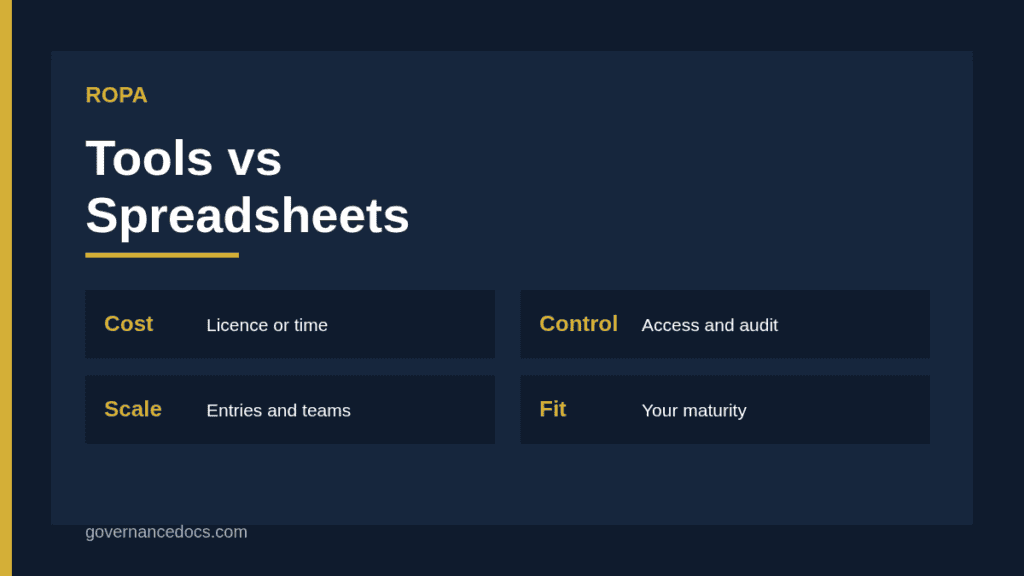
ROPA tools vs spreadsheets is the question every privacy team eventually asks about its record of processing: is a spreadsheet good enough, or do we need a dedicated platform? The honest answer is that it depends on size, complexity and how disciplined the team is, not on which option sounds more professional.
Article 30 of the GDPR requires a written record but does not say what format it must take. This guide compares the two approaches on the factors that matter, explains when each is the sensible choice and shows how to avoid the failures common to both. It is general information rather than legal advice.
What the law actually requires from the format
The regulation asks for a record in writing, including in electronic form, containing specified information, and asks that it be made available to the supervisory authority on request. It does not mandate software. A well-kept workbook satisfies the text just as well as a platform, so the ROPA tools vs spreadsheets question is about practicality, not compliance by format.
What the law does expect is accuracy and currency. A beautiful platform full of stale entries fails, while a modest spreadsheet reviewed quarterly can pass. Keep that in mind as you weigh the options, and see our ROPA example for the level of detail a regulator expects.
Where a spreadsheet works well
A spreadsheet is a sound starting point for many organizations. It costs almost nothing, everyone can open it, and you control the columns. For a company with a modest number of processing activities and a small privacy team, ROPA tools vs spreadsheets often ends in favour of the spreadsheet simply because it is proportionate.
It also teaches you the data. Filling in a workbook by hand forces conversations with process owners that a tool cannot replace. If you have not yet done a data mapping exercise, read GDPR data mapping first and use the spreadsheet to capture the results.
Factor
Spreadsheet
Dedicated tool
Upfront cost
Very low
Licence plus set-up
Audit trail
Manual versioning
Built-in change history
Collaboration
Limited, file-based
Workflows and assignments
Integrations
Rare
Often available
Best for
Small or simple estates
Large or fast-changing estates
Fast to start and easy to customise
No procurement, licence or training needed
Simple to share with auditors and counsel
Easy to export or migrate later if you outgrow it
Free ROPA template and builder
Could you hand your records of processing to a regulator tomorrow?
Check whether Article 30 applies to you, add your processing activities from a library organized by department, complete every Article 30 content, and see which activities are missing a lawful basis, a transfer safeguard, a DPIA or an LIA. Free, with a record score and findings.
The weaknesses appear with scale. Version control becomes a mess when several people edit copies. There is no built-in reminder to review an entry, no approval trail and no link to the systems or contracts behind each activity. Formulas break, columns drift and nobody notices.
The typical symptom is a record that nobody trusts. Entries have no owner, dates are missing and the file has names like “final_v7”. If that sounds familiar, put a ROPA review process in place before you buy anything, because the process problem will follow you into a new tool.
What dedicated ROPA tools add
A purpose-built platform can assign each entry to an owner, send review reminders, keep a change history and link records to vendors, systems and assessments. Some connect to data discovery or vendor management modules so entries update from real inventories. Approval workflows and role-based access are hard to reproduce in a workbook.
For organizations with dozens of business units, frequent change or many processors, those features save real time. They also make a regulator request for the record easier to answer, because the history and owners are already captured.
The hidden costs of each option
Neither choice is free. A spreadsheet costs staff time in chasing updates and reconciling versions. A platform costs licence fees, configuration and training, and it still needs people to keep the content honest. Tools also carry lock-in risk: check whether you can export the full record, with history, in a usable format.
Ask any vendor how the tool handles entries where you act as a processor, how it records international transfers and whether it supports joint controller arrangements. Gaps in those areas are common, and they are exactly where regulators ask questions.
How to decide between ROPA tools vs spreadsheets
Use a few practical questions. How many processing activities do you have, and how quickly do they change? How many people must edit the record? Do you need approval evidence for audits? Do you already own a governance, risk and compliance platform that could host it? Is your privacy team one person or ten?
As a rough guide, a small organization with a single team and stable processing is usually fine with a well-structured workbook. A group with many entities, frequent change and several contributors will usually benefit from a tool. If you are unsure, start with a structured spreadsheet and move when the pain is clear, because the data model you build will transfer.
Getting the fundamentals right in either format
Whichever way the ROPA tools vs spreadsheets debate ends for you, the fundamentals do not change. Cover every Article 30 field, record retention periods as explained in ROPA retention periods, describe transfers as in international transfers in the ROPA and summarise security measures at a general level, as covered in ROPA security measures.
Assign an owner and a review date to every line. Keep a version history. Align entries with your privacy notice. These habits matter more than the container. The wording of the legal duty is in Article 30 of the GDPR if you want to check the requirement itself.
Moving from a spreadsheet to a tool without losing history
If you decide a platform is right, plan the migration rather than importing a messy file and hoping. Start by cleaning the workbook: remove duplicates, merge entries that describe the same activity, fill in missing owners and standardise the wording of purposes, recipients and retention. A tool will faithfully reproduce whatever you give it, including the confusion.
Next, agree the data model. Decide which fields are mandatory, which are drop-down lists and how you will handle entries where you are a processor rather than a controller. Import a small batch first, check that the fields map correctly and let two or three process owners test the review workflow before you load everything. Keep the original spreadsheet, dated and locked, as evidence of what the record said before the move.
Finally, retrain owners. The biggest risk in any ROPA tools vs spreadsheets change is that people stop updating the record because the new system feels unfamiliar. A twenty-minute walkthrough and a clear reminder schedule prevent most of that.
Questions to ask a vendor before you buy
Ask how the tool records the change history and whether you can export it. Ask who can see and edit each entry and whether access is logged. Ask how it supports processor records, transfers and retention. Ask what happens to your data if you leave, where it is hosted and what security certifications the vendor holds. Ask for a reference from a customer of similar size and sector.
Be sceptical of anything that promises to build the record automatically. Discovery features can suggest systems and data categories, but a person who understands the business still has to confirm the purpose, the lawful basis and the recipients. The best ROPA tools vs spreadsheets decision is the one that fits how your team really works, so pilot before you commit and judge the result by whether entries stay accurate three months later.
Cost of ownership over three years
Compare total cost rather than sticker price. For a spreadsheet, estimate the hours spent each quarter chasing owners, reconciling versions and preparing evidence for audits. For a platform, add licence fees, implementation, training and any integration work. Small teams often find the workbook cheaper for years. Larger organizations frequently find the time saved by workflows and reminders outweighs the licence within the first year.
A structured starting point
If you want a ready layout that works as a proper workbook rather than a blank sheet, the ROPA Report and Workbook gives you the Article 30 fields, guidance and a maintainable register you can adapt. It suits teams that want the discipline of a structured record without the cost of a platform, and it can be migrated into a tool later.
ROPA tools vs spreadsheets FAQ
Is a spreadsheet acceptable to a regulator?
Yes. The regulation requires a written record, not particular software. What counts is that the record is complete, accurate and available on request.
When should we move from a spreadsheet to a tool?
Consider moving when many people edit the record, versions conflict, reviews are missed or you need approval trails and integrations that a workbook cannot provide.
Do ROPA tools make us compliant?
No. A tool helps you manage the record, but compliance depends on the accuracy of the content and the review discipline behind it.
Can we export data if we change tools?
Check before you buy. You should be able to export every field and the change history in a usable format such as CSV, so you are not locked in.
What should we look for first in a tool?
Look for ownership and review reminders, change history, support for processor records and transfers, and easy export. These features address the most common ROPA failures.