RoPA security measures are the part of your record of processing activities that summarizes how the personal data in each activity is protected. Article 30 asks for it in one line, but the field is often the weakest in the record: left blank, filled with a vague phrase such as appropriate technical and organizational measures, or copied from a template so that every activity looks identical.
This guide explains what the law requires you to record, how detailed the description should be, which categories of measure to cover, how to link the entry to your security controls and risk assessment, and how to keep it accurate over time.
What Article 30 requires
Article 30(1)(g) requires a controller’s record to contain, where possible, a general description of the technical and organizational security measures referred to in Article 32(1). Article 30(2)(d) requires the same for a processor’s record. Article 32 in turn requires appropriate measures to ensure a level of security appropriate to the risk, and gives examples: pseudonymization and encryption of personal data, the ability to ensure ongoing confidentiality, integrity, availability and resilience of processing systems, the ability to restore availability and access after an incident, and a process for regularly testing and evaluating the effectiveness of measures. The UK regulator’s security guidance gives further detail on what appropriate means.
The words where possible and general description matter. The record does not have to list every control, but it must say something meaningful about the protection of each activity. Our guide to the RoPA example shows how the field appears in a complete entry.
How detailed should RoPA security measures be
Aim for a summary that a knowledgeable reader could use to understand the level of protection, and that you could back up with evidence if asked. Too little detail invites the criticism that you have not considered security. Too much creates an unmaintainable document and exposes information that an attacker could use. A good target is a short paragraph or a set of tags per activity, referring to detailed policies and standards held elsewhere.
Too vague
Useful
Appropriate technical and organizational measures
Encryption at rest and in transit, role-based access with quarterly review, multi-factor authentication, daily backups tested twice a year
Standard security
Hosted in an ISO 27001-certified data center; access limited to payroll team; access logged and reviewed monthly
Company policies apply
Information security policy v4, clear desk rule, confidentiality clauses, annual training with a phishing test
Categories of measure to cover
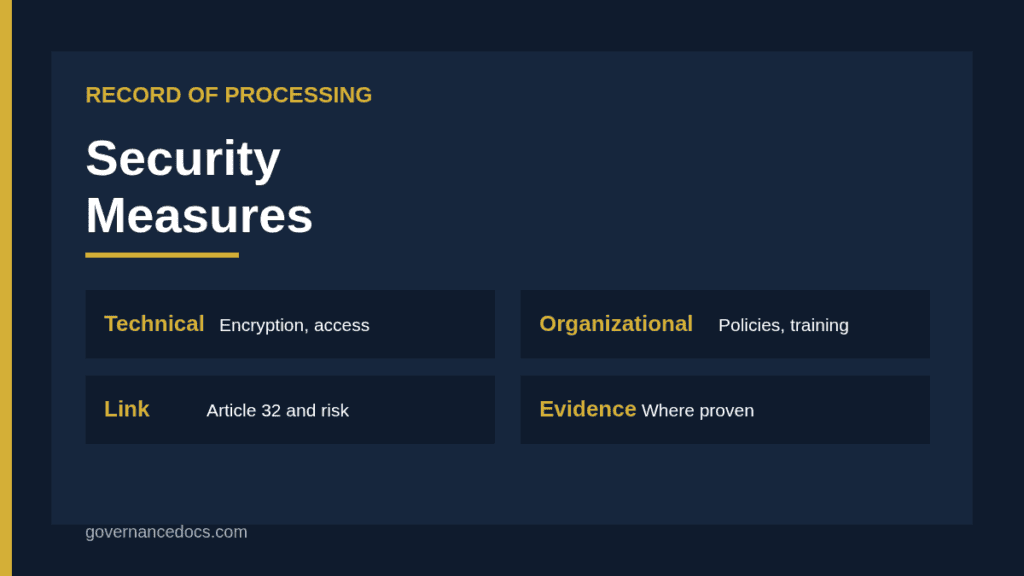
Use a consistent set of categories, so that entries can be compared and gaps are easy to see.
Different activities need different protection, and the entries should show it. Special category data or large volumes of financial data warrant stronger measures than a marketing contact list. A payroll entry might mention restricted access to a small team, segregation of duties for changes to bank details and encryption of payment files. A CCTV entry might mention restricted viewing, secure storage of footage and logging of exports. If every entry says the same thing, either the measures are uniform, which should be stated once with a reference, or the entries are not really describing the activity.
Refer to a control set instead of repeating it
For measures that apply everywhere, describe them once in a baseline security description, and refer to it from each entry, adding only what is specific. This keeps the record short and consistent, and it means that a change to a baseline control is updated in one place. Reference the standards you follow, such as ISO/IEC 27001 or a national framework, and note certifications, with dates and scope.
Linking RoPA security measures to Article 32 and risk assessment
Security measures should be chosen in response to risk, and the record should reflect that. Link each activity to its risk assessment or DPIA, and record the risk level. Where the risk is high, check that the measures listed are proportionate. Our guide to the privacy risk assessment methodology shows how to rate risks, and the DPIA guidance explains how measures reduce residual risk. If assessment shows a gap between the risk and the measures, the RoPA is the place where the gap becomes visible, and the plan to close it should be tracked elsewhere.
Free ROPA template and builder
Could you hand your records of processing to a regulator tomorrow?
Check whether Article 30 applies to you, add your processing activities from a library organized by department, complete every Article 30 content, and see which activities are missing a lawful basis, a transfer safeguard, a DPIA or an LIA. Free, with a record score and findings.
Where a processor performs part of the activity, the record should note what the processor is responsible for and how you assured yourself that its measures are adequate, for example through a contract, an audit report or a certification. Processors keep their own records with their own security descriptions. Our guide to controller and processor entries in the RoPA explains the different fields for each role. For activities involving joint controllers, see RoPA joint controllers.
Evidence behind the description
The description is a statement you may need to prove. Keep evidence in a place you can reach: policies, configuration screenshots, access review records, backup test results, penetration test summaries, certificates and training records. Spot-check a sample of entries each cycle by asking the system owner to demonstrate a measure. If a measure cannot be shown, correct the record or fix the control. Do not record measures that do not exist, since an inaccurate record is worse than a sparse one.
Sensitive areas deserve extra care when you write RoPA security measures. Staff records, covered in our guide to RoPA for HR processing, usually involve health and financial data, so the entry should show tighter access, separate storage where used and logging of who viewed which file. Whichever wording you choose, say plainly which of these measures are in place today, and which are still only planned, so that nobody reading the record later mistakes an aspiration for a fact or a finished control.
A short worked example
An entry for customer support tickets reads: data is stored in a hosted platform certified to ISO/IEC 27001, encrypted in transit and at rest, with single sign-on and multi-factor authentication; access is limited to the support team and team leads by role; attachments are scanned for malware; access is logged and reviewed quarterly; data is deleted 24 months after ticket closure by an automated job; staff complete annual data protection and phishing training. The entry also refers to the baseline security description and to the supplier assessment for the platform. Each statement is backed by a document or a report held in the compliance system.
Keeping RoPA security measures current
Review the field whenever systems, suppliers or controls change, after incidents that reveal weaknesses, when audits or tests produce findings and at least annually with the rest of the record. Link the review to your change process so that new systems and major changes trigger a check of the entry. Our guide to the RoPA review process shows how to set owners and dates.
Common mistakes with RoPA security measures
Organizations leave the field empty, copy generic phrases, list controls that do not exist, describe measures too specifically so that the entry is out of date within weeks, forget processors, fail to link to risk and do not review after changes. Another mistake is confusing the record with a full security policy. It should be a concise, accurate summary that points to the detail.
Using a ready structure
If you want a starting structure, the RoPA Report and Workbook provides a structured report and working register with fields for security measures in each entry. Whichever tool you use, make RoPA security measures specific enough to be meaningful, accurate enough to defend and short enough to maintain.
RoPA security measures FAQ
Is describing security measures in the RoPA mandatory?
Article 30 requires a general description of technical and organizational security measures where possible, for both controllers and processors. Leaving it blank is hard to justify.
How detailed should the description be?
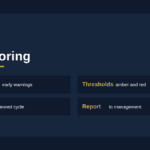
General but meaningful. Summarize the main controls in categories such as access, encryption, resilience, monitoring and organizational measures, and refer to detailed policies and standards held elsewhere.
Can I use the same wording for every activity?
Only for measures that genuinely apply everywhere, described once in a baseline. Add specific measures for activities with higher risk or special features.
Should I list certifications?
Yes, with scope and dates, if they support the description. They are useful evidence, but do not replace a description of measures relevant to the activity.
How often should the field be reviewed?
At least annually with the record, and whenever systems, suppliers, controls or risks change, or after an incident or audit finding.