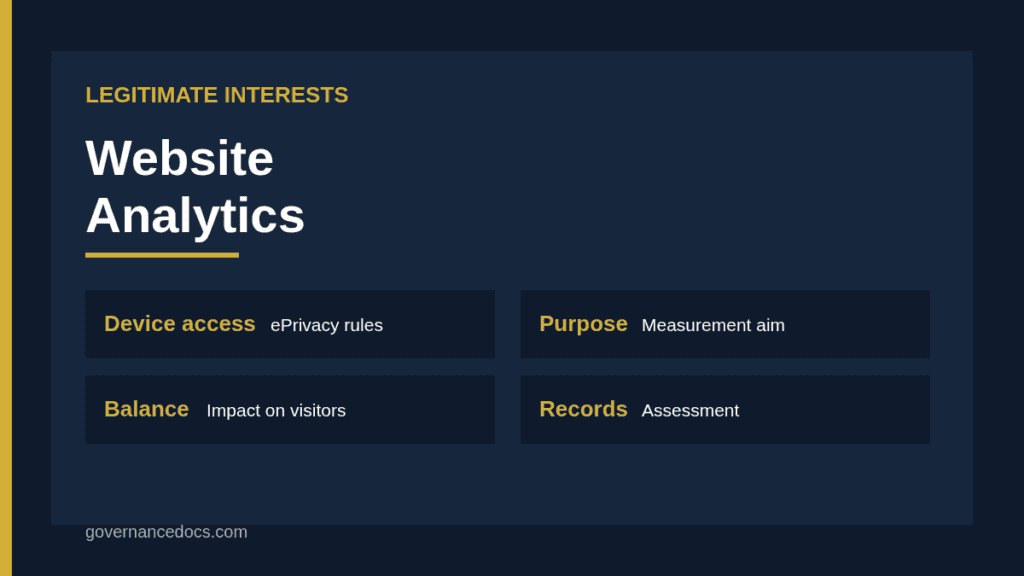
Legitimate interests for website analytics is a question that sounds simple and is not. The GDPR lets you rely on legitimate interests when processing is necessary for a genuine business purpose and the balance favors you, and understanding how visitors use your site is a genuine purpose. But most analytics tools set cookies or read information from the visitor’s device, and separate ePrivacy rules require consent for that in most cases, whatever lawful basis the GDPR would otherwise allow.
This guide explains how the two sets of rules interact, when legitimate interests can support analytics, which designs reduce the need for consent, how to run the balancing test and what to record.
Two layers of law for analytics
The first layer is the GDPR, which governs the processing of personal data such as IP addresses, identifiers and behavioral records. Article 6(1)(f) allows processing necessary for legitimate interests, unless overridden by the rights and interests of the individual. The second layer is the ePrivacy Directive, implemented in national law. Article 5(3) requires consent before information is stored on, or accessed from, a user’s device, except where it is strictly necessary to provide a service the user has requested, or for the sole purpose of carrying out the transmission of a communication. Regulators have consistently treated standard analytics cookies as not strictly necessary, so consent is generally required for them.
This is the point that catches many organizations out. Even if a legitimate interests assessment concludes that analytics is proportionate, that conclusion does not remove the need for consent to place the cookie. Our guide to legitimate interests and consent explains how to think about the two together, and the guide to cookie consent covers the consent mechanics.
When legitimate interests for website analytics can apply
There are situations in which the ePrivacy consent rule is not triggered, and legitimate interests can then be the GDPR basis for the processing that follows.
Server-side log analysis. Analyzing web server logs without placing anything on the visitor’s device is not covered by the cookie rule, though the logs still contain personal data such as IP addresses.
Cookieless measurement. Tools that do not store or read identifiers on the device, and use only what the request itself provides, may fall outside Article 5(3), subject to how they work and what national regulators say.
Exempted audience measurement. Some regulators, such as the French CNIL, have set conditions under which limited first-party audience measurement can be exempt from consent, for example strictly limited purposes, no cross-site tracking, short retention and no sharing with third parties. Check the current guidance of the authority in each country.
Legislated exceptions. The United Kingdom has legislated to widen the exceptions to the cookie consent rule for certain low-risk purposes, such as statistical analysis to improve a service. Check the commencement status and conditions before relying on it.
Can you rely on legitimate interests for this processing?
Check whether legitimate interests is available, set out the purpose, test necessity, weigh the impact on people from 25 scenarios and choose the safeguards that tip the balance. Built to GDPR Article 6(1)(f), free.
Where legitimate interests is available, apply the standard test and record it. The three parts are purpose, necessity and balancing.
Part
Question
Analytics example
Purpose
Is there a legitimate interest?
Understanding which pages are used, to improve the site and fix errors
Necessity
Is the processing needed, and is there a less intrusive way?
Aggregate counts may be enough without individual profiles or full IP addresses
Balance
Do the visitors’ interests override yours?
Low intrusion if data is aggregated, short-lived and not shared; higher if tracked across sites
Design choices that improve the balance
Choices you make about the analytics setup can move the balance considerably. Truncate or anonymize IP addresses as early as possible. Avoid cross-site or cross-device tracking. Keep the data within your control, or with a processor bound by contract not to use it for its own purposes. Use short retention. Exclude sensitive pages, such as those revealing health, finances or beliefs, from detailed tracking. Do not combine analytics data with advertising profiles. Each choice reduces the intrusion, and each should be written into the assessment.
Where consent is needed instead of legitimate interests for website analytics
If your analytics tool sets cookies or identifiers that fall under Article 5(3) and no exception applies, you need consent for the device access, and it makes sense to use consent as the basis for the whole processing, since a person who can refuse the cookie will be surprised if the same data is collected another way. Tools that share data with the provider for its own purposes, or feed advertising networks, generally need consent. Marketing profiling, retargeting and cross-site measurement are not suited to legitimate interests in this context. See our guide to legitimate interests examples for uses where the basis works better.
Transparency and objections
Tell visitors what you collect and why, in your privacy notice, and describe the legitimate interests you rely on. Provide an easy way to object or opt out of analytics, for example a link in the privacy notice and a setting honored on later visits. Where the right to object applies, you must stop processing unless you can show compelling legitimate grounds that override the visitor’s interests. Our guide to the right to object under legitimate interests explains how to handle such requests.
Processors and transfers
The same care applies to marketing tools, as our guide to legitimate interests for B2B marketing explains, since each tool has its own data flows and its own rules.
If a provider runs the analytics for you, it usually acts as a processor and you need a contract with the required terms. Check where the data is stored and processed, and whether the provider transfers it outside the EEA or UK. Where it does, identify the transfer tool and assess the risk. Several European authorities have taken action on certain analytics services because of transfers to the United States, so treat this as a live compliance issue and check current guidance. Keep records of the provider’s configuration and settings, and review them when it updates its service.
When you plan a new analytics project, decide on legitimate interests for website analytics early, because the answer shapes which tool you can buy and how it must be configured. Involve marketing, engineering and legal at the design stage, not after the tag is live.
A short worked example
A publisher wants to know which articles are read and where visitors leave. It compares three options. A tool using third-party cookies that share data with the vendor would need consent and raises transfer questions. A cookieless tool operating on the publisher’s own server, using truncated IP addresses and no persistent identifiers, avoids device access, and a legitimate interests assessment concludes that the purpose is legitimate, aggregated counts are necessary and the balance favors the publisher because the data is short-lived and not shared. The publisher chooses the second, records the assessment, adds a notice and an opt-out, and reviews the choice after a year.
Records for legitimate interests for website analytics
Keep the assessment, the technical description of the analytics setup, the notice text and the vendor contract. Note any regulator guidance relied on, with dates. Review when the tool changes, when the site adds features that collect more data, when regulator guidance or law changes, and at least annually. Our legitimate interests assessment example shows a completed record.
Common mistakes with legitimate interests for website analytics
Organizations conclude that a completed balancing test removes the need for consent to place cookies, use a cookie banner that sets tags before consent, assume cookieless means no personal data, forget provider transfers, share analytics data with advertising partners under the same notice and leave the assessment unreviewed after vendor changes. Another is treating the choice as purely legal. The technical setup determines which rules apply, so involve the people who configure the tools.
Using a ready structure
If you want a structured assessment to record the decision, the Legitimate Interests Assessment Report and Workbook provides a structured assessment, scoring and a working register. Whichever format you use, treat legitimate interests for website analytics as a decision that depends on the technology as much as the law, and record why you reached it.
Legitimate interests for website analytics FAQ
Can I use legitimate interests for analytics cookies?
Not for the cookie itself in most cases. The ePrivacy rule requires consent to store or access information on a device unless an exception applies, so legitimate interests alone does not permit typical analytics cookies.
When is legitimate interests available for analytics?
When the measurement does not store or access information on the device, such as server log analysis or some cookieless tools, or where a national exemption applies. The processing must still pass the three-part test.
Is an IP address personal data?
Generally yes, because it can identify a person in combination with other data. Truncating or anonymizing it early reduces risk.
Do I need a legitimate interests assessment?
Where you rely on legitimate interests, a written assessment is the usual way to show that the test was met and is regarded as good practice by regulators.
Do visitors have a right to object?
Yes. Where legitimate interests is the basis, individuals can object, and you must stop unless you can show compelling grounds that override their interests.