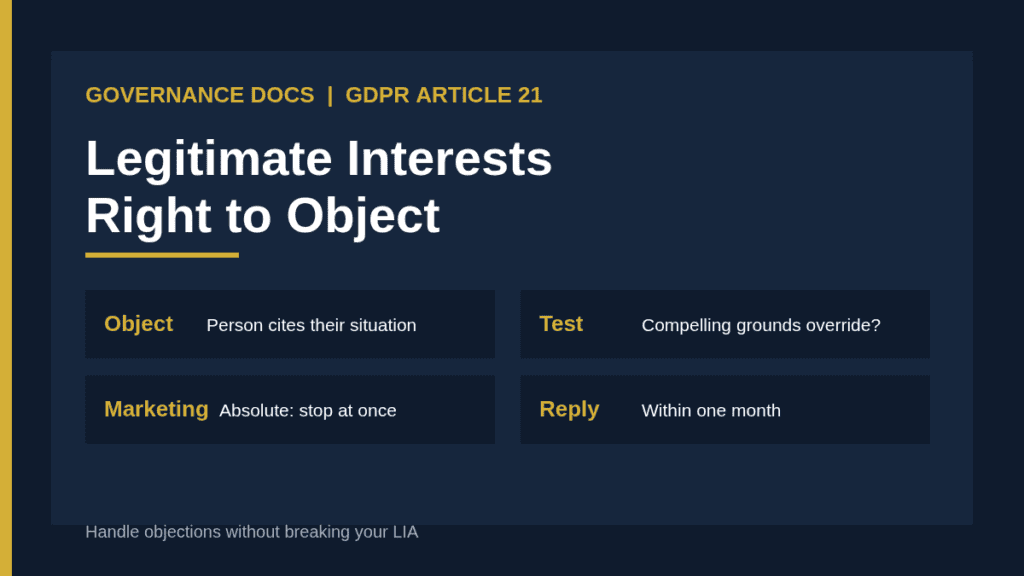
The legitimate interests right to object is the safety valve that makes the legitimate interests lawful basis workable. When you process personal data on that basis, you are deciding on the individual’s behalf that your interests outweigh their privacy. Article 21 of the GDPR lets the person disagree, and when they do, the balance you struck in your assessment no longer settles the matter. You must stop unless you can show something stronger.
This guide explains when the right applies, how the test changes once someone objects, why direct marketing is treated differently, what deadlines apply, and how to build a handling process that keeps your legitimate interests assessment honest.
Free gap assessment
Could you demonstrate GDPR compliance today?
Score yourself against what a supervisory authority actually asks for, free — the records, not the policy.
When the legitimate interests right to object applies
Article 21(1) gives individuals the right to object, on grounds relating to their particular situation, to processing based on Article 6(1)(e), the public task basis, or Article 6(1)(f), legitimate interests. That includes profiling based on those provisions. The words “particular situation” matter: the objection should explain why the processing affects this person in a way your general assessment did not anticipate, such as a safety concern, a sensitive personal circumstance or a specific harm.
The right does not apply to processing based on consent, contract or legal obligation. Consent has its own mechanism, because the person can simply withdraw it, and the right to object is the corresponding mechanism for processing you justified yourself. Our guide to legitimate interests versus consent explains how that choice affects your obligations.
How the test changes after an objection
Before anyone objects, you run a legitimate interests assessment: purpose, necessity and balancing. After an objection, the standard rises. You must stop processing the person’s data unless you demonstrate compelling legitimate grounds for the processing which override their interests, rights and freedoms, or unless the processing is needed for the establishment, exercise or defence of legal claims.
Original assessment
After an objection
Question
Do our interests outweigh theirs?
Do compelling grounds override this person’s interests?
Who decides
The controller, in advance
The controller, on the specific facts, and the burden is on you
Information used
General expectations of typical individuals
The individual’s stated situation as well
Default outcome
Processing may go ahead
Processing stops unless you can show compelling grounds
Record
The assessment document
A documented decision for each objection
The practical consequence is that the burden of proof sits with you. If you cannot explain in writing why your grounds are compelling for this individual, you should stop. Read the wording for yourself in the text of GDPR Article 21.
What counts as compelling
The standard is deliberately demanding, and ordinary commercial convenience will rarely meet it. Situations that may qualify include processing needed to prevent or investigate fraud involving the person, to protect the security of a network they use or to keep accurate records needed for a live legal dispute. Situations that usually do not qualify include wanting to keep a customer for analytics, avoiding the effort of deleting data or preferring one marketing channel. Record the specific facts you relied on and avoid generic statements such as “we have a business need”.
Direct marketing is different
Article 21(2) and (3) create an absolute right to object to processing for direct marketing, including profiling related to it. When someone objects, you must stop using their data for that purpose. There is no balancing test and no compelling-grounds exception. That is why relying on legitimate interests for marketing is safe only if you can honor the legitimate interests right to object immediately and everywhere.
In practice, keep a suppression list. Storing the minimum needed, typically the contact detail and the fact of the objection, is what allows you to make sure the person is not contacted again. Deleting everything can cause the person to be re-added from a purchased list or a new sign-up. Include the suppression step in every campaign workflow and every data import.
Deadlines for responding to an objection
Article 12 sets the timing for responding to individuals exercising their rights. You must act without undue delay and in any event within one month of receiving the request. You may extend that by up to two further months where necessary, taking into account the complexity and number of requests, but you must tell the individual about the extension and the reasons within the first month. The response should be free of charge unless the request is manifestly unfounded or excessive.
If you decide not to act, you must explain why and tell the person that they can complain to a supervisory authority and seek a judicial remedy, all within the same one-month period. Log the date the objection was received, because that starts the clock, and route any message that sounds like an objection, even if it does not use the term, to the person who handles rights requests.
A 7-step process for handling an objection
Log and acknowledge. Record the date and confirm receipt.
Confirm identity. Verify the requester without collecting more data than you need.
Identify the processing. List every purpose and system that relies on legitimate interests for this person.
Check for marketing. If the purpose is direct marketing, stop and suppress immediately.
Assess compelling grounds. For other purposes, weigh your grounds against the person’s stated situation and document the decision.
Act and reply. Stop processing, or explain in writing why you can continue, within the deadline.
Feed back. Update your legitimate interests assessment if the objection reveals a pattern.
Related rights to watch
An objection interacts with other rights. While you verify whether your grounds override the person’s, they can ask you to restrict processing under Article 18(1)(d). If the objection succeeds and there are no overriding grounds, the person can also request erasure under Article 17(1)(c). Treat the objection as a package: one message can trigger several obligations, and your response should address each.
Telling people about the right
You must make the legitimate interests right to object visible. Article 21(4) requires that it be explicitly brought to the attention of the individual at the latest at the time of the first communication, and presented clearly and separately from other information. Your privacy notice must also state the legitimate interests you pursue when you rely on that basis, so that people can judge whether to object. Check your notices, your welcome emails and your marketing footers to make sure the right is stated where people will see it. Our guide to legitimate interests examples shows how organizations describe their interests in practice.
Keeping your legitimate interests assessment honest
Objections are data, and tracking how often the legitimate interests right to object is used tells you whether your assessment still holds. If many people object to the same processing, your original balancing probably underestimated the impact or overestimated what people expect. Count objections per purpose each quarter, review the reasons and update the assessment where a pattern appears. Record the review date. A legitimate interests assessment that never changes despite steady objections looks like a paper exercise.
Common mistakes with the legitimate interests right to object
Treating every objection as a complaint. It is a rights request with a deadline.
Applying the original balancing test. After an objection the bar is compelling grounds, and the burden is yours.
Refusing to stop marketing. The marketing right is absolute.
Deleting the suppression record. Keep the minimum needed to honor the objection.
Missing the clock. One month runs from receipt, not from identity verification you delayed.
No notice of the right. Article 21(4) requires it to be clearly presented.
Build a legitimate interests assessment that survives objections
A strong assessment makes objections easier to handle, because the reasoning you need is already written down. The Legitimate Interests Assessment Report and Workbook gives you a structured report covering screening, purpose, necessity and balancing tests, safeguards and a live workbook for your own processing activities.
Legitimate interests right to object FAQ
Can someone object to processing based on legitimate interests at any time?
Yes. The right can be exercised whenever the processing relies on legitimate interests, and the person must give grounds relating to their particular situation, except for direct marketing where no grounds are needed.
Must I always stop processing after an objection?
You must stop unless you demonstrate compelling legitimate grounds that override the person’s interests, rights and freedoms, or the processing is needed for legal claims. For direct marketing you must always stop.
How long do I have to respond?
One month from receipt, extendable by up to two further months for complex or numerous requests, provided you tell the person about the extension and the reasons within the first month.
Does the legitimate interests right to object apply to consent-based processing?
No. Consent-based processing is ended by withdrawing consent, while the right to object applies to processing you justify under legitimate interests or the public task basis.
Should I keep data about someone who has objected to marketing?
Keep the minimum needed to honor the objection, typically the contact detail and a note of the objection, so the person is not contacted again through another channel or list.