CART
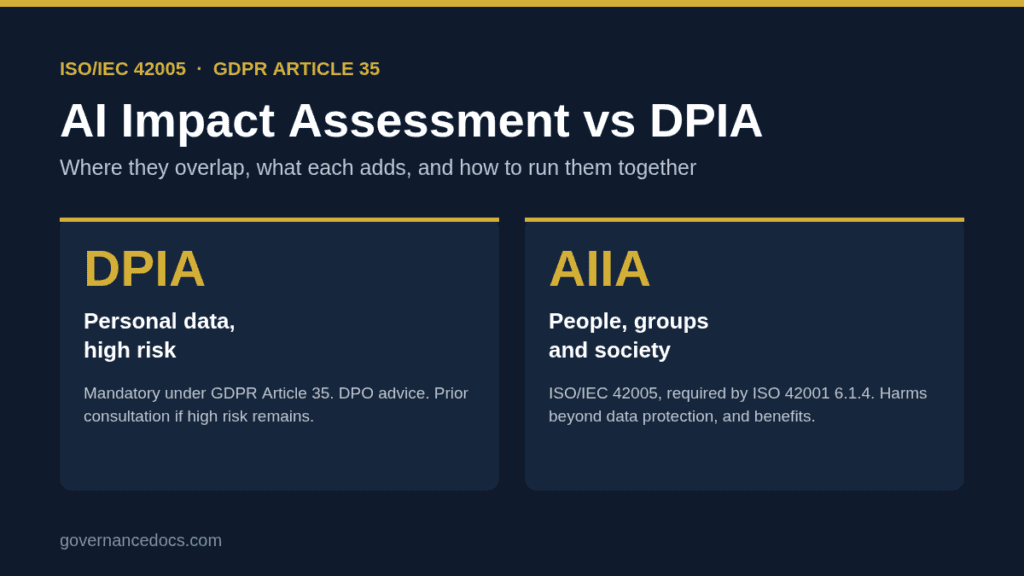
AI impact assessment vs DPIA comes up whenever an AI system uses personal data, which is most of the time. A data protection impact assessment (DPIA) is a legal duty under Article 35 of the GDPR for processing likely to be high risk. An AI system impact assessment, as ISO/IEC 42005 describes it, looks at everything an AI system could do to people and society, whether or not personal data is involved. They overlap heavily, but neither replaces the other. This guide sets out the differences, where they meet and how to run them together.
A DPIA asks whether processing personal data is likely to result in a high risk to people’s rights and freedoms, and what measures bring that risk down. It is mandatory when the test is met, and if high risk remains, the supervisory authority must be consulted before processing starts. An AI system impact assessment asks what an AI system’s reasonably foreseeable impacts are on individuals, groups and society, benefits as well as harms, across the whole lifecycle. It is guidance under ISO/IEC 42005 and a requirement for organizations certified to ISO/IEC 42001 (clause 6.1.4).
| DPIA | AI system impact assessment | |
|---|---|---|
| Source | GDPR and UK GDPR Article 35 | ISO/IEC 42005; required by ISO/IEC 42001 clause 6.1.4 |
| Mandatory? | Yes, where processing is likely to be high risk | For ISO/IEC 42001; otherwise good practice |
| Trigger | Processing of personal data likely to be high risk | An AI system in scope, before deployment and on significant change |
| Scope of harm | Rights and freedoms of the people whose data it is | Individuals, groups and society, including people whose data is not used |
| Core content | Description, necessity and proportionality, risks, measures (Article 35(7)) | System, uses and misuse, data, model, environment, people affected, impacts, measures |
| Benefits | Weighed in necessity and proportionality | Recorded and weighed explicitly |
| Who advises | The DPO, where one is designated (Article 35(2)) | An AI governance function, as the organization decides |
| Regulator | Prior consultation if high risk remains (Article 36) | None under the standard |
The UK Information Commissioner’s Office is direct about it: its guidance on AI and data protection says that in the vast majority of cases, using AI will involve processing likely to result in a high risk, and so will trigger the legal requirement for a DPIA. Several of the nine criteria regulators use to screen for a DPIA, such as evaluation or scoring, automated decisions, innovative technology and large scale, describe typical AI uses. Our guide to when a DPIA is required covers the screening.
A DPIA is anchored to personal data and to data protection law. An AI impact assessment reaches further:
Much of the description is the same: what the system does, the data, the people affected, the recipients and the safeguards. Fairness, transparency, human review and contestability appear in both. Rather than two teams describing one system twice, run them together:
Our AI impact assessment example shows a recruitment tool where Brightwell did exactly this, and the DPIA example shows the data protection half for a different system.
Certain deployers of high-risk AI systems, including public bodies, private entities providing public services, and deployers of credit scoring or life and health insurance pricing, also owe a fundamental rights impact assessment under Article 27 of the EU AI Act. The Act itself says that where a DPIA already covers some of the obligations, the fundamental rights assessment complements it. After the Digital Omnibus, the duties for Annex III high-risk systems apply from December 2027. See our guide to the fundamental rights impact assessment.
When the two run together, keep each record complete on its own terms, so either can be shown to the person who asks for it:
| Record | DPIA | AI impact assessment |
|---|---|---|
| Screening | Article 35(3) cases, the authority’s list, the nine criteria | Prohibited and sensitive uses, context factors |
| Description | Purposes, lawful basis, data, recipients, retention, transfers | System, uses and misuse, data quality, model, deployment, people affected, benefits |
| Analysis | Necessity and proportionality; risks to rights and freedoms | Safeguards per dimension of impact; impacts on individuals, groups and society |
| Measures | Data protection measures, referenced to GDPR articles | Measures referenced to ISO/IEC 42001 Annex A controls |
| Sign-off | DPO advice, views of the people concerned, outcome, Article 36 check | Governance review, views of the people affected, decision, next review |
Cross-reference the two by risk, so a reviewer can see that a privacy harm in the DPIA and the same harm in the impact assessment carry the same rating and the same measures. That single step removes most of the AI impact assessment vs DPIA confusion an auditor or regulator would otherwise find.
Yes, if it contains everything Article 35(7) requires, records the DPO’s advice, covers the ISO/IEC 42005 elements, and makes one decision on the system. Many organizations prefer two linked records, because the DPIA has legal consequences the impact assessment does not.
Then no DPIA is needed, but an impact assessment still is: an AI system can affect people without processing their data.
Screen for both at once. If a DPIA is required, its timing is fixed: before the processing starts.
In the AI impact assessment vs DPIA split, the DPIA belongs to the controller, advised by the DPO. The impact assessment belongs to whoever owns the AI system, with the AI governance function reviewing it.
Run the impact assessment with our free AI impact assessment template and the DPIA with the free DPIA template; both rate harms for the people affected, not for the organization. For the documents around them, see the ISO 42001 Toolkit and the GDPR Toolkit, and for how the impact assessment relates to AI risk, our comparison of AI impact assessment vs risk assessment.


September 28, 2026
September 28, 2026
September 28, 2026
September 28, 2026
September 28, 2026

