CART
Facilitation payments — small payments to a public official to speed up a routine action the payer is already entitled to, such as a customs clearance, a permit, a utility connection or a visa stamp — are the point where anti-bribery law diverges most sharply between jurisdictions and where a global policy has to choose one rule for everyone. The UK Bribery Act 2010 treats them as bribes with no exemption. The U.S. Foreign Corrupt Practices Act carves out a narrow exception for “facilitating or expediting” payments to secure “routine governmental action”. Canada repealed its exception in 2017. Australia keeps a statutory defence. Brazil’s Clean Company Act has no exception at all. ISO 37001:2025 does not use the phrase, but its definition of bribery — an undue advantage “of any value”, offered “as an inducement or reward for a person acting or refraining from acting in relation to the performance of that person’s duties” — covers them, and a certified anti-bribery management system that permits them would have to argue they are lawful in every jurisdiction it operates in. This guide sets out what the five laws actually say, why the OECD position has converged on prohibition, what ISO 37001 requires of your policy, how to write a policy that survives audit, and what to do when the demand is made at a border at midnight.
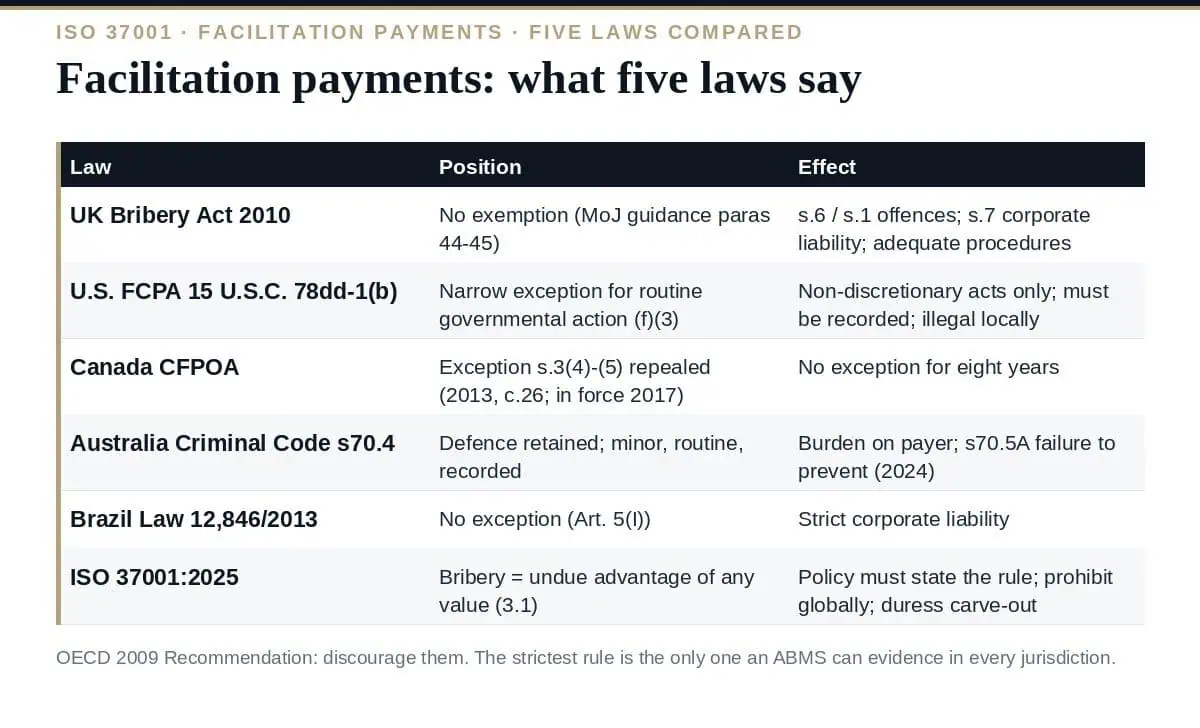
| Law | Position | What the text says | Practical effect |
|---|---|---|---|
| UK Bribery Act 2010 | Prohibited | The Ministry of Justice guidance states that small bribes to facilitate routine government action “could trigger either the section 6 offence or … the section 1 offence and therefore potential liability under section 7”, and that the Act “does not (unlike US foreign bribery law) provide any exemption for such payments” | A facilitation payment by an associated person can make the company liable for failure to prevent bribery; the only protection is adequate procedures, and prosecutorial discretion on the public interest |
| U.S. FCPA (15 U.S.C. §78dd-1) | Narrow exception | Subsection (b): the anti-bribery provisions “shall not apply to any facilitating or expediting payment … the purpose of which is to expedite or to secure the performance of a routine governmental action”; subsection (f)(3) defines routine governmental action as actions “ordinarily and commonly performed” — permits and licences to qualify to do business, processing visas and work orders, police protection, mail, scheduling inspections, utilities, loading and unloading cargo — and states it “does not include any decision … whether, or on what terms, to award new business” | Legal under U.S. federal law only if genuinely routine and non-discretionary; must still be accurately recorded under the books-and-records provisions; almost never legal under the local law of the country where it is paid. DOJ’s June 2025 FCPA enforcement guidelines changed prosecutorial priorities, not the statute |
| Canada — Corruption of Foreign Public Officials Act | Prohibited since 31 October 2017 | Section 3(4)–(5), which excepted payments to expedite routine acts, are shown in the consolidated Act as “[Repealed, 2013, c. 26, s. 3]” | Canadian companies and nationals have had no exception for eight years; policies still citing it are wrong |
| Australia — Criminal Code Act 1995, Division 70 | Defence retained | The current compilation lists s70.4 “Defence—facilitation payments” alongside s70.3 (conduct lawful in the official’s country) and the s70.5A failure-to-prevent offence added in 2024; the defence applies to payments of minor value made to expedite routine government action of a minor nature and recorded as soon as practicable | A defence, not an exception: the burden sits with the payer, the record is mandatory, and the 2024 failure-to-prevent offence makes a corporate policy of tolerating them hard to reconcile with adequate procedures |
| Brazil — Law 12,846/2013 (Clean Company Act) | Prohibited | Article 5(I) makes it an act against public administration to “promise, offer or give, directly or indirectly, an undue advantage to a public agent, or to a third person related to him”; the law contains no de minimis or facilitation exception | Strict civil and administrative corporate liability; no small-payment threshold |
The pattern is the one the UK guidance describes: the 2009 OECD Recommendation “recognises the corrosive effect of facilitation payments and asks adhering countries to discourage companies from making such payments”, and exemptions “create artificial distinctions that are difficult to enforce, undermine corporate anti-bribery procedures, confuse anti-bribery communication with employees and other associated persons, perpetuate an existing ‘culture’ of bribery and have the potential to be abused”. The FCPA exception is the outlier, and it is narrower than most people assume.
| ISO 37001:2025 clause | Requirement | Applied to facilitation payments |
|---|---|---|
| 3.1 Bribery | “Offering, promising, giving, accepting or soliciting of an undue advantage of any value … as an inducement or reward for a person acting or refraining from acting in relation to the performance of that person’s duties”, with the meaning set by applicable law and the organisation’s own ABMS | A payment to speed a routine act is an advantage of value to induce performance of duties; it is bribery unless the applicable law says otherwise — and the organisation’s ABMS can define it as bribery regardless |
| 4.5 Bribery risk assessment | Identify and assess bribery risks by activity, country, transaction type and relationship | Border, customs, licensing and inspection interactions in countries where demands are common are the risk rows |
| 5.2 Anti-bribery policy | A policy that prohibits bribery and requires compliance with applicable anti-bribery laws | The policy must state the rule on facilitation payments; a policy silent on them fails audit in any organisation with cross-border operations |
| 7.3 Awareness; 7.2 Competence | Personnel aware of the policy and trained by exposure | Drivers, customs agents, site managers and expatriate staff trained on refusing, recording and escalating demands |
| 8.3 Financial controls | Controls to prevent bribery through payments | No cash floats without accounting; expense codes that expose ‘expediting fees’; approval of any payment to an official |
| 8.7 Gifts, hospitality, donations and similar benefits | Controls over benefits that could be perceived as bribery | ‘Fees’ demanded by officials assessed under the same controls |
| 8.9 Raising concerns; 8.10 Investigating | A protected route to report; an investigation process | Every demand reported; every payment made under duress investigated and recorded |
Our guide to ISO 37001:2025 covers the standard; our guide to gifts and hospitality covers the neighbouring controls under 8.7.
| Situation | Do | Record |
|---|---|---|
| Official asks for a small unofficial fee to release goods | Ask for the legal basis and a receipt; ask for a supervisor; call the escalation contact; refuse | Demand log entry: date, place, official, amount, outcome |
| Official says the fee is a published charge | Pay only against an official receipt, through the company, to the government account | Invoice and receipt in accounts payable |
| Threat to detain the employee or endanger safety | Pay if necessary to remove the threat; report immediately | Incident report under 8.9; accurate accounting entry; investigation under 8.10 |
| Agent or broker invoices ‘expediting fees’ | Withhold payment pending explanation and evidence; treat as a red flag for due diligence | Financial control record; due diligence file update |
| Repeated demands on one route | Escalate to management; consider route change, diplomatic channels, industry bodies | Risk assessment update; management review input |
Are facilitation payments legal?
Under the UK Bribery Act, Canada’s CFPOA since 2017 and Brazil’s Clean Company Act, no. Under the U.S. FCPA a narrowly defined exception exists for payments to secure routine, non-discretionary governmental action. Under Australian federal law a statutory defence exists for minor payments, recorded, to expedite routine government action of a minor nature. Under the local law of the country where the payment is made, almost never.
Does ISO 37001 prohibit facilitation payments?
ISO 37001:2025 does not use the term, but its definition of bribery — an undue advantage of any value to induce the performance of duties — covers them, and the standard requires a policy that prohibits bribery and complies with applicable law. In practice a certifiable ABMS prohibits them globally.
What about payments made under duress?
A payment made to remove an imminent threat to health, safety or liberty is treated differently by most prosecutors and by the UK guidance, which discusses duress separately. The policy should require immediate reporting, accurate recording and investigation, and should never leave the person who paid exposed.
Is the FCPA exception safe to rely on?
Only for genuinely routine, non-discretionary actions, and only under U.S. law; the payment must be accurately recorded, and it remains illegal in the country where it is paid. DOJ’s June 2025 enforcement guidelines reset priorities but did not change the statute.
What is the difference between a facilitation payment and an expediting fee?
A published, receipted fee paid to a government body for a faster official service is a lawful charge. An unofficial payment to an individual official to do what they should do anyway is a facilitation payment — and a bribe in most jurisdictions.
Write one rule on facilitation payments for the whole organisation — prohibited, with a duress carve-out that requires reporting — define them against lawful expediting fees, train the people who face the demands, give them the script and the time, flow the rule to agents and brokers, and log the demands. The five laws disagree on the letter; the policy that satisfies all of them, and ISO 37001, is the strictest one.
The Anti-Bribery Policy with the facilitation payments and duress clauses drafted, the demand and incident log, the training deck by exposure, the business associate commitment clauses and the financial controls procedure are in the ISO 37001 Anti-Bribery Toolkit, or start with the free templates.

September 20, 2026
September 19, 2026

September 19, 2026

September 19, 2026

September 19, 2026

