CART

Laboratory impartiality is the first substantive requirement in ISO/IEC 17025:2017 — clause 4.1, before confidentiality, structure or a single technical clause — and it is the one accreditation assessors have found most often documented as a sentence rather than managed as a risk.
The clause has five parts: laboratory activities are undertaken impartially and structured and managed to safeguard impartiality; management is committed to impartiality; the laboratory is responsible for the impartiality of its activities and does not allow commercial, financial or other pressures to compromise it; the laboratory identifies risks to its impartiality on an ongoing basis, including those arising from its activities, its relationships and the relationships of its personnel; and where a risk is identified, the laboratory demonstrates how it eliminates or minimises it.
The fourth and fifth parts are the work, and the note to 4.1.4 names where the risks come from — ownership, governance, management, personnel, shared resources, finances, contracts, marketing and commission payments. This guide sets out the five requirements, the eight risk sources, how to run an impartiality risk assessment that survives assessment, how the result feeds management review, and the five failures assessors record.
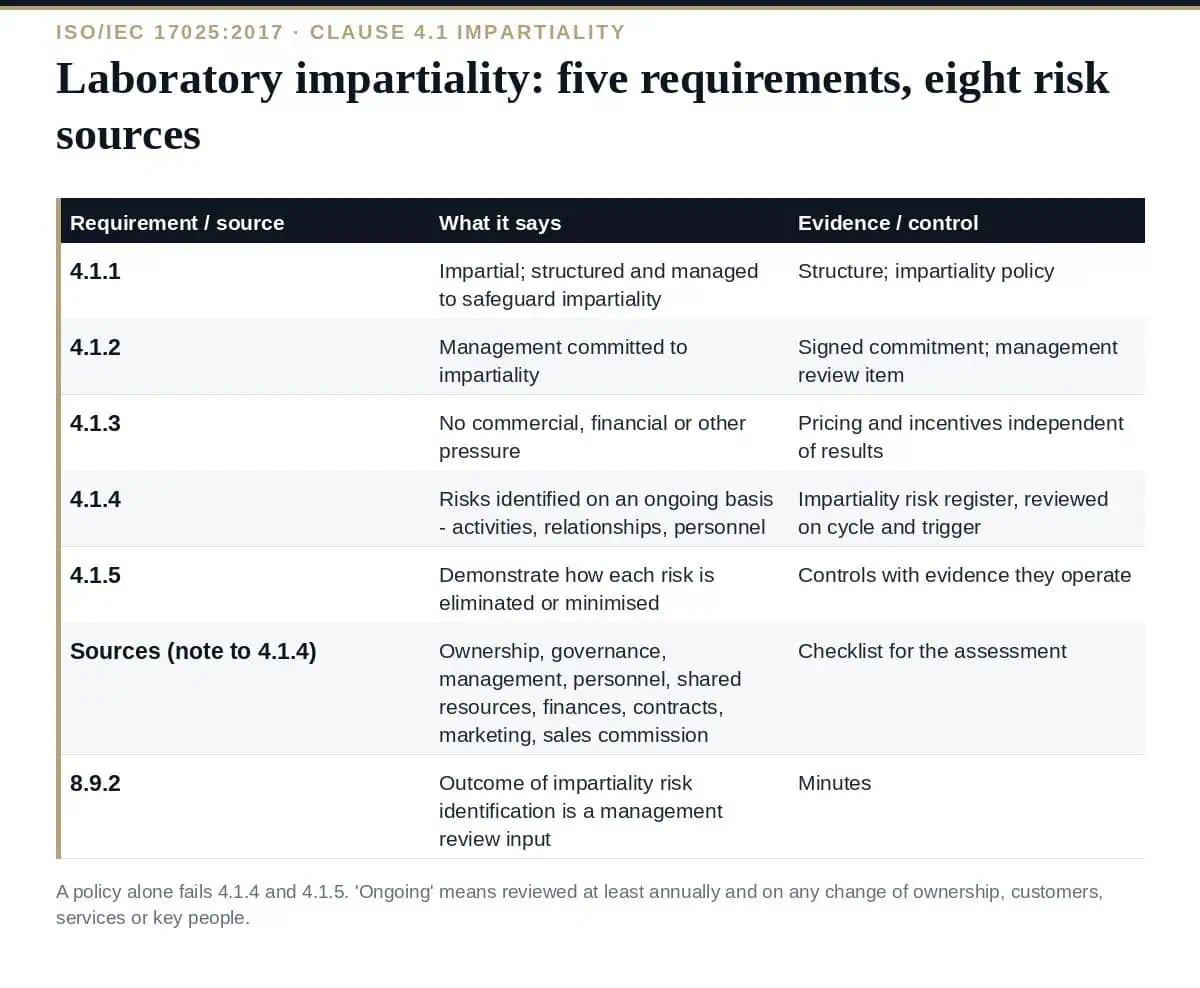
| Subclause | Requirement | What evidences it |
|---|---|---|
| 4.1.1 | Laboratory activities undertaken impartially, and structured and managed so as to safeguard impartiality | An organisational structure that separates testing from the interests that could bias it; an impartiality policy |
| 4.1.2 | Laboratory management committed to impartiality | A signed commitment; management review of impartiality; resources for the controls |
| 4.1.3 | The laboratory responsible for impartiality and not allowing commercial, financial or other pressures to compromise it | Pricing, targets and incentives that do not depend on results; a route for staff to report pressure |
| 4.1.4 | Risks to impartiality identified on an ongoing basis, including from activities, relationships and personnel relationships | An impartiality risk register, reviewed on a cycle and on trigger |
| 4.1.5 | Where a risk is identified, the laboratory able to demonstrate how it eliminates or minimises it | Controls recorded against each risk, with evidence they operate |
“Ongoing” in 4.1.4 is the word assessors test. A risk assessment done at accreditation and never revisited fails the clause on its face; a new customer who is also a shareholder, a new service line that tests products the parent company makes, or a technician who joins from a major customer are all triggers. Our guide to ISO 17025 covers where the clause sits in the standard.
| Source (note to 4.1.4) | Typical scenario | Typical control |
|---|---|---|
| Ownership | The laboratory is owned by a manufacturer whose products it tests, or by a customer | Structural separation; independent review of results for the owner’s products; disclosure |
| Governance | Board members with interests in tested products or competing laboratories | Declarations of interest; recusal rules |
| Management | A manager responsible for both sales targets and result release | Separate the authorisation of results from commercial accountability |
| Personnel | An analyst with a family member at a customer; a former employee of a tested company | Personal declarations at hire and annually; reassignment where needed |
| Shared resources | Equipment or staff shared with a production or consultancy function | Defined boundaries; records of when resources act for the laboratory |
| Finances | Revenue concentrated in one customer; results linked to invoicing | Customer concentration monitoring; fixed pricing irrespective of outcome |
| Contracts | A contract that pays more for a pass, or that lets the customer choose the analyst | Contract review under 7.1 rejects outcome-dependent terms |
| Marketing and commission | Commission paid to staff on sales to customers whose samples they test; marketing that implies favourable results | No commission linked to results; marketing review |
Laboratory impartiality does not end with the register. Clause 8.9.2 requires management review inputs to include the outcome of the identification of risks to impartiality — one of the three inputs an Option B laboratory has to add on top of ISO 9001’s list. The impartiality register, its review and any new controls are therefore a standing management review item, and the review minutes are the evidence that 4.1.2’s management commitment is real. Impartiality risks also feed the general risks-and-opportunities process under 8.5 and, where a control is a contractual term, the contract review under 7.1. Our guide to ISO 17025 vs ISO 9001 covers the Option B additions.
What does ISO 17025 require for laboratory impartiality?
Clause 4.1 of ISO/IEC 17025:2017: activities undertaken impartially and structured to safeguard it; management commitment; no commercial, financial or other pressure compromising impartiality; risks to impartiality identified on an ongoing basis from activities, relationships and personnel relationships; and a demonstration of how each identified risk is eliminated or minimised.
Where do impartiality risks come from?
The note to 4.1.4 lists ownership, governance, management, personnel, shared resources, finances, contracts, marketing and payment of sales commission — the checklist an assessment should follow.
How often must the risk assessment be reviewed?
The clause says ongoing; in practice at least annually and on any change of ownership, structure, customers, services or key personnel, with the review recorded even when nothing changed.
Is an impartiality policy enough?
No. The policy evidences 4.1.1 and 4.1.2; 4.1.4 and 4.1.5 require identified risks and demonstrated controls, which is what assessors examine.
Does impartiality go to management review?
Yes. Clause 8.9.2 lists the outcome of the identification of risks to impartiality as a required input — one of the three inputs an Option B laboratory must add to its ISO 9001 management review.
Treat laboratory impartiality as a managed risk with a register: map the relationships, identify risks against the eight sources, control and demonstrate each, review on a cycle and on trigger, and take the outcome to management review. Clause 4.1 is five sentences long; the assessment of it is a request for the register, the controls and the minutes.
The Impartiality Policy, the Impartiality Risk Assessment Procedure, the Impartiality Risk Register, the Confidentiality Policy and Undertaking and the Review of Requests, Tenders and Contracts Procedure are in the ISO 17025 Toolkit, or start with the free templates.

September 20, 2026
September 19, 2026

September 19, 2026

September 19, 2026

September 19, 2026

