CART
Method validation is the laboratory’s proof that a method does what the customer needs it to do, and ISO/IEC 17025:2017 clause 7.2 is precise about when proof is owed and what it must contain. Clause 7.2.1 governs the selection and verification of methods: the laboratory uses appropriate methods, keeps them current, and verifies that it can perform a standard method properly before introducing it. Clause 7.2.2 governs validation: non-standard methods, laboratory-developed methods, standard methods used outside their intended scope, and modified standard methods must be validated, and the validation must be “as extensive as is necessary to meet the needs of the given application”.
The line between the two — verify a standard method, validate everything else — is the one most laboratories draw in the wrong place, and the records clause 7.2.2.4 requires are the ones assessors ask for first. This guide sets out the verification–validation boundary, the performance characteristics a validation establishes, the five records the clause requires, what happens when a validated method changes, and the six method validation failures assessors find.
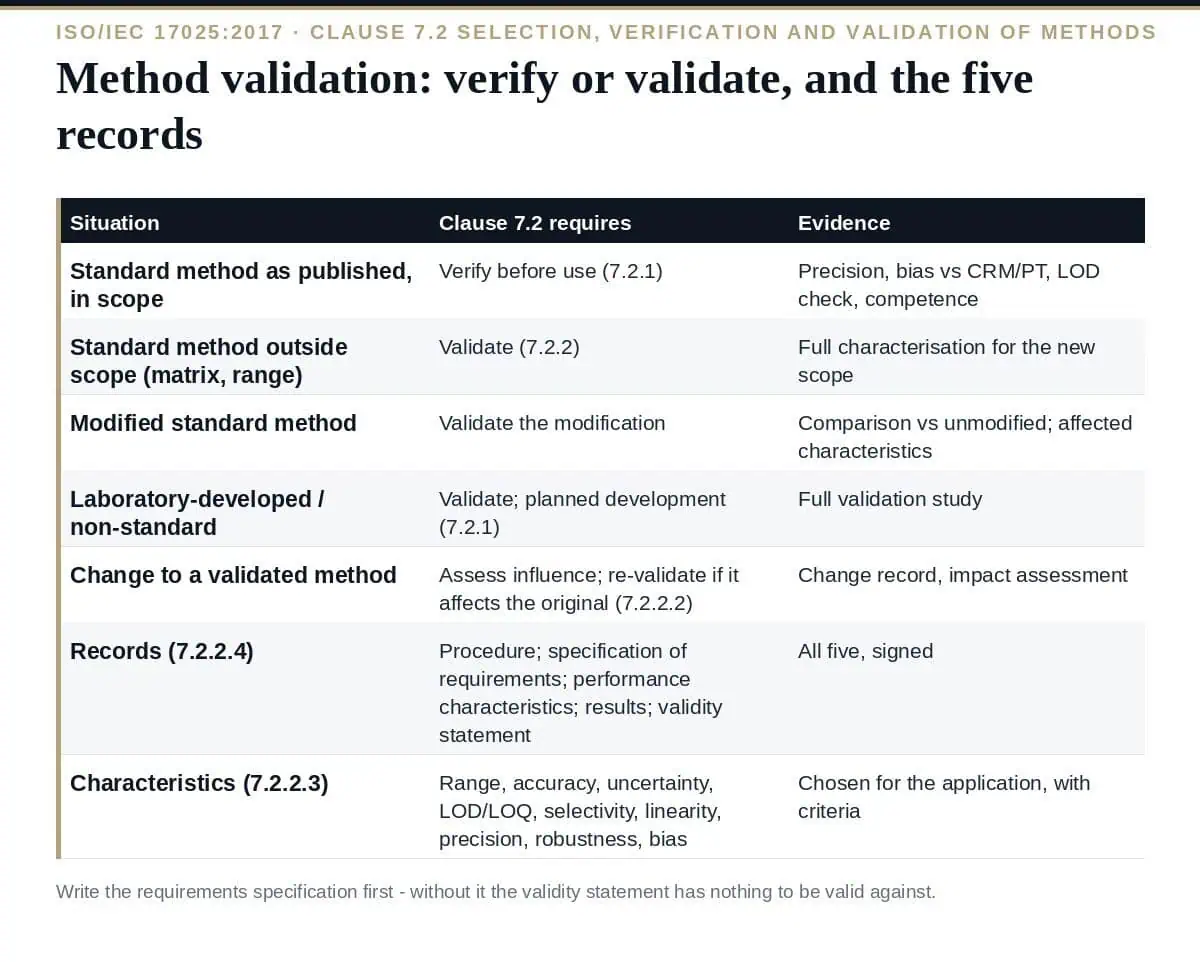
| Situation | What clause 7.2 requires | Typical evidence |
|---|---|---|
| Standard method (ISO, ASTM, pharmacopoeia, regulatory) used as published, within its scope | Verification under 7.2.1: confirm the laboratory can achieve the method’s stated performance before introducing it; records retained | Precision, bias against a reference material or PT sample, LOD/LOQ check, analyst competence |
| Standard method with the latest edition change | Re-verify the affected aspects; the laboratory uses the latest valid version unless inappropriate | Gap review of the edition change, targeted re-verification |
| Standard method used outside its intended scope (matrix, range, analyte) | Validation under 7.2.2 | Full performance characterisation for the new scope |
| Modified standard method | Validation under 7.2.2 of the modification and its effect | Comparison against the unmodified method; affected characteristics |
| Laboratory-developed or non-standard method | Validation under 7.2.2, planned as a development activity with responsibilities and stages | Full validation study |
| Change to a validated method | Determine the influence of the change; re-validate where it affects the original validation | Change record, impact assessment, targeted re-validation |
The boundary follows the method’s authority, not its difficulty. A published method run exactly as written on the matrix and range it was written for needs verification; the moment the laboratory changes the method, the matrix, the range or the purpose, it owns the method and owes a validation. Our guide to ISO 17025 covers where laboratories lose findings; 7.2 is high on the list.
Clause 7.2.2.3 lists the performance characteristics a validation can include — the choice depends on the method and the application — and a validation plan states which apply and the acceptance criterion for each.
| Characteristic | What it answers | How it is typically established |
|---|---|---|
| Measuring range | Over what interval does the method work? | Calibration across the range; linearity or fit-for-purpose response |
| Accuracy (trueness) | How close is the result to the true value? | Certified reference materials, spiked samples, comparison with a reference method |
| Measurement uncertainty | How large is the interval around the result? | A budget from the validation data and other contributions |
| Limit of detection and limit of quantification | What is the smallest amount the method can detect, and measure reliably? | Blank and low-level replicates |
| Selectivity | Does the method respond to the analyte and not to interferents? | Interference and matrix studies |
| Linearity | Is the response proportional over the range? | Multi-level calibration and residual analysis |
| Repeatability and reproducibility | How consistent are results within a run, and between runs, analysts, days or instruments? | Replicate studies under repeatability and intermediate-precision conditions |
| Robustness | How sensitive is the method to small changes in conditions? | Deliberate variation of parameters |
| Bias | Is there a systematic offset? | Reference materials and interlaboratory comparison |
The uncertainty row is the bridge to clause 7.6: validation data is the main input to the budget, and a validation that establishes precision without capturing the other contributions produces a budget built from repeatability alone. Our guide to measurement uncertainty covers that trap.
Record 2 is the one most often missing. Without a specification of requirements, the validity statement has nothing to be valid against, and an assessor reading “the method is validated” will ask “for what”.
Clause 7.2.1 requires method development to be a planned activity, assigned to competent personnel, with periodic review to confirm the customer’s needs are still being met, and with modifications approved and authorised. Clause 7.2.2.2 requires that when changes are made to a validated method, the influence of the changes is determined and, where it affects the original validation, a new validation is performed. The practical mechanism is a method register with a validation status per method and a change control that routes every modification through an impact assessment: instrument replaced, reagent supplier changed, software updated, matrix added. Our guide to proficiency testing covers the ongoing evidence that a validated method stays valid.
What is method validation under ISO 17025?
The confirmation, required by clause 7.2.2 of ISO/IEC 17025:2017, that a non-standard, laboratory-developed, out-of-scope or modified standard method meets the requirements of its intended use, established through performance characteristics such as range, accuracy, uncertainty, detection and quantification limits, selectivity, linearity, precision, robustness and bias, and recorded with a statement of validity.
What is the difference between verification and validation?
Verification (7.2.1) confirms the laboratory can perform a standard method as published and achieve its stated performance; validation (7.2.2) establishes the performance of a method the laboratory has developed, modified or is using outside its published scope.
Which performance characteristics are required?
Clause 7.2.2.3 lists candidates — range, accuracy, uncertainty, LOD and LOQ, selectivity, linearity, repeatability and reproducibility, robustness, bias — and the laboratory selects those the application needs, stating the acceptance criterion for each.
What records must be kept?
Clause 7.2.2.4: the validation procedure, the specification of requirements, the determination of performance characteristics, the results obtained, and a statement on the validity of the method for its intended use.
When must a method be re-validated?
When changes are made to a validated method and the assessment of their influence shows they affect the original validation — a new instrument, matrix, reagent source or software version are the usual triggers.
Draw the method validation line where clause 7.2 draws it — verify what you run as published, validate what you own — write the requirements before the data, choose characteristics the application needs, keep the five records, and route every change through an impact assessment. The assessor’s first question is not whether the method works; it is what you required of it and how you proved it.
The Method Selection and Verification Procedure, the Method Validation Procedure, the Laboratory Developed Method Control Procedure and the Method Register and Validation Status are in the ISO 17025 Toolkit, or start with the free templates.

September 21, 2026
September 21, 2026

September 20, 2026
September 20, 2026
September 19, 2026

