CART
Laboratory quality indicators are the measures a medical laboratory uses to show that its processes are performing — sample rejection rates, turnaround times, critical result notification times, EQA performance, corrected reports — and ISO 15189:2022 keeps them where the 2012 edition put them: as a required evaluation tool, now at clause 8.8.2 within 8.8 Evaluations, with a link to the objectives in clause 5.5. The requirement is short and the failure mode is consistent. Laboratories collect indicators because the standard asks for them, report them at management review because the standard asks for that too, and never set the target, the review interval or the action that turns a number into a decision. This guide sets out what clause 8.8.2 asks for, the eight indicators that cover the examination pathway from request to report, how to define each so it can be acted on, where the indicator set connects to the rest of the 2022 edition, and the four ways an indicator programme fails assessment.
Clause 8.8 of ISO 15189:2022 covers evaluations — 8.8.1 general, 8.8.2 quality indicators, 8.8.3 internal audits — and UKAS’s transition gap analysis maps the 2012 requirement at 4.14.7 to both 8.8.2 and to 5.5, objectives and policies, grading the change as minor. The substance carried over: the laboratory establishes quality indicators to monitor and evaluate performance throughout the critical aspects of the pre-examination, examination and post-examination processes; plans the process for each — purpose, methodology, interpretation, limits, action plan and duration of measurement; and reviews the indicators periodically so that they remain appropriate. The link to 5.5 is the part most programmes miss: an indicator with no objective behind it is data, and an objective with no indicator is a wish. Our guide to ISO 15189 covers the clause structure the indicators sit in.
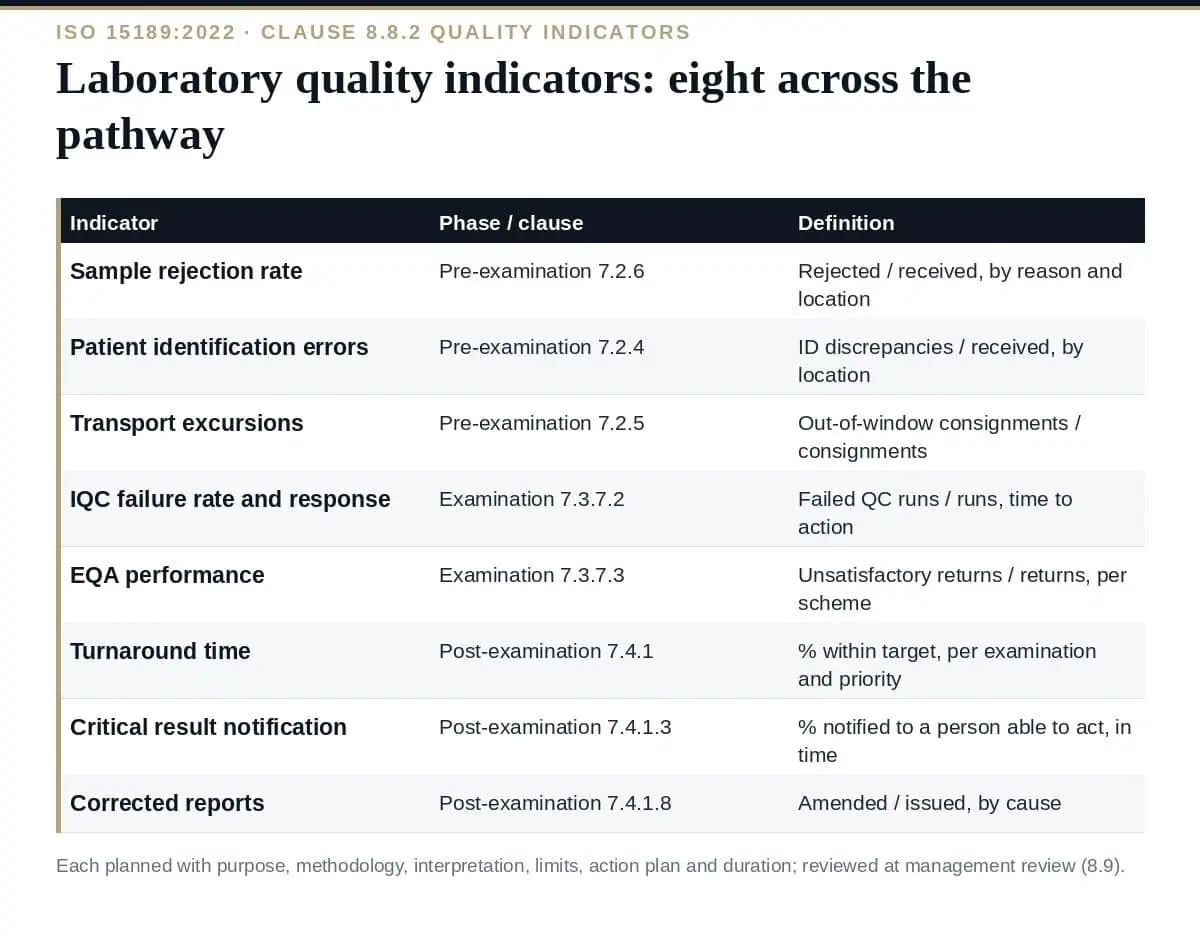
| Indicator | Phase | Definition that can be acted on | Typical target and interval |
|---|---|---|---|
| Sample rejection rate | Pre-examination (7.2.6) | Samples rejected ÷ samples received, by reason (haemolysed, clotted, insufficient, unlabelled, wrong container) and by requesting location | Set per specimen type; reviewed monthly by location |
| Patient identification errors | Pre-examination (7.2.4) | Samples with an identification discrepancy detected at receipt or later ÷ samples received, by location; transfusion samples tracked separately | Zero tolerance for transfusion; monthly |
| Transport excursions | Pre-examination (7.2.5) | Consignments outside the specified temperature or time window ÷ consignments, by route | Per route; monthly |
| IQC failure rate and response | Examination (7.3.7.2) | QC runs failing the defined rule ÷ QC runs, per analyte, with the time to documented action | Per analyte; weekly review, monthly trend |
| EQA performance | Examination (7.3.7.3) | Unsatisfactory EQA returns ÷ returns, per scheme, with the time to investigation close | Zero unsatisfactory without investigation; per distribution |
| Turnaround time | Post-examination (7.4.1) | Percentage of results reported within the published target, measured from sample receipt (and from collection where recorded), per examination and priority | e.g. 90–95% within target; weekly for urgent, monthly for routine |
| Critical result notification | Post-examination (7.4.1.3) | Critical results with documented notification to a person able to act, within the defined time, ÷ critical results | 100% notified; time target per analyte; monthly |
| Corrected reports | Post-examination (7.4.1.8) | Reports amended after release ÷ reports issued, by cause (analytical, clerical, transcription) | Trend-based; monthly |
Eight laboratory quality indicators are a working set, not a ceiling; clause 8.8.2 asks for coverage of the critical aspects of all three phases, and a laboratory with a large point-of-care estate adds a POCT indicator — operator competence currency, device QC compliance — because POCT is inside scope since ISO 22870 was absorbed. Our guides to pre-analytical errors and critical value reporting cover the two indicators that most often expose a real patient-safety gap.
Clause 8.8.2 asks the laboratory to plan each indicator’s purpose, methodology, interpretation, limits, action plan and duration of measurement. A definition that satisfies that list has six parts.
| Clause | Connection |
|---|---|
| 5.5 Objectives and policies | Each indicator monitors an objective; each objective has at least one indicator. UKAS maps the 2012 quality-indicator requirement to both clauses |
| 5.6 Risk management | Indicators are the monitoring arm of risk treatment; a risk to patients accepted with a control should have an indicator on the control |
| 7.5 Nonconforming work and 8.7 Corrective actions | A breached limit is a nonconformity; the action plan names the route |
| 8.6.2 Patient, user and personnel feedback | Complaints and feedback volumes are themselves indicators, and validate the others |
| 8.8.3 Internal audits | The audit programme is risk-based; indicator trends are an input to where audits go |
| 8.9 Management reviews | Indicator results, trends and actions are a required input; the review records the decisions taken on them |
What are laboratory quality indicators under ISO 15189?
Measures the laboratory establishes under clause 8.8.2 of ISO 15189:2022 to monitor and evaluate performance across the critical aspects of the pre-examination, examination and post-examination processes, each planned with a purpose, methodology, interpretation, limits, action plan and measurement duration, and reviewed periodically.
How many indicators are needed?
The standard sets no number; it requires coverage of the critical aspects of all three phases. Eight across the pathway — rejection, identification, transport, IQC, EQA, turnaround, critical result notification and corrected reports — is a workable core, extended for POCT and specialist disciplines.
Which clause is it in the 2022 edition?
8.8.2, within 8.8 Evaluations, alongside 8.8.3 internal audits. UKAS’s transition gap analysis maps the 2012 requirement at 4.14.7 to 8.8.2 and to 5.5 objectives and policies.
Do indicators need targets?
Yes. The clause requires limits and an action plan; an indicator without a limit cannot be evaluated, and a breached limit with no action is a finding.
How often should they be reviewed?
Operationally at a cadence matched to the process — weekly for urgent turnaround and IQC, monthly for most — and at management review under 8.9; the indicator set itself is reviewed periodically for continued appropriateness.
Build laboratory quality indicators from the objectives and risks, define each with a numerator, denominator, stratification, limit, action route and review interval, extract them automatically, act on breaches through 7.5 and 8.7, and review the set annually. Clause 8.8.2 is short; the assessor’s question — “what did you do when it went red?” — is the whole of it.
The Quality Objectives and Policy Statement, the Risk and Opportunity Register, the Internal Quality Control Procedure, the Results Review and Authorisation Procedure and the ISO 15189 Internal Audit Checklist are in the ISO 15189 Toolkit, or start with the free templates.

September 20, 2026
September 19, 2026

September 19, 2026

September 19, 2026

September 19, 2026

