CART
CRA penalties are set in three tiers by Article 64 of Regulation (EU) 2024/2847, and the top tier is larger than NIS2’s: up to EUR 15 million or 2.5% of total worldwide annual turnover, whichever is higher, for a product that fails the essential cybersecurity requirements of Annex I or a manufacturer that fails its Article 13 obligations or its Article 14 reporting duties. Below that sit EUR 10 million or 2% for the obligations of importers, distributors, notified bodies and the conformity-assessment machinery, and EUR 5 million or 1% for supplying incorrect, incomplete or misleading information to a notified body or market surveillance authority. The fines are imposed by national market surveillance authorities under national rules, they can be stacked on top of a withdrawal or recall, and two carve-outs — for micro and small enterprises that miss a reporting deadline, and for open-source software stewards — narrow who pays. This guide sets out the three tiers with the articles they attach to, the factors that scale a fine, the exemptions, the non-financial measures that arrive first, and when each exposure begins.
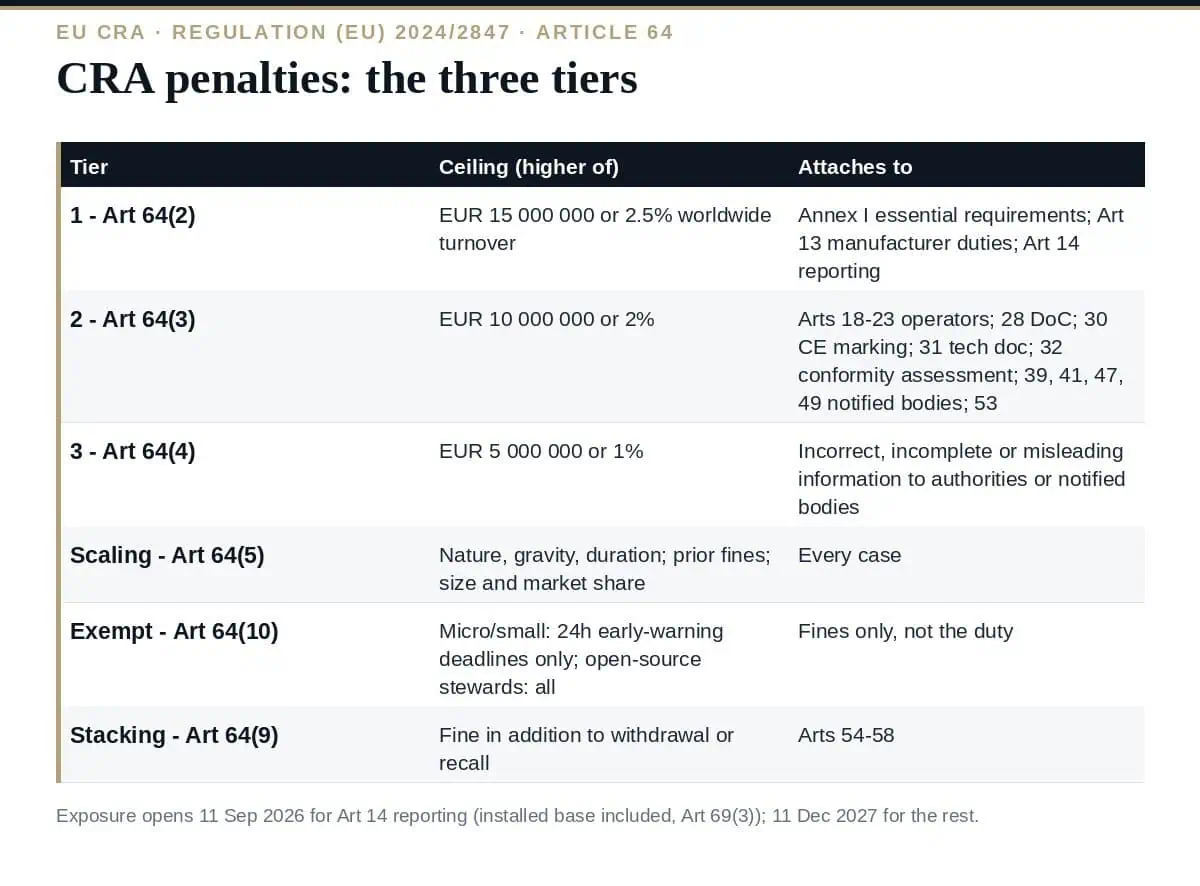
| Tier | Ceiling (whichever is higher) | What it attaches to | Article 64 |
|---|---|---|---|
| 1 | EUR 15 000 000 or 2.5% of total worldwide annual turnover for the preceding financial year | Non-compliance with the essential cybersecurity requirements in Annex I; the manufacturer obligations in Article 13; the reporting obligations in Article 14 | 64(2) |
| 2 | EUR 10 000 000 or 2% | Articles 18 to 23 (authorised representatives, importers, distributors, cases where manufacturer obligations transfer, identification of economic operators); Article 28 (EU declaration of conformity); Article 30(1)–(4) (CE marking); Article 31(1)–(4) (technical documentation); Article 32(1)–(3) (conformity assessment); Article 33(5); Articles 39, 41, 47, 49 (notified bodies); Article 53 (access to data and documentation) | 64(3) |
| 3 | EUR 5 000 000 or 1% | Supplying incorrect, incomplete or misleading information to notified bodies and market surveillance authorities in reply to a request | 64(4) |
Read the CRA penalties tiers by who they reach. Tier 1 is the manufacturer’s tier: a product without an SBOM, shipped with a known exploitable vulnerability, supported for less than the Article 13(8) minimum of five years, or whose actively exploited vulnerability was not notified within 24 hours, all sit here. Tier 2 reaches the rest of the supply chain — an importer that places a non-conforming product on the market, a distributor that fails its verification duties — and the manufacturer’s own paperwork failures around the declaration, the CE marking and the technical documentation. Tier 3 is about candour under investigation. Our guide to the EU CRA covers the obligations the tiers attach to.
Article 64(1) leaves the rules to Member States, requiring only that penalties be “effective, proportionate and dissuasive”, and Article 64(5) lists what must be weighed in every case:
Two structural rules sit alongside. Article 64(6) requires authorities that fine to tell the other Member States’ authorities through the Regulation (EU) 2019/1020 information system, so a fine in one country is known to the others before a similar case there. And Article 64(9) allows fines “in addition to any other corrective or restrictive measures applied by the market surveillance authorities for the same infringement” — the fine and the recall are not alternatives.
| Exemption | Scope | Article |
|---|---|---|
| Micro and small enterprises — reporting deadlines | No administrative fine for missing the 24-hour early-warning deadline for an actively exploited vulnerability (Article 14(2)(a)) or a severe incident (Article 14(4)(a)). The 72-hour notification and the final report are not covered by the exemption | 64(10)(a) |
| Open-source software stewards | No administrative fines for any infringement of the Regulation | 64(10)(b) |
| Public authorities and public bodies | Each Member State decides whether and to what extent fines may be imposed on its own public bodies | 64(7) |
The first exemption is narrower than it is usually reported. A small manufacturer that misses the 24-hour early warning is spared the fine; one that never submits the 72-hour vulnerability notification or the 14-day final report is not. And the exemption is from the fine only — the reporting obligation itself still applies, and Article 14(8)’s duty to inform users still applies.
CRA penalties are the last step of a market-surveillance procedure, not the first. Under Article 54 a national authority that finds a product presenting a significant cybersecurity risk requires the operator to bring it into conformity, withdraw it or recall it within a set period; if the operator does not, the authority takes the measures itself and notifies the Commission and the other Member States. Article 57 allows the same measures for a product that is compliant but still presents a significant risk. Article 58 covers formal non-compliance — CE marking wrongly affixed or missing, no declaration of conformity, technical documentation unavailable — and again leads to withdrawal or recall if not corrected. Article 60 gives authorities the power to run coordinated “sweeps” of product categories. The commercial consequence of withdrawal usually exceeds the fine, which is why the fine tiers are the wrong number to plan around.
| Obligation | Applies from | Fine tier | Note |
|---|---|---|---|
| Article 14 reporting — actively exploited vulnerabilities and severe incidents | 11 September 2026 | Tier 1 | Applies to products already on the market before 11 December 2027 under Article 69(3) |
| Annex I essential requirements; Article 13 manufacturer obligations | 11 December 2027 | Tier 1 | Products placed on the market earlier are caught only on substantial modification, Article 69(2) |
| Importer, distributor, declaration, CE marking, technical documentation, conformity assessment | 11 December 2027 | Tier 2 | |
| Notified body obligations | 11 June 2026 (Chapter IV) | Tier 2 | Articles 39, 41, 47 and 49 |
| Misleading information to authorities or notified bodies | With the obligation being investigated | Tier 3 |
The reporting exposure is the first of the CRA penalties to go live and reaches furthest. From 11 September 2026 a manufacturer with connected products on the EU market — whenever they were placed there — that learns of an actively exploited vulnerability and does not notify within 24 hours is in the top tier, and the exemption in Article 64(10)(a) covers only micro and small enterprises. Our guide to the CRA reporting deadline covers the workflow; the CRA vs NIS2 comparison sets the fines against the NIS2 scale of EUR 10 million or 2%.
What is the maximum fine under the CRA?
Up to EUR 15 million or 2.5% of total worldwide annual turnover for the preceding financial year, whichever is higher, under Article 64(2), for non-compliance with the Annex I essential cybersecurity requirements or the Article 13 and 14 obligations.
Who imposes CRA penalties?
National market surveillance authorities under rules each Member State lays down under Article 64(1); depending on the legal system, national courts may impose them under Article 64(8). Authorities notify each other of fines through the Regulation (EU) 2019/1020 system.
Are small companies exempt?
Only in one respect: Article 64(10)(a) exempts micro and small enterprises from fines for missing the 24-hour early-warning deadlines in Article 14(2)(a) and 14(4)(a). Every other obligation and its fine applies, with size weighed under Article 64(5)(c).
Do open-source projects face fines?
Open-source software stewards face no administrative fines under Article 64(10)(b). A manufacturer that monetises open-source software as a product remains a manufacturer and is fined as one.
Can a fine be added to a recall?
Yes. Article 64(9) allows administrative fines in addition to any corrective or restrictive measures applied for the same infringement.
Plan CRA penalties by tier and by date: the Tier 1 reporting exposure opens on 11 September 2026 for every product already on the market, the Tier 1 product and Tier 2 paperwork exposures open on 11 December 2027, and all of them sit behind withdrawal and recall powers that cost more than the fine. Build the reporting workflow first, document the support period, classify early, and answer authorities in full.
The Reporting Obligations Procedure, the Legacy Product Reporting Readiness Assessment, the Notified Body Engagement Procedure and the EU Declaration of Conformity templates are in the EU CRA Toolkit, or start with the free templates.

September 20, 2026
September 19, 2026

September 19, 2026

September 19, 2026

September 19, 2026

