
CART
No products in the cart.
ISO Compliance Insights & Best Practices
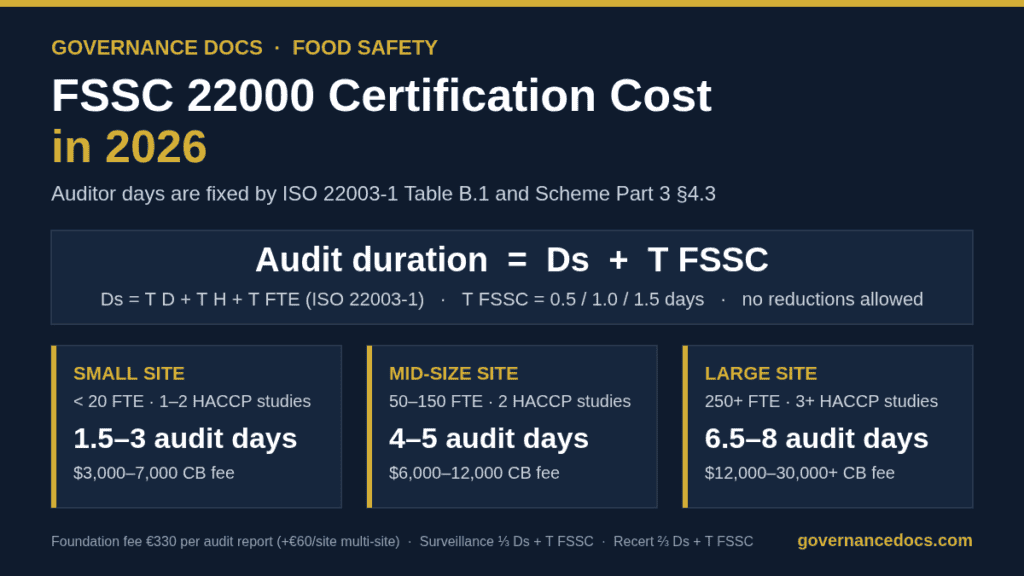
FSSC 22000 certification cost is not a number a certification body pulls out of the air. Almost all of it is auditor days multiplied by a day rate, and the number of auditor days is fixed by two public documents: ISO 22003-1:2022 Annex B and Part 3 of the FSSC 22000 Scheme. Once you know how those two documents count your site, you can predict the audit fee before the first quote arrives, spot a padded proposal, and budget the whole three-year cycle instead of just year one. This guide walks through the calculation, the Foundation’s own fees, the implementation costs nobody publishes, and the Version 7 upgrade that lands in 2027.
For a single food manufacturing site, total first-year FSSC 22000 certification cost typically lands between US$12,000 and US$45,000 once you add implementation to the audit, with the audit itself usually a minority of that. The ranges below are typical figures aggregated from published 2026 guidance by accredited certification bodies and consultancies. They are not a survey and your quote will differ; the point of the table is the shape of the spend, not the decimals.
| Cost component | Small site (under 20 FTE) | Mid-size site (50–150 FTE) | Large or multi-line site (250+ FTE) | Who sets it |
|---|---|---|---|---|
| Initial audit (Stage 1 + Stage 2), auditor days | 1.5–3 days | 4–5 days | 6.5–8 days | ISO 22003-1 Table B.1 + FSSC Part 3 §4.3 |
| Certification body fee, initial audit | $3,000–7,000 | $6,000–12,000 | $12,000–30,000+ | CB day rate × days |
| Foundation FSSC certificate fee | €330 per audit report | €330 per audit report | €330 per audit report (+€60/site multi-site) | Foundation FSSC, fixed |
| Consultant or gap analysis | $0–8,000 | $8,000–18,000 | $15,000–40,000+ | Market |
| Internal time, training, PRP capital fixes | $2,000–8,000 | $5,000–15,000 | $10,000–30,000+ | You |
| Annual surveillance (each of years 2 and 3) | $2,000–4,000 | $3,000–6,000 | $5,000–12,000 | One-third of Ds + FSSC time |
Two things stand out. The certification body is rarely the biggest line, and the only genuinely fixed number on the page is the Foundation’s €330. Everything else is negotiable, and the audit line is predictable if you do the arithmetic yourself.
Part 3 of the Scheme (Requirements for the Certification Process, Version 7, May 2026) defines a single-site audit duration as Ds + TFSSC. Ds is the ISO 22003-1:2022 minimum and TFSSC is the extra time the Scheme adds for its own Additional Requirements.
Ds = TD + TH + TFTE, where:
TFSSC is 0.5 day for sites under 100 FTE with at most two HACCP studies, 1.0 day for 100–249 FTE with at most two studies, and 1.5 days for 250 FTE or more or three or more HACCP studies. The Scheme states that no reductions to Ds or TFSSC are allowed, which matters when a certification body offers a discount: it can cut its day rate, but not the days.
The minimum Ds is one day, and for categories C, D and K the minimum total audit duration is two days. Results are rounded up to the nearest quarter day. Two exemptions exist: sites under 20 FTE with at most two HACCP studies may be brought down to a 1.5-day floor in any category, and subcategory FII (brokering, trading, e-commerce) may also use 1.5 days. Version 7 widened the small-site exemption from one HACCP study to two and dropped the old “simple process” condition, so a small artisan producer with two product families now qualifies where it did not under Version 6.
Part 3 §4.3.1.2 requires at least 0.25 auditor day for preparation and at least 1.0 auditor day for reporting per audit (0.5 day when the delivered audit was 1.5 days). Most certification bodies bundle those into the quote; some itemise them. Either way they are real hours you pay for, and a quote that shows 4.0 days for a 4.0-day calculation has hidden them somewhere else. Travel is always additional.
All three are category C (food manufacturing), where most FSSC 22000 certification cost questions come from.
| Site | Ds calculation | TFSSC | Initial audit | Surveillance (⅓ Ds + TFSSC) | Recertification (⅔ Ds + TFSSC) |
|---|---|---|---|---|---|
| Artisan bakery, 15 FTE, 1 HACCP study | 2.0 + 0 + 0.5 = 2.5 | 0.5 | 3.0 days (CB may reduce toward 1.5) | 2.0 days (category C floor) | 2.25 days |
| Sauce plant, 60 FTE, 2 HACCP studies | 2.0 + 0.5 + 1.0 = 3.5 | 0.5 | 4.0 days | 2.0 days (1.67 rounds to 1.75, floor lifts it to 2.0) | 3.0 days |
| Dairy, 300 FTE, 4 HACCP studies | 2.0 + 1.5 + 2.0 = 5.5 | 1.5 | 7.0 days | 3.5 days | 5.25 days |
Now price the middle row. Published certification-body day rates for food safety audits in 2026 typically run US$1,200–2,000 in North America and £850–1,500 in the UK, with lower rates in South and Southeast Asia. Four audit days plus 1.25 days of preparation and reporting is 5.25 auditor days, so the initial audit fee sits around $6,300–10,500 before travel. Across the three-year cycle the same site buys 4.0 + 2.0 + 2.0 = 8.0 audit days, roughly two to two-and-a-half times the initial fee, which is the same ratio you will find on any ISO certification cost page. The 60-FTE site also pays the Foundation €330 three times in the cycle, once per uploaded report.
From 1 January 2026 the Foundation FSSC charges a certificate fee of €330 per uploaded audit report, payable by the certified organisation through its certification body, plus €60 per site listed under a multi-site certificate at initial, renewal and surveillance audits. The fees apply per scheme and cannot be combined. The certification body itself pays the Foundation an annual licence fee of €7,500 to €15,500 depending on how many reports it uploads, which it recovers through its day rate. All of this is published on the Foundation’s requirements for licensed certification bodies page, so if a proposal shows a “scheme registration fee” of several thousand, ask what it covers. The Foundation’s own charge for a single-site certificate is €330 per audit, and it lands on every audit in the cycle, not just the first.
If you are weighing FSSC 22000 against plain ISO 22000, the audit-fee difference is smaller than most people expect, because Ds is the same ISO 22003-1 calculation for both. The differences are TFSSC, the Foundation fee, and the audit programme.
| Line | ISO 22000:2018 only | FSSC 22000 Version 7 |
|---|---|---|
| Base audit days (Ds) | ISO 22003-1 Table B.1 | Same |
| Scheme additional time | None | +0.5, 1.0 or 1.5 days per audit |
| Scheme owner fee | None | €330 per audit report (+€60/site multi-site) |
| Unannounced audits | Not required | At least one unannounced surveillance audit every three-year cycle |
| Prerequisite programme standard | Guidance only (ISO 22000 clause 8.2.3 says “should”) | Mandatory ISO 22002 part for your category |
| Additional Requirements | None | 18 groups, 66 lettered requirements in Part 2 |
| GFSI recognition | No | Yes |
For the 60-FTE sauce plant that is roughly 1.5 extra auditor days across the cycle plus €990 in Foundation fees, against a GFSI-recognised certificate that most major retailers and brand owners accept in place of their own supplier audits. Our post on FSSC 22000 vs ISO 22000 covers the non-cost side of that decision. The real cost gap is in implementation: the mandatory ISO 22002 prerequisite programmes and the 18 Additional Requirement groups are where a site that is “ISO 22000 ready” discovers it is not FSSC ready.
Consultant and internal figures vary far more than audit fees because they depend on how far the site is from a working system today. Published 2026 guidance from food safety consultancies puts implementation support at roughly US$5,000–20,000 for a small to mid-size manufacturer on a fixed-fee basis, or $150–350 per hour, with large or multi-line plants at $15,000–40,000 or more. Those are labelled typical ranges, and the cheap end is worth scrutiny: packages under about $3,000 that promise full readiness usually ship generic templates that fall over at Stage 2.
The items that actually drive the number:
A documentation pack removes the drafting cost from the equation and lets your team spend their hours on the plant floor instead of on Word. The FSSC 22000 Toolkit covers ISO 22000:2018, the PRP layer and all 18 Additional Requirement groups in 111 templates for $99, which is less than one auditor hour.
Part 3 §5.2 and §5.3 add time that single-site guides skip. Each off-site storage or cross-docking facility adds at least 0.25 auditor day. A satellite manufacturing site is calculated separately, with up to a 50% reduction of its Ds, and travel between sites is extra. Head office functions such as procurement, supplier approval and product development that are controlled away from the site must be audited and included in the site’s certification, which can mean a separate head office visit.
Formal multi-site certification with sampling is only available in subcategories BIII, E, FI, FII and G, so a group of factories cannot sample: every manufacturing site is audited every year on its own calculation. Where multi-site does apply, the central function is priced at the full Ds (one-third and two-thirds at surveillance and recertification, never under 1.0 day), each site gets 50% of its Ds plus TFSSC with a 1.5-day floor, all sites are audited up to 20 sites, and above that the sample is 20 plus the square root of the remainder. Add the €60 per-site Foundation fee on top.
The Foundation published FSSC 22000 Version 7 in May 2026. Audits against Version 6 are allowed until 30 April 2027; upgrade audits against Version 7 run from 1 May 2027 to 30 April 2028; certification bodies must complete the upgrade in the Assurance Platform by 30 June 2028; and any Version 6 certificate still standing after that date is automatically withdrawn. The four dates are separate clocks and the last one is the expensive one, because a withdrawn certificate means a full initial audit, not a surveillance visit.
The upgrade audit is a full audit against Version 7, delivered at the next scheduled surveillance or recertification audit in the window, so there is no standalone transition fee in the Scheme. What does change is the audit duration calculation itself: the Upgrade Process document requires certification bodies to recalculate every certified organisation’s duration under Version 7 and issue a new contract or an addendum. Ask for that recalculation now rather than discovering it on the 2027 invoice. Our Version 7 transition guide lists what changed in Part 2 so you can price the documentation work alongside the audit.
For the implementation side, our complete FSSC 22000 certification guide covers the sequence from gap analysis to certificate, and the Additional Requirements breakdown shows which of the 18 groups apply to your food chain category, which is where most of the unbudgeted work hides.
For a single site under 20 FTE with one or two HACCP studies, the audit runs 1.5–3 auditor days, so the certification body fee is typically US$3,000–7,000 for the initial audit plus €330 to the Foundation, with annual surveillance at $2,000–4,000. Implementation is the larger and less predictable part; a self-implementing site with a documentation pack can keep first-year total FSSC 22000 certification cost near $8,000–15,000, while one that needs consultant support and PRP building work will spend $15,000–30,000.
At the audit, only slightly: the same ISO 22003-1 base calculation applies to both, and FSSC adds 0.5–1.5 auditor days per audit, a €330 fee per audit report, and one unannounced surveillance audit per cycle. The real difference is implementation, because FSSC makes the ISO 22002 prerequisite programme standard mandatory and adds 18 groups of Additional Requirements that ISO 22000 alone does not contain.
No. The upgrade is a full Version 7 audit delivered at a scheduled surveillance or recertification audit between 1 May 2027 and 30 April 2028. Your audit duration will be recalculated under the Version 7 rules, and your certification body must issue a new contract or addendum reflecting it, so the days can move even though there is no transition surcharge in the Scheme.
Each surveillance audit is one-third of your Ds plus the FSSC time, never below the category floor, plus preparation and reporting and the €330 report fee. For a typical mid-size manufacturer that is 2–3 auditor days, or roughly $3,000–6,000 a year, plus the internal cost of running internal audits, management review, environmental monitoring and the other Additional Requirement records year-round. Budget the three-year cycle at two to two-and-a-half times the initial audit fee.
Not below the calculated minimum. Part 3 §4.3.1.1 states that no reductions to Ds or TFSSC are allowed, and the only exemptions are the sub-20-FTE and FII floors. What you can negotiate is the day rate, travel terms, whether preparation and reporting are itemised, and combined-audit reductions where you hold another certification with the same body.
Run the calculation above for your own site before you request quotes: category, HACCP studies, FTE, and the TFSSC band. That gives you the auditor days every accredited certification body must reach, and a quote that lands far from it is telling you something. Then spend the budget where the audit is actually won or lost, on the prerequisite programmes and the Additional Requirements, rather than on documentation that a ready-built FSSC 22000 Toolkit already covers. The Scheme documents themselves are free from the Foundation FSSC; the only thing you need to buy from ISO is ISO 22000:2018 and the ISO 22002 part for your category.

September 15, 2026
September 14, 2026
September 14, 2026

September 14, 2026
September 14, 2026
