CART
A data steward is the role that makes data governance operational rather than aspirational. Owners decide, stewards do — and programmes that appoint one without the other either produce decisions nobody implements or work nobody has authorised.
This guide separates the four roles that get confused, covers what a steward actually does week to week, how many you need, and why the job title is less important than the decision rights behind it.
Free gap assessment
How mature is your data management, area by area?
Score all eleven DAMA knowledge areas, free, plus the ethics, AI and organisational change chapters that sit off the wheel.
Run the free data governance maturity assessment → or View premium report sample
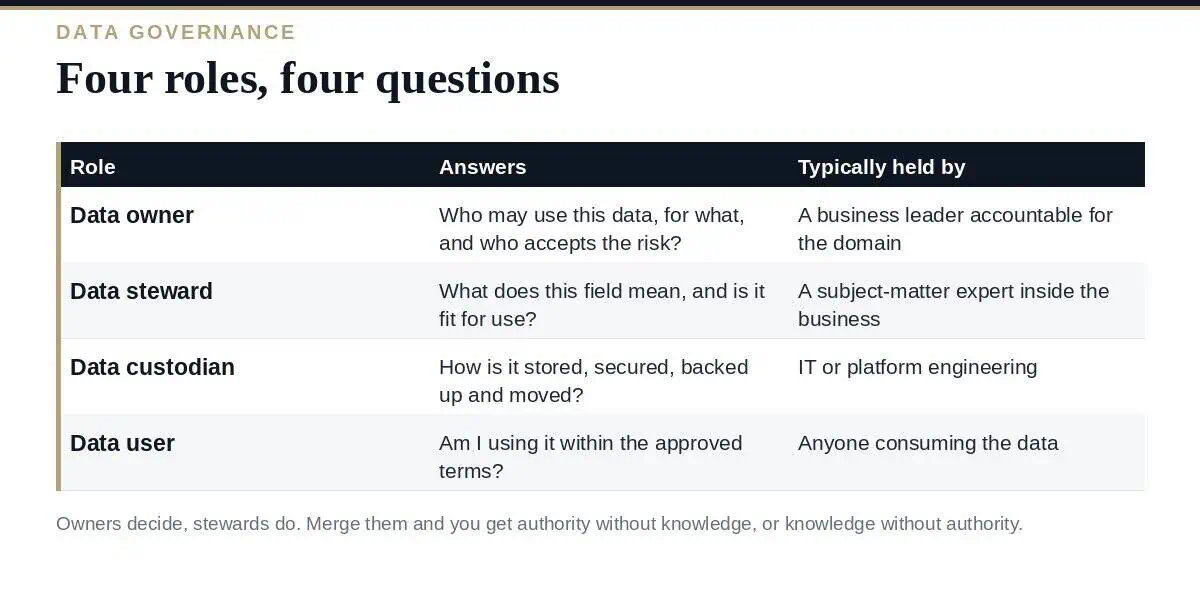
| Role | Answers | Typically held by |
|---|---|---|
| Data owner | Who may use this data, for what, and who accepts the risk? | A business leader accountable for the domain |
| Data steward | What does this field mean, and is it fit for use? | A subject-matter expert inside the business |
| Data custodian | How is it stored, secured, backed up and moved? | IT or platform engineering |
| Data user | Am I using it within the terms it was approved for? | Anyone consuming the data |
The distinction that matters most is owner against steward. The owner has authority and rarely has time; the data steward has knowledge and needs the owner’s authority to make it count. Merge them and you get a senior person who cannot answer questions about the data, or a specialist making decisions they cannot defend.
Appointing a data steward with no time allocation is the most reliable way to kill a governance programme. The work is real — a domain of any size is a day a week at minimum — and stewards appointed on top of a full job will do the urgent thing instead, every time. The second failure is appointing someone without domain credibility: the role runs on persuasion, and a steward whose definitions are ignored has no other lever.
Steward by data domain — customer, product, employee, finance, asset — rather than by system or by department. Systems change; domains do not. One steward per domain, with named deputies, is enough for most organizations; large domains split by sub-domain rather than by geography.
Two models work in practice. Federated: stewards stay in the business, report to their line manager, and are coordinated by a central function. Centralised: stewards sit in a data office and partner with the business. Federated keeps domain knowledge and struggles with consistency; centralised is consistent and drifts away from how the business actually works. Federated with a strong central standard is the common middle, and it is the one that survives reorganisations.
What does a data steward do?
Defines and maintains the meaning, business rules and quality of data within a domain, monitors it, triages issues and advises the owner on use — the operational half of data governance.
How is a data steward different from a data owner?
The owner holds accountability and decision rights; the steward holds the knowledge and does the work. The owner approves; the steward proposes and maintains.
Is it a full-time job?
Sometimes, in large domains. More often it is a defined portion of an existing role — but it has to be defined, or it will not happen.
Do we need stewards to comply with privacy law?
No regime requires the title. Several require the outcomes stewards produce — knowing what data you hold, what it means, where it came from and who may use it — which is why privacy programmes end up building stewardship whether they call it that or not.
Where does the DMBOK fit?
It is the standard reference for the knowledge areas and roles, and a useful vocabulary. Our guide to data governance and the DMBOK covers what it is and is not.
Appoint a data steward per domain, pair each with a named owner who holds the decision rights, and write down which decisions belong to which. Allocate real time, pick people whose domain judgement the business already trusts, and measure the role on something operational rather than on documents produced. Start with the domain causing the most rework — one working stewardship model teaches you more than a complete framework nobody is staffed to run.
Role descriptions, decision-rights matrices and the stewardship charter are in the Data Governance Toolkit, or start with the free ISO templates.

October 24, 2026
October 23, 2026
October 23, 2026
October 22, 2026
October 22, 2026

