CART
An integrated management system manual is the one document that explains how a single set of processes satisfies several ISO standards at once. Nothing in ISO 9001, ISO 14001 or ISO 45001 requires you to write one — the mandatory quality manual disappeared in 2015 — and organizations running two or more standards write one anyway, because without it nobody can see the system whole.
This guide covers what the manual should contain, how the harmonized structure makes it possible, and how to keep it from becoming the thickest unread document you own.
Free gap assessment
Are you ready for the 2026 edition of ISO 9001?
Score yourself against the new edition, free, including the risk and opportunity split and the clause 10 renumbering that breaks converted checklists.
Run the free ISO 9001 gap assessment → or View premium report sample
ISO 9001:2015 removed the requirement for a quality manual, and the standards written since have not brought it back. What replaced it is “documented information” — keep what you need, prove what you claim.
That works for a single standard. It stops working when one process serves three: an internal audit programme covering quality, environment and safety; one risk process; one corrective action route; three certificates. An integrated management system manual is where you state, once, which process meets which requirement in which standard — so an auditor arriving for ISO 45001 can see what is shared and what is specific without you rebuilding the explanation each time.
Modern ISO management system standards are written to a common skeleton — clauses 4 to 10, with identical core text and shared definitions. It is set out in Annex SL of the ISO/IEC Directives, and the 2021 edition renamed what everyone had been calling the high level structure to the harmonized structure.
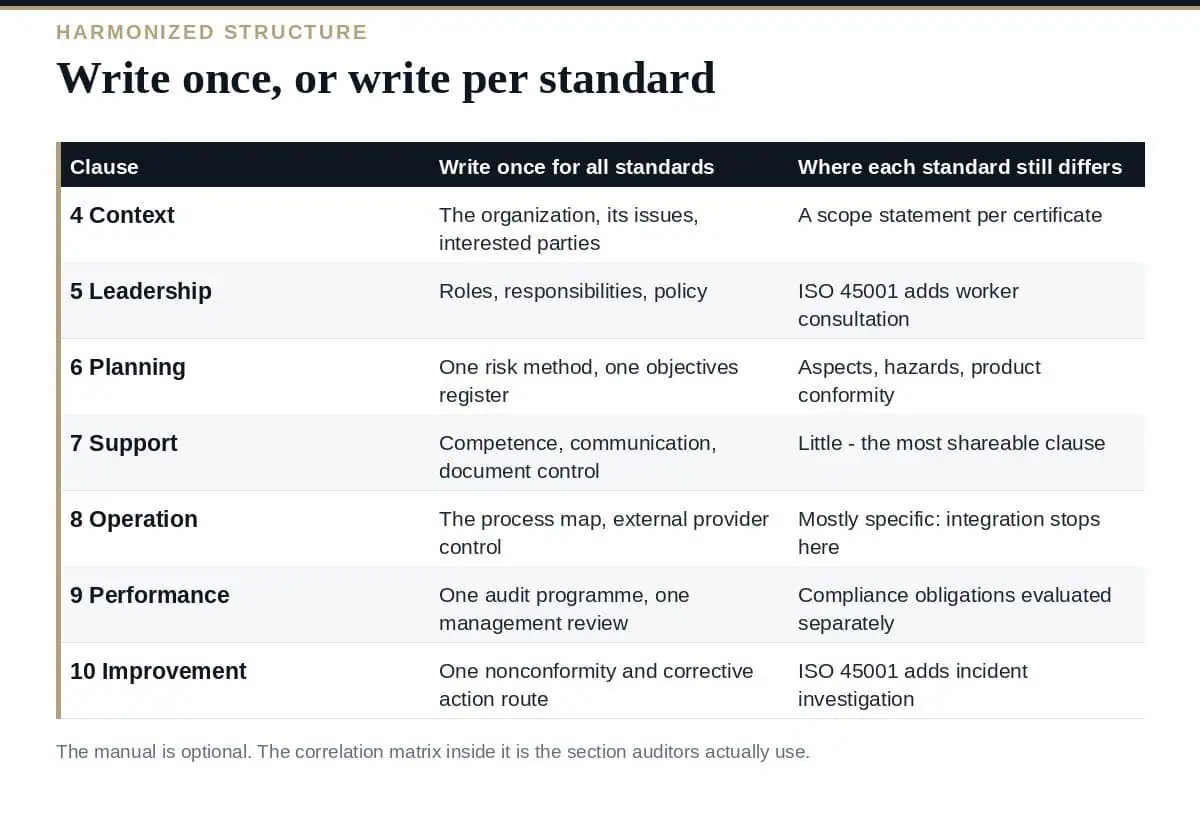
Practically, that means these clauses can be answered once for the whole organization:
| Clause | Write once for all standards | Where each standard still differs |
|---|---|---|
| 4 Context | The organization, its issues, interested parties | Scope statement per certificate; environmental and OH&S parties differ |
| 5 Leadership | Roles, responsibilities, one combined policy or three aligned ones | ISO 45001 adds worker consultation and participation |
| 6 Planning | One risk and opportunity method, one objectives register | Environmental aspects; hazard identification; product conformity |
| 7 Support | Competence, awareness, communication, document control | Little — this is the most shareable clause |
| 8 Operation | The process map and external provider control | Mostly standard-specific: this is where integration stops |
| 9 Performance | One audit programme, one management review | Compliance obligations evaluated separately per standard |
| 10 Improvement | One nonconformity and corrective action process | ISO 45001 adds incident investigation |
A manual for three standards can run to twenty pages or to two hundred. The short one gets read, gets updated, and points to the procedures that carry the detail. The long one duplicates those procedures, drifts out of step within a year, and creates findings when the two versions disagree. Write the integrated management system manual as a map, not as a library.
The matrix has not kept up. Clause references left pointing at a superseded edition of a standard are the fastest way to lose auditor confidence in the whole document.
Integration claimed, not performed. A manual describing a single audit programme, with three separate audit schedules run by three teams who never meet, describes an organization that does not exist.
Scope written to be impressive. A scope covering sites that were never audited will surface at the first surveillance visit. It should match the certificate, exactly.
Is an integrated management system manual mandatory?
No. ISO 9001:2015 dropped the mandatory quality manual and no current management system standard requires one. It is kept because it is useful, particularly to auditors and new starters.
Can one manual cover ISO 9001, ISO 14001 and ISO 45001?
Yes, and that is the usual reason for writing one. The harmonized structure means clauses 4 to 7, 9 and 10 can be answered once, with standard-specific content concentrated in clause 8.
Do we need one policy or three?
Either is acceptable. A combined policy must genuinely address each standard’s requirements — an environmental commitment cannot be implied by a quality statement.
Will one manual get us one audit?
It helps, but the certification body decides. Combined audits are normal where the same body certifies all the standards; audit days are reduced, not merged into one.
How often should it be reviewed?
At least annually, and whenever scope, sites, standards or the process map change. Tie the review to management review so it has a fixed date.
Build the integrated management system manual around the correlation matrix and the process map, keep the shared procedures outside it, and be honest about where the standards diverge instead of forcing everything into common text. Match each scope to its certificate word for word, review it with management review once a year, and resist length — the manual’s job is to let somebody find the answer, not to contain every answer.
Manual templates, correlation matrices and the shared procedure set are in the IMS Toolkit, or start with the free ISO templates.

October 24, 2026
October 24, 2026
October 23, 2026
October 23, 2026
October 22, 2026

