CART

Food safety culture became an auditable requirement rather than a management aspiration, and it is the one FSSC 22000 requirement most sites cannot satisfy by writing a document. It asks for objectives, a plan with targets and timelines, and performance measurement across every part of the organisation that affects food safety — not just production.
That last clause is what turns it from a poster campaign into an organisational change.
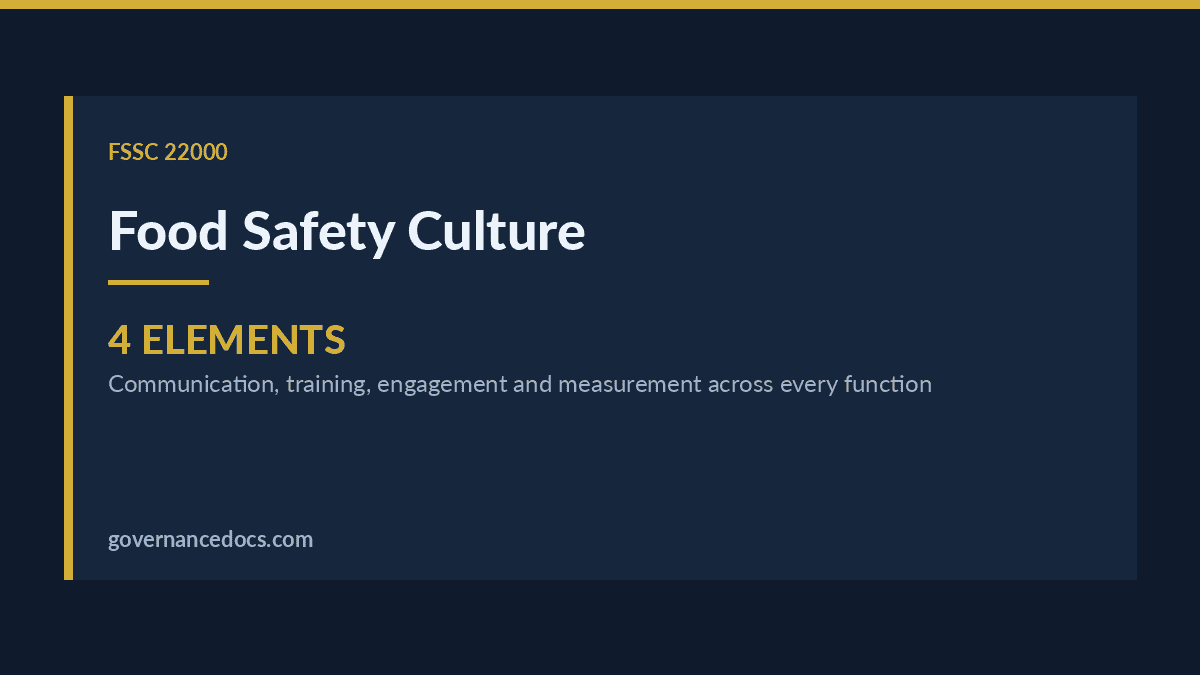
FSSC 22000 Additional Requirement 2.5.8 sits alongside ISO 22000 clause 5.1 and adds three obligations.
Senior management must establish, implement and maintain food safety and quality culture objectives as part of the management system, and resource them. Those objectives must address four elements as a minimum:
The objectives must be supported by a documented food safety culture plan with targets and timelines, included in management review and continual improvement. And a demonstrable commitment from all personnel to the production and safe handling of food must be available.
A food safety culture programme confined to the production floor does not meet element four, and this is where most sites fall short.
Engineering decides whether a temporary repair becomes permanent. Procurement decides whether to accept a cheaper supplier with thinner assurance. Planning decides whether the schedule leaves time for a proper allergen changeover. Commercial decides whether to promise a customer a date that forces a shortcut. HR decides how quickly a vacancy on the hygiene team is filled.
Every one of those is a food safety decision taken outside the food safety team, and every one needs a measure. If your culture dashboard only reports on production, it is measuring the function with the least discretion.
The requirement says targets and timelines explicitly. An activity list without a numeric target and a date does not satisfy it on the requirement’s own wording, whatever else the plan contains.
| Element | Weak objective | Auditable objective |
|---|---|---|
| Communication | Improve food safety communication | Publish food safety performance to all shifts monthly; 90% of staff able to state current performance by Q3 |
| Training | Deliver annual training | 100% allergen-area staff pass area-specific assessment within 30 days of assignment |
| Feedback and engagement | Encourage reporting | Raise concerns reported per 100 staff from 4 to 10 per quarter; median closure 10 working days |
| Performance measurement | Monitor food safety KPIs | Every function affecting food safety reports one measure monthly; baseline set Q1, all reporting by Q3 |
The most informative measure a site has is the number of concerns raised through a confidential route — and the direction people usually read it backwards.
A rising count of raised concerns is generally good. It means people believe reporting works. A fall to zero is a warning, not a success: it almost always means the last few reports went nowhere, or somebody was made to regret raising one.
Useful food safety culture measures share a shape — they are behavioural, they are collected routinely, and they cannot be improved by writing anything:
An anonymous survey is the standard instrument for food safety culture, and it is worth doing properly. Ask about behaviour rather than knowledge — people know the right answer to a knowledge question and will give it.
Questions that produce usable signal:
Then publish the results — including the uncomfortable ones. A survey whose findings are never shared will not be answered honestly a second time, and you will have destroyed your own instrument.
A simple four-level model is enough to make food safety culture assessable without inventing a scoring system nobody trusts.
| Level | What it looks like |
|---|---|
| 1 — Reactive | Food safety is discussed when something has gone wrong |
| 2 — Compliant | Communication and training happen on a schedule, one-way |
| 3 — Proactive | Communication is two-way, performance is published, effectiveness is evaluated |
| 4 — Embedded | People raise concerns early and expect them to be acted on, in every function |
The distance between level 2 and level 3 is exactly what the food safety culture requirement is trying to close — and it is the gap a site is most likely to describe itself across rather than measure. An auditor will look for evidence rather than self-assessment.
Expect the evidence trail to be walked backwards. An auditor typically asks a line operator what the site’s food safety objectives are, then asks how they would raise a concern, then asks for an example of one that was raised and what happened. If the answer stops at “I’d tell my supervisor” with no example, the plan on the wall does not help.
They will also check that culture plan progress reached management review, because the requirement puts it there explicitly. An agenda built from ISO 22000 alone omits it, along with four other FSSC-specific inputs — see our guide to the 18 Additional Requirement groups.
Step 1 is the one that gets skipped, and skipping it makes the whole plan unauditable — a target with no baseline cannot be shown to have been met.
The FSSC 22000 Toolkit includes a food safety culture plan with targets and timelines, a maturity assessment across the four required elements, and a ten-question engagement survey mapped element by element to the requirement.
The business case is rarely made well, so it is worth putting plainly. A weak food safety culture does not usually cause a dramatic failure. It causes a slow accumulation of small permissions.
A changeover shortened because the schedule is tight. A temporary repair left in place because nobody owns replacing it. A monitoring box filled in from memory at the end of a shift. A pest contractor’s recommendation filed rather than actioned. Each of those is individually defensible and collectively is how a recall happens.
There is a diagnostic worth running against your own audit history. Look at whether findings cluster in one area rather than appearing in isolation across the site, and whether the same causes recur from one audit to the next. If your corrective actions keep addressing the instance and the same instance keeps returning, the problem is not the procedure.
One control does more for food safety culture than any other: a route for anyone to raise a concern without fear of consequence, including anonymously, with the outcome communicated back.
It has to be genuinely usable. That means it does not route through the line manager who might be the subject of the concern, it produces an acknowledgement, and the outcome is visible even when the answer is “we looked and there was no issue”. A route that swallows reports silently trains people to stop using it within about two cycles.
Record the number of reports received as a standing measure. It is the closest thing to a leading indicator that a food safety culture programme produces — every other measure tells you about the past.
>Frequently asked questions on food safety culture
ISO 22000 clause 5.1 requires leadership and commitment, and culture is implicit in it. The explicit requirement — objectives, four named elements, a documented plan with targets and timelines — comes from the FSSC Additional Requirements. See our FSSC 22000 vs ISO 22000 comparison for the wider difference.
The Scheme sets no number. What it asks for is performance measurement covering all sections of the organisation impacting food safety and quality, so the practical test is coverage rather than sample size — every function represented, not a fixed percentage of headcount.
You can buy the instruments — survey, maturity model, plan template — and they save real time. What cannot be bought is the part that makes it work: senior management being visibly present, and the first few concerns being acted on where everyone can see it.
Part 2, clause 2.5.8 of the FSSC 22000 Scheme, free from the Foundation at fssc.com. It is about a third of a page, and worth reading in the original before designing anything.
Food safety culture is the requirement least amenable to documentation and most amenable to a few visible decisions. Publish performance honestly, act on the first concerns raised, measure the functions outside production, and set targets with dates. Sites that do those four things pass this requirement without a campaign. Sites that run a campaign without them produce excellent posters and a level 2 culture. For the wider scheme picture, start with our guide to FSSC 22000 certification.


August 31, 2026

August 31, 2026
August 31, 2026
August 31, 2026

August 31, 2026