CART
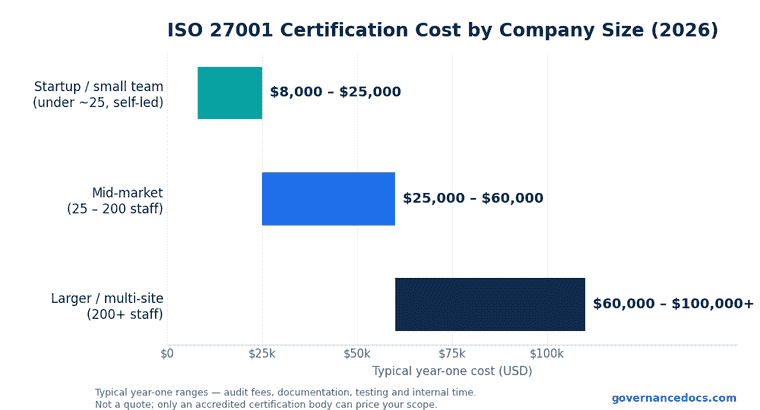
The ISO 27001 certification cost for most organizations runs between $8,000 and $60,000 in the first year, depending on your size, your scope, and how much of the work you do yourself. A small company that writes its own documentation and hires a certification body for the audit can get certified for roughly $8,000 to $25,000. Add a hands-on consultant and a compliance automation platform and the number climbs to $25,000 to $60,000 or more. The single largest cost is usually not the audit itself. It is the internal staff time spent building and running your information security management system (ISMS) before an auditor ever shows up.
Below is the full 2026 breakdown of the ISO 27001 certification cost: every line item, what pushes the price up or down, how to cut it without cutting corners, and how long the whole process takes.
Free gap assessment
Where do you actually stand against ISO 27001?
Score every management system clause and all 93 Annex A controls, free, and get a prioritised gap list back.
| Company profile | Typical year-one spend | What that covers |
|---|---|---|
| Startup / small team (under ~25 in scope), self-led with a documentation toolkit | $8,000 – $25,000 | Certification-body audit, toolkit, basic testing, in-house effort |
| Mid-market (25 – 200 staff), consultant and/or automation platform | $25,000 – $60,000 | Audit, consulting, GRC software, penetration test, training |
| Larger or multi-site (200+ staff) | $60,000 – $100,000+ | Bigger audit scope, dedicated staff, tooling, multiple locations |
Treat these as typical ranges, not quotes. Your real number depends on how many people and locations sit inside your certification scope and how mature your security program already is. Only an accredited certification body can give you a firm ISO 27001 certification cost for your exact scope.
ISO/IEC 27001 is not a single invoice. It is a bundle of one-time and recurring costs, some of which you can do yourself and some of which you cannot. Here is where the money goes.
| Cost item | Typical 2026 range | Can you DIY it? |
|---|---|---|
| Certification-body audit (Stage 1 + Stage 2) | $5,000 – $20,000 | No, must use an accredited body |
| Surveillance audit (years 2 and 3, each) | ~one-third of the initial audit | No |
| Recertification (every 3 years) | ~equal to the initial audit | No |
| Documentation via editable toolkit | $99 – $500 | Yes |
| Documentation + implementation consultant | $5,000 – $40,000+ | Optional alternative to a toolkit |
| Compliance automation platform (Vanta, Drata, and similar) | $7,000 – $25,000 / year | Optional |
| Risk assessment and gap analysis | $0 (DIY) – $6,000 | Yes |
| Internal audit before Stage 2 | $0 (DIY) – $7,500 | Yes |
| Penetration test | $3,000 – $15,000 | Common, not mandatory |
| Staff security-awareness training | ~$50 / employee | Yes |
| Internal staff time | Often the largest true cost | Unavoidable |
This is the one cost you cannot avoid or do in-house. An accredited certification body (also called a registrar) runs a two-stage initial audit. Stage 1 is a review of your documentation and readiness. Stage 2 is the deep assessment of whether your controls actually work in practice. Auditors bill by the day, typically $1,000 to $1,500 per auditor-day in 2026, and rates rose noticeably this year.
The number of audit days is not arbitrary. It is set by international rules (ISO/IEC 27006) tied mainly to how many people fall inside your scope, so you can estimate it before you call anyone.
| People in scope | Typical initial audit days (Stage 1 + Stage 2) |
|---|---|
| 1 – 10 | ~5 |
| 11 – 25 | ~6 – 7 |
| 26 – 45 | ~8 – 9 |
| 46 – 65 | ~10 |
So a 20-person company might see six or seven audit days at around $1,200 each, or roughly $7,000 to $9,000 for initial certification. Stage 1 usually accounts for 20 to 30 percent of that, and Stage 2 the rest.
Then plan for the full three-year cycle, not just the first invoice. Surveillance audits in years two and three each cost about a third of the initial fee, and a full recertification, roughly equal to the initial audit, comes due every three years. If you want to see exactly what an auditor will look for, our guide to preparing for an ISO 27001 audit walks through both stages.
Here is how the ISO 27001 certification cost typically adds up for a 30-person software company that does most of the work in-house, in its first year:
Cash out the door lands around $15,000, most of it the audit and the penetration test. Hire a consultant to run the project and add a GRC platform, and the same company can easily spend $35,000 to $50,000 for an identical certificate. The scope and the audit are the same; the only difference is how much of the work you choose to buy rather than do.
Split your budget into two buckets. The one-time cost is the first-year build: documentation, the risk assessment, gap remediation, and the initial Stage 1 and Stage 2 audit. The ongoing cost repeats every year the certificate is live: an annual surveillance audit (about a third of the initial audit fee), any automation subscriptions you keep, and the internal time to maintain evidence and run your yearly internal audit and management review. Every third year, plan for a larger recertification audit roughly equal to your first one. Most small companies should expect ongoing costs of about $5,000 to $20,000 a year on top of year one.
The ranges above cover getting certified, not fixing everything the audit expects to see. Budget separately for the security work itself: the tools and changes that close your gaps. That often means multi-factor authentication, endpoint protection, logging or a SIEM, backup and encryption, and a password manager. If your environment is already reasonably mature, this is minor. If you are starting from scratch, remediation can rival the ISO 27001 certification cost on its own. Treat the certificate as proof that good security exists, not as a substitute for building it.
The audit invoice is easy to see. The hundreds of hours your team spends scoping the ISMS, writing policies, running a risk assessment, closing gaps, and gathering evidence is not. For a small company this is often one person working several months part-time, and at a typical security or compliance salary that time is easily worth $15,000 to $40,000 even though it never appears as a line item.
This is exactly where a documentation toolkit or an automation platform earns its money. Neither reduces the audit fee, but both cut the from-scratch writing and evidence-wrangling that eats your calendar. On a live ISO 27001:2022 project, that documentation set is substantial: a defined list of mandatory policies and records, plus the mandatory Statement of Applicability that justifies your treatment of all 93 Annex A controls.
If documentation is where you want to save, our ISO 27001 Toolkit gives you 175 editable templates, including the policies and the Statement of Applicability auditors expect, for a one-time $99, instead of consultant day rates. Pair it with the ISO 27001 mandatory documents checklist so you know precisely what you need to produce.
Most organizations reach certification in 3 to 12 months. A focused small company using prewritten documentation can be ready in three to four months. Larger or less-prepared organizations commonly take six to twelve. A realistic path looks like this: one to four months to scope the ISMS, run the risk assessment, write your documentation, and fix gaps; then a stretch where the ISMS actually operates and generates real records, because you need evidence, including at least one internal audit and one management review, before Stage 2; then the Stage 1 and Stage 2 audits, usually a few weeks apart.
Automation tools can shorten the preparation phase, but they cannot skip the operating-evidence period or the two-stage audit, so promises of certification “in a matter of weeks” rarely survive contact with a real auditor. Your certificate is valid for three years, with a surveillance audit each year. One timing note for 2026: since the ISO 27001:2013 to 2022 transition deadline passed in October 2025, every new certificate is now issued against ISO 27001:2022. Our step-by-step guide to getting ISO 27001 certified lays out the full sequence.
For a small company, the biggest slice is usually internal staff time, followed by the certification-body audit fee. Documentation and tooling are where the numbers swing most: paying a consultant to write everything can cost more than the audit itself, while a toolkit keeps that line small. The audit fee is the one part you cannot remove.
Keep the scope tight, use a documentation toolkit instead of a consultant, run the internal audit and management review yourself, and only add a GRC platform if your evidence volume justifies it. Those four choices are what separate an $8,000 project from a $40,000 one for a company of the same size.
For companies that sell to enterprise customers, handle sensitive data, or hit a security questionnaire in every deal, it usually is. A single enterprise contract unblocked by the certificate often exceeds the entire program cost, and ISO 27001 is recognized worldwide. If no customer, partner, or regulator is asking for it yet, you may not need it right now.
Yes. Many small companies certify using a documentation toolkit and their own team. You still must hire an accredited certification body for the audit, because that part cannot be done in-house, but the scoping, documentation, risk assessment, and internal audit can all be handled internally.
Budget for the annual surveillance audit (about a third of your initial audit fee), any automation subscriptions you keep, and ongoing internal time for reviews and evidence. For a small company that is often $5,000 to $20,000 a year, with a larger recertification audit every third year.
They land in a similar price range, but they are different instruments. ISO 27001 is a certification against an international standard; SOC 2 is an attestation report produced by a CPA firm. Companies that pursue both usually find the ISO 27001 ISMS does most of the heavy lifting for SOC 2. Our comparison of ISO 27001 vs SOC 2 covers which one your buyers are more likely to ask for.
Ready to start? The most reliable way to control the ISO 27001 certification cost is to stop paying by the hour for documentation. The ISO 27001 Toolkit gives you the policies, the Statement of Applicability, and the records auditors expect, ready to edit with your details, so you can put your budget where it counts: the audit and the actual security work.

September 25, 2026
September 24, 2026
September 24, 2026
September 24, 2026
September 24, 2026

