
CART
No products in the cart.
ISO Compliance Insights & Best Practices
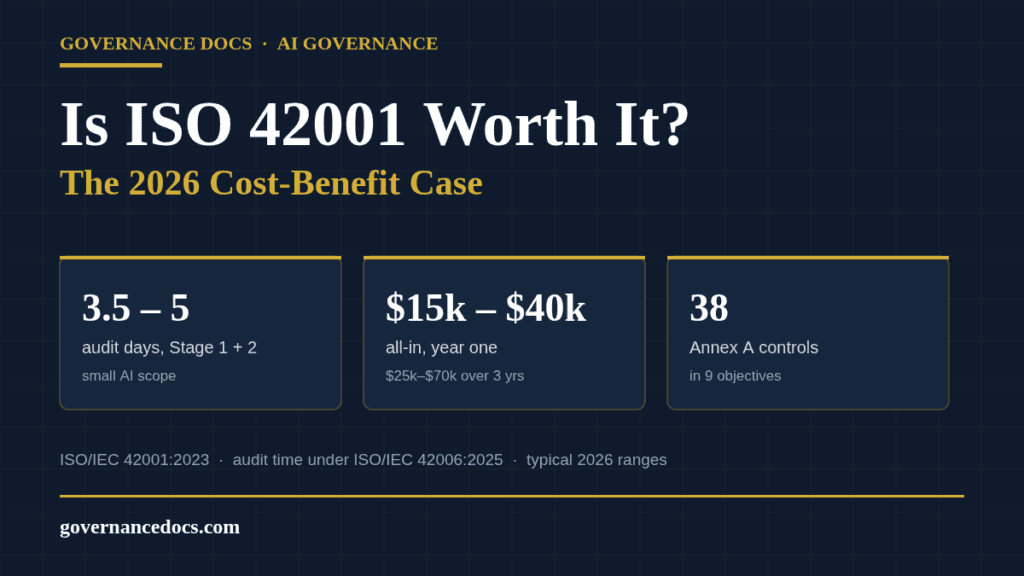
Is ISO 42001 worth it? The answer turns on one thing you can check today: has a customer, an investor or a regulator asked you to prove how you govern artificial intelligence? If the answer is yes, the certificate usually pays for itself inside a year. If the answer is no, you are about to spend real money building a management system nobody has asked to see.
ISO/IEC 42001:2023 was published in December 2023 as the world’s first artificial intelligence management system (AIMS) standard. It is a 51-page Edition 1 document from ISO/IEC JTC 1/SC 42, structured like every other ISO management system standard, with an Annex A offering 38 controls grouped under nine control objectives. An accredited certification body audits your AIMS against it and, if you pass, issues a certificate valid for three years.
So: is ISO 42001 worth it for your organization? This post prices the decision honestly — what you pay across the full three-year cycle, what comes back, and the situations where the answer is a straight no.
Free gap assessment
How much of ISO 42001 could you evidence today?
Score every clause and Annex A control of the AI management standard, free, and see where the programme really sits.
Run the free ISO 42001 gap assessment → or View premium report sample
The question “is ISO 42001 worth it” has two answers, because the standard is sold into two very different markets: companies that build AI and companies that merely use it. Find your row below.
| Your situation | Verdict | Why |
|---|---|---|
| Enterprise buyers are adding AI governance questions to your security reviews | Yes — clearly worth it | An accredited certificate closes that whole section of the questionnaire with one document instead of a bespoke answer per deal |
| You develop or resell AI features into health, finance, HR or the public sector | Yes | Your customers inherit your AI risk, and their auditors will eventually ask who governs it |
| You are a high-risk provider under Annex III of the EU AI Act | Worth it, but not sufficient on its own | Those obligations now apply from 2 December 2027, and ISO 42001 is not a harmonised standard, so it grants no presumption of conformity |
| You already hold ISO 27001 and AI is entering your product | Yes — at the cheapest price you will ever see for it | An integrated audit reuses your existing document control, internal audit and management review, and can cut audit time by up to 20% |
| You use third-party AI tools and ship none of your own | Usually not yet | A documented AI use policy, a vendor register and per-system impact assessments answer most buyer questions at a fraction of the cost |
| Pre-revenue, no AI governance question anywhere in your pipeline | No | The free NIST AI Risk Management Framework gives you the same discipline with no audit fee attached |
Notice what decides it. Not the sophistication of your models, and not how much AI you use — only whether somebody outside your company needs independent assurance about it. That is the whole test.
Certification bodies price the engagement in audit days, then apply a day rate. Since ISO/IEC 42006:2025 was published on 7 July 2025, how those days get counted is no longer a matter of taste: the standard sets out the audit-time calculation that bodies certifying an AIMS must follow, and it keys the starting figure to the number of people involved in AI activities rather than your total headcount.
That distinction is worth real money. A 600-person manufacturer with fifteen people building and overseeing one model is sized as a small organization. A 40-person startup where everyone touches the model pipeline is not.
| Profile | Audit days (Stage 1 + Stage 2) | Certification body fee, year one | All-in year one | Three-year cycle total |
|---|---|---|---|---|
| Small: up to ~10 people in the AI lifecycle, one or two AI systems | 3.5 – 5 | $5,000 – $10,000 | $15,000 – $40,000 | $25,000 – $70,000 |
| Mid-size: up to ~25 people, several systems, some regulated use | 4.5 – 7 | $8,000 – $18,000 | $40,000 – $90,000 | $60,000 – $140,000 |
| Large: ~85 people or more, multi-site, high-risk applications | 7.5 – 11+ | $20,000 – $40,000+ | $90,000 – $200,000+ | $150,000 – $350,000+ |
Treat those as planning ranges for 2026, not quotes. Two patterns hold across all three rows. First, the audit fee is only about a quarter to two-fifths of year-one spend — the work that gets you audit-ready costs more than the audit. Second, year one is not the bill. Surveillance audits in years two and three typically run at 30% to 40% of the initial audit fee, and recertification in year four repeats something close to the original Stage 2 effort. Our full ISO 42001 certification cost breakdown takes each line item apart. The three-year figure, not the first invoice, is the number to weigh when you ask “is ISO 42001 worth it”.
Four returns decide whether the answer to “is ISO 42001 worth it” is yes. Only the first shows up in revenue, and it is the only one most boards care about.
This is the return that actually shows up in revenue. AI governance clauses have moved into standard enterprise procurement, and the buyer-side reviewer is rarely qualified to assess your model documentation. What they can do is check for a certificate. When an AIMS certificate turns a six-week security review into a document exchange, the value is not the certificate — it is the deal that closed in the quarter it was forecast in.
Be precise here, because vendors are not. ISO 42001 is an international management system standard, not a European harmonised standard. Article 40 of the EU AI Act attaches a presumption of conformity only to harmonised standards whose references have been cited in the Official Journal, and as of 2026 none of the CEN-CENELEC JTC 21 deliverables has been cited. A dedicated AI quality management standard for EU regulatory purposes is still in development.
What the certificate does buy you is the plumbing: a risk process, impact assessments, a data governance trail, human oversight records, post-deployment monitoring. When the Annex III high-risk obligations bite on 2 December 2027 — moved back from 2 August 2026 by the 2026 Digital Omnibus, with Annex I product-embedded systems following on 2 August 2028 — you will be building on an existing system rather than starting from a blank page. Our comparison of ISO 42001 and the EU AI Act maps which clauses do and do not carry over.
The underrated benefit. Building the Statement of Applicability forces you to list every AI system in scope, name an owner for each, and record what data trained it. Most organizations discover during that exercise that the number of AI systems in production is higher than anyone believed, and that two or three of them were never reviewed by anyone. You can get this benefit without a certificate. Almost nobody does, because nothing forces the inventory except an audit date.
Once the AIMS exists, each new AI feature enters an established process: impact assessment, risk treatment, sign-off, monitoring. The second AI system costs a fraction of the first. That compounding is the strongest argument for certifying early rather than after your AI footprint has tripled.
Free AI risk assessment
Which of your AI systems could harm people, or you?
List your AI systems, models and data, pick from 38 AI risk scenarios, rate them for the people affected and for you, and plan treatment with ISO 42001 Annex A controls. You get a heat map, a process score and the findings an auditor would raise, free.
Run the free AI risk assessment → or View premium report sample
Take the small-organization row: roughly $15,000 to $40,000 in year one, and $25,000 to $70,000 across the three-year cycle once surveillance audits and internal effort are counted. Now set that against your pipeline.
If one enterprise contract worth $100,000 or more in annual recurring revenue is genuinely blocked behind an AI governance review, the certificate pays for its entire first cycle out of that single deal — and every subsequent deal in that segment gets cheaper to win. That is the case where the answer to “is ISO 42001 worth it” is obviously yes, and where hesitating costs more than certifying.
If no such contract exists, the arithmetic inverts. You would be spending $25,000 or more for internal discipline you could largely buy with a good policy set, an AI system register and a documented impact assessment procedure. Do that first. Certify when a buyer asks, not in anticipation of a buyer who may never ask. The same logic applies to information security, which is why our ISO 27001 ROI breakdown reaches the same conclusion from the other direction.
Five situations where the answer to “is ISO 42001 worth it” is no. Recognizing yours early saves a five-figure sum and several months.
The return is not fixed. Four decisions move it more than anything else you will do.
1. Scope on the AI lifecycle, not the org chart. If a certification body quotes off total employee count, ask them to re-scope against the people genuinely inside your AI lifecycle. Under the ISO/IEC 42006 method that is the correct basis, and it is the cheapest cost reduction available to you.
2. Integrate the audit with ISO 27001 if you hold it. Global ACI-TECH-3-008 (M) — the successor to IAF MD 11, issued 10 July 2026 — allows an integrated management system audit to reduce audit time, capped at 20% below the starting point, and the body confirms your actual level of integration at Stage 1. Shared documentation, one internal audit program and one management review are what earn that reduction. See how the two standards overlap in our ISO 27001 vs ISO 42001 comparison.
3. Check the accreditation mark before you sign. The accredited AIMS market is young. ANAB accredited its first ISO 42001 certification body in September 2024; UKAS granted its first AIMS accreditation on 15 January 2026; and the European co-operation for Accreditation resolved on 20 November 2025 to make ISO/IEC 42006 the mandatory standard used when accrediting AIMS certification bodies. Ask which accreditation body signs off on your certifier, and check that the accreditation covers ISO 42001 specifically.
4. Do not pay consultant day rates to draft documents. Policies, procedures, the AI system register, impact assessment templates and the Statement of Applicability are where first-time certification budgets leak. Templates get you to a reviewable draft in days; use paid expertise on risk decisions and scope, which is where it is worth the money.
For an organization starting with no management system, plan on six to twelve months from kickoff to certificate: three to six months to build and operate the AIMS, a mandatory period of real records to audit against, then Stage 1 and Stage 2 four to eight weeks apart. If you already run ISO 27001, three to six months is realistic. Our step-by-step guide to getting ISO 42001 certified sets out the sequence.
No. ISO 42001 is a standalone management system standard with no prerequisite certification. Holding ISO 27001 makes it faster and cheaper, because clauses 4 through 10 are largely the same machinery, but it is not required.
Yes — deployers can and do certify. The question is whether it is worth it. Your Statement of Applicability will justify excluding many development-stage controls, which makes for a thinner system and a shorter audit, but also a certificate that says less. If a specific customer is demanding it, certify. Otherwise start with an AI use policy and a vendor assessment process.
No, and this is the most common misunderstanding. The certificate is issued to your management system, not to any model. It says you govern AI responsibly and can evidence it. It does not say any particular model is safe, accurate or unbiased — no ISO management system certificate makes a product claim.
Tell your certification body. New AI systems, new high-risk applications and new regulatory regimes are all upward adjustments to audit time, and the body confirms at each surveillance visit that the established duration still applies. Adding systems quietly and hoping the scope holds is how organizations end up with a nonconformity in year two.
Is ISO 42001 worth it? Yes, if you sell AI-enabled products to buyers who ask how you govern them — the certificate turns a recurring, expensive sales objection into a document, and the three-year cost sits well below the value of one enterprise contract. No, if you are certifying because AI governance is in the news. And genuinely cheap, in relative terms, if you already hold ISO 27001 and can fold the audit into a system you already maintain.
Whichever way your row in the first table reads, the documentation is the same work. Our ISO 42001 Toolkit ($249) provides the AIMS policy set, AI risk and impact assessment templates, the Statement of Applicability covering all 38 Annex A controls, and the internal audit and management review records an auditor will ask for — so your budget goes on decisions rather than drafting.

October 19, 2026
October 19, 2026
October 18, 2026
October 18, 2026
October 15, 2026
