Vendor risk scoring is the method an organization uses to turn what it knows about a supplier into a rating that drives decisions: how deeply to assess, how often to review, what contract terms to require and whether to proceed at all. A poor scoring model gives false comfort or overwhelms the team with red flags. A sound one is simple enough to explain, consistent between assessors and connected to action.
This guide explains how to build vendor risk scoring: separating inherent risk from residual risk, choosing factors and weights, setting scales and thresholds, handling overrides, calibrating results and using the scores in tiering and reporting.
Inherent risk and residual risk in vendor scoring
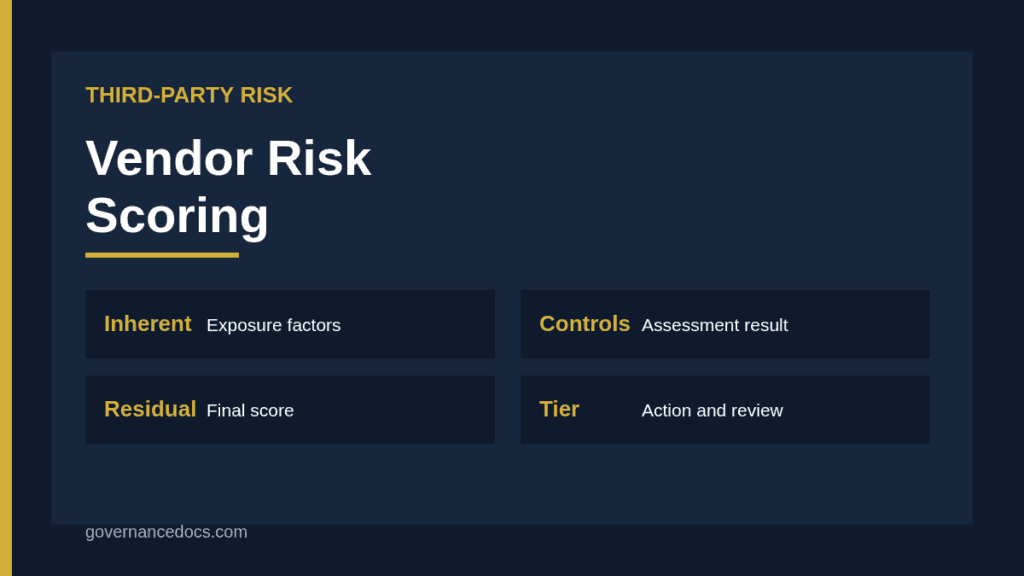
Two scores matter. Inherent risk describes the exposure created by the relationship before considering the vendor’s controls: what data the vendor holds, how critical the service is, how many customers or staff depend on it. Residual risk is what remains after taking into account how well the vendor manages that exposure, as shown by due diligence, assurance reports and monitoring. Keep them separate. The inherent score decides how much scrutiny a vendor deserves, and it should not change because a vendor is charming or has passed a questionnaire. The residual score decides whether the relationship is acceptable and what mitigation is needed.
The guidance in NIST SP 800-161 on cybersecurity supply chain risk management uses similar logic, asking organizations to assess the criticality of suppliers and products and the threats and vulnerabilities associated with them. You can read the publication on the NIST Computer Security Resource Center. Our guide to the third-party risk management framework explains where scoring fits in the lifecycle.
Factors for inherent risk scoring
Choose a limited set of factors that you can answer for every vendor at onboarding, from information the business already has. Each should be defined so that two people would answer it the same way.
Factor
Question
Example scale
Data sensitivity
What is the most sensitive data the vendor handles?
None, internal, confidential, regulated or special category
Data volume
How many records or people are involved?
Few, thousands, millions
Access
What access to systems or premises does the vendor have?
None, limited, privileged, network-wide
Business criticality
What happens if the service fails?
Minor inconvenience, disruption within days, critical activity stops within hours
Substitutability
How easily could the vendor be replaced?
Easy, months, very difficult
Regulatory exposure
Does the service support a regulated activity?
No, indirectly, directly
Location and jurisdiction
Where is data processed and which laws apply?
Domestic, adequate country, other
Reputation and safety
Could a failure harm customers or the brand?
Low, moderate, severe
Weighting and combining
The simplest reliable approach is to score each factor from one to four and take the highest for the overall inherent score, with the average as a secondary check. Using the maximum stops a vendor with access to highly sensitive data from looking moderate because it is otherwise unimportant. If you use weights, keep them few and explainable, and test them on real vendors. A model that puts a payroll provider in the low tier is wrong however elegant the arithmetic.
Scoring control effectiveness for residual risk
Assess the vendor’s controls against the same themes as the inherent factors: information security, privacy, resilience, financial stability, compliance and, where relevant, ethics, labor practices or AI governance. Sources include questionnaires, independent assurance reports, certifications, evidence of testing, external scans and interviews. Weigh evidence by strength: a recent independent report with a clean opinion counts more than an unsupported yes on a questionnaire. Our guides to the vendor security questionnaire and vendor due diligence checklist show what to collect.
Rate each control area as strong, adequate, weak or not evidenced.
Record the evidence and its date next to each rating.
Combine the ratings into an overall control score, again giving weight to the weakest critical area.
Calculate residual risk from inherent risk and control score using a matrix.
Building the residual risk matrix
A simple matrix has inherent risk on one axis and control strength on the other. High inherent risk with strong controls might result in medium residual risk, while high inherent risk with weak controls results in very high residual risk. Define what each residual band requires: for example, low can be accepted by the relationship owner, medium needs a documented action plan, high needs senior approval and a remediation deadline, and very high means do not proceed or exit unless the executive committee decides otherwise.
Tiers and actions from vendor risk scoring
The inherent score normally sets the tier, and the tier sets the depth and frequency of due diligence, as described in our guide to vendor risk tiering. The residual score sets the treatment. For example, tier one vendors receive an in-depth assessment, annual review and continuous monitoring, as described in our guide to third-party continuous monitoring, while tier four vendors receive a short check at onboarding and a contract clause. Fix the rules in your written policy, and make sure they are approved by the risk committee, so that tiers do not depend on who happens to run the process.
Overrides and exceptions in vendor risk scoring
Judgment will sometimes disagree with the model. Allow overrides, but control them: require a written reason, approval by someone senior to the assessor, and a record of every override. Review the pattern each quarter. Many overrides in the same direction mean the model is wrong and should be changed. Never allow commercial pressure to lower a score without documented rationale and approval.
Calibrating and testing the vendor risk scoring model
Before rolling it out, score a sample of thirty to fifty existing vendors and compare the results with your expectations and the views of experienced staff. Ask two assessors to score the same vendors independently, and study the differences. Adjust definitions where scoring diverges. Test edge cases: a small vendor with access to your production environment, a large well-known vendor with a weak evidence file, and a critical vendor with no alternative. Then review the model at least annually, after significant incidents and when regulation changes.
Using scores in reporting and decisions
Scores are useful when they are visible. Show the distribution by tier, the vendors with high residual risk, the average age of scores and the number of overrides. Use the results to prioritize assessments, target remediation and focus attention on the vendors that matter. Our guide to third-party risk reporting shows how to present them. Do not put too much weight on small differences in numbers, since the scores are estimates, and treat them as a guide to attention rather than precise measurement.
A short worked example
Consider a case. A company assesses a marketing analytics platform. Inherent factors score data sensitivity at three, data volume at three, access at two, criticality at two, substitutability at two and regulatory exposure at two, giving an inherent rating of three, so tier two. The due diligence file shows a current independent assurance report with no significant exceptions, but the vendor cannot show a tested incident response plan. Controls are rated adequate overall and weak for incident response. The residual risk is medium. The relationship owner accepts it on the condition that the vendor provides evidence of an incident response test within six months, and the contract adds a notification obligation. The score, evidence and decision are recorded, and the next review is set for twelve months.
Common mistakes in vendor risk scoring
Organizations mix inherent and residual risk, score everything from the questionnaire alone, use factors nobody can answer, average away serious weaknesses, use scales without definitions, allow unlimited overrides and never test the model. Another mistake is confusing precision with accuracy: a score of 73.4 looks scientific, but it rests on judgments that do not deserve that precision. Prefer a small number of clear bands.
Using a ready structure
If you want a starting structure for scoring, findings and the register, the Third-Party Risk Assessment Report and Workbook provides a structured report, scoring and a working register. Whichever tool you use, make vendor risk scoring consistent, evidence-based and tied to the actions each score requires.
Free third-party risk assessment
How much risk does this vendor bring?
Tier the vendor, check the evidence, rate the risks from 30 third-party scenarios and choose controls referenced to ISO 27001, NIST CSF 2.0 and DORA. You get a tier, a heat map and the findings an auditor would raise, free.
It is the method of rating a supplier’s risk, typically as an inherent score based on exposure and a residual score after considering the vendor’s controls, used to drive due diligence and decisions.
What is the difference between inherent and residual risk?
Inherent risk is the exposure created by the relationship before controls. Residual risk is what remains after considering how well the vendor manages that exposure.
How many factors should I use?
Use a small set you can answer for every vendor, commonly six to ten, each clearly defined. More factors rarely improve accuracy and slow the process.
Should I use a numerical score or bands?
Bands are usually better. Numbers imply precision the inputs do not support, while clear bands tie directly to actions and are easier to explain.
How often should scores be updated?
Update inherent scores when the relationship changes, and residual scores at the review interval for the tier and when monitoring shows a material change.