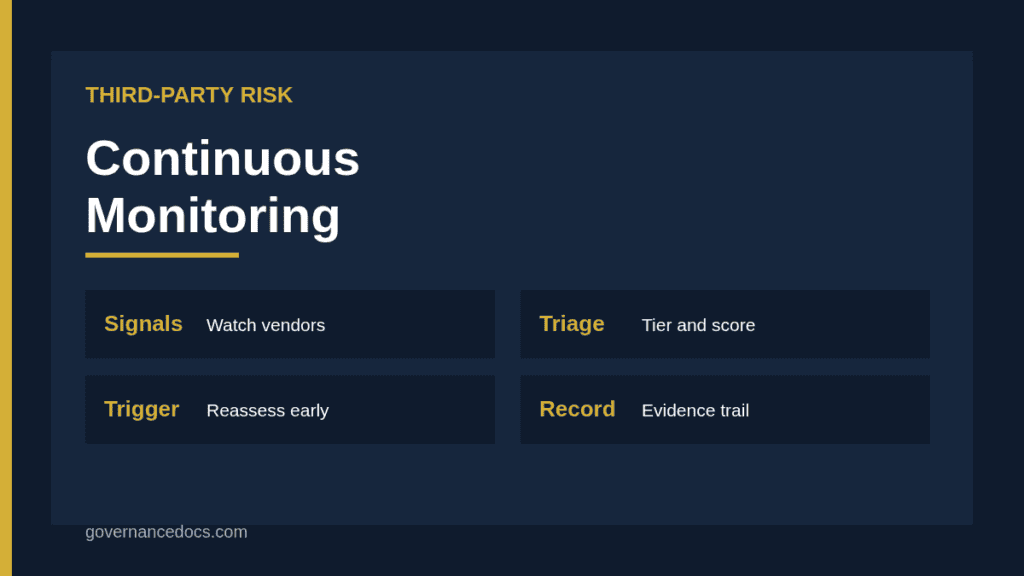
Third-party continuous monitoring is the practice of watching your suppliers and service providers for changes in risk between formal assessments. A vendor that passed due diligence in January can suffer a breach, lose a key certification, change ownership or run into financial trouble by June, and an annual questionnaire will not tell you until the next cycle. Monitoring closes that gap.
This guide explains what third-party continuous monitoring involves, which signals are worth watching, how to match effort to vendor criticality, how to trigger reassessment and how to keep records that satisfy auditors and regulators.
Why point-in-time assessments are not enough
A traditional assessment is a snapshot. It records what the vendor said and showed at one moment, and it usually repeats once a year for critical suppliers and less often for the rest. Meanwhile, the risk changes continuously. Staff leave, systems are updated, subcontractors change and attackers find new weaknesses. Regulators have noticed. Frameworks for financial entities, such as the EU Digital Operational Resilience Act, expect ongoing oversight of ICT providers, not only onboarding checks. Our guide to the third-party risk management framework shows where monitoring fits in the full lifecycle.
What third-party continuous monitoring covers
Despite the name, monitoring is rarely truly continuous for every vendor. It means a defined set of checks, run at defined frequencies, with clear rules for what happens when something changes. The concept comes from information security, where NIST SP 800-137 describes continuous monitoring as maintaining ongoing awareness of security, vulnerabilities and threats to support risk decisions. You can read the publication on the NIST Computer Security Resource Center. The same logic applies to suppliers: know what you are watching, why, how often and what you will do about it.
Certificate expiry, new audit report, qualified opinions
Vendor portal, trust center, requested reports
Financial health
Credit deterioration, late filings, funding events
Credit agencies, public filings, news
Legal and regulatory
Enforcement actions, sanctions, litigation
Screening databases, regulator notices
Operational
Outages, missed service levels, incident volume
Service reports, tickets, status pages
Change in the relationship
Ownership change, new subcontractors, new data locations
Contract notices, vendor communication
Matching third-party continuous monitoring to vendor tier
You cannot watch every vendor equally, and you should not try. Use your vendor tiering to set how much monitoring each group gets. Our guide to vendor risk tiering explains how to classify suppliers by criticality and data sensitivity.
Critical vendors. Frequent automated checks, monthly review of signals, review of assurance reports as issued, and named relationship owner.
Important vendors. Automated checks on a slower cycle, quarterly review, and assurance checks at renewal.
Standard vendors. Event-driven checks such as breach news or expiry alerts, and review at contract renewal.
Low-risk vendors. No routine monitoring beyond a change notice clause and a periodic list check.
Setting triggers for early reassessment
Monitoring is only useful if it changes what you do. Write down which events trigger action, who is told and how quickly. A short trigger table is more effective than a long policy.
Security incident at the vendor. Contact the vendor, establish whether your data or service is affected and decide on containment.
Loss or expiry of a key certification or report. Ask for the replacement and consider a targeted reassessment if it is not supplied.
Material change in ownership, location or subcontractors. Review contract notice rights and reassess the affected areas.
Sustained service failure. Record against the service levels and escalate through the relationship owner.
Adverse financial or regulatory event. Assess the effect on continuity and review exit options.
Define thresholds so that alerts are not simply ignored. If a scanning tool raises hundreds of low-value findings, agree which categories matter and which are noise, and review that decision regularly.
Tools and manual methods
Commercial platforms provide security ratings, financial data feeds and news alerts that can be tied to your vendor inventory. They save time, but they also produce false alarms and are only as good as the inventory and the response process. Treat a rating as a prompt for a question, not a conclusion about the vendor. Smaller organizations can achieve a lot with a spreadsheet, a calendar and a few free sources: certificate expiry dates, vendor status pages, public breach notices and a monthly news search on the critical names.
Record third-party continuous monitoring results properly
Keep a log for each critical and important vendor: what was checked, when, by whom, what was found and what was done. Findings should flow into the same register as the outcomes of formal assessments, so that both sources of information are visible together. Our article on third-party risk assessment findings shows how to record and close them, and it applies equally to issues discovered through monitoring.
Free third-party risk assessment
How much risk does this vendor bring?
Tier the vendor, check the evidence, rate the risks from 30 third-party scenarios and choose controls referenced to ISO 27001, NIST CSF 2.0 and DORA. You get a tier, a heat map and the findings an auditor would raise, free.
Auditors and supervisors want to see that monitoring is more than a plan. They will ask for examples of alerts received, decisions taken and follow-up completed. A short trail of real cases is more convincing than a detailed procedure without evidence.
Roles and responsibilities
Monitoring fails when nobody owns it. Give each critical vendor a relationship owner in the business who receives alerts and speaks to the vendor. Give the third-party risk team responsibility for the method, the tools and the log. Give procurement responsibility for contract notice rights and renewals, and give information security responsibility for interpreting technical signals. Write these roles into your third-party risk policy so that people know who acts when an alert arrives, and review the assignments whenever staff change roles.
Contract terms that make monitoring possible
You can only monitor what you are allowed to see. Contracts should require the vendor to notify you promptly of security incidents, changes of control, changes of subcontractors and locations of data, and losses of certification. They should give you the right to receive assurance reports and, for critical vendors, to audit or to commission an assessment. Where a vendor refuses reasonable transparency, treat the refusal itself as a risk signal and record the decision to accept or exit. The third-party risk management lifecycle explains how these terms are agreed at onboarding and revisited at renewal.
Measuring whether monitoring works
Track a few measures: the share of critical vendors with monitoring in place, the time from a signal to a documented decision, the number of alerts that led to reassessment or action, and the number of overdue follow-ups. If alerts never lead to decisions, either the signals are wrong or nobody is reading them. Review these figures with the risk committee each quarter and use them to adjust the frequency and the list of signals. Third-party continuous monitoring earns its cost only when it changes decisions, so measure the decisions, not the number of dashboards.
Avoid alert fatigue
Start with a short list of signals that matter for each tier, run them for a few months and add more only when there is a clear use for the extra information. Combine related alerts into one weekly summary for standard vendors, and reserve immediate notification for critical vendors and serious events. A small, well-read set of signals beats a large set that everyone learns to ignore.
Concentration and exit considerations
Monitoring should also look at the shape of your supplier base. Several vendors depending on one underlying provider, or many critical services running on one cloud platform, create concentration risk that no single assessment reveals. See our guide to vendor concentration risk for how to measure it. When monitoring shows a vendor deteriorating, you need a way out, and the vendor offboarding checklist helps make sure the exit is orderly and data is returned or deleted.
Getting started with a workable structure
Begin with your critical vendors, list the signals you will watch, set frequencies, name owners and define triggers. Run it for a quarter, review what was useful and adjust. If you prefer to start from a structured template, the Third-Party Risk Assessment Report and Workbook provides scoring, findings and a working register that can hold both assessment and monitoring records. Built this way, third-party continuous monitoring becomes a routine part of vendor management instead of a special project.
Third-party continuous monitoring FAQ
What is third-party continuous monitoring?
It is the ongoing tracking of vendor risk signals, such as security posture, assurance status, financial health and service performance, between formal assessments, with defined triggers for action.
Does it replace annual vendor assessments?
No. Monitoring complements formal assessments. Assessments examine controls in depth, while monitoring detects change in between. Both are usually needed for critical vendors.
Which vendors should be monitored?
Start with critical and high-risk vendors, then extend by tier. Low-risk vendors usually need only contractual change notices and periodic checks.
Do I need a commercial tool?
Not necessarily. Tools add scale and automation, but a small organization can monitor critical vendors effectively with manual checks, provided the process is documented and followed.
What should be recorded?
Record what was checked, when, by whom, what was found, and what action followed, for each monitored vendor. Link findings to the vendor risk register so they are tracked to closure.