CART
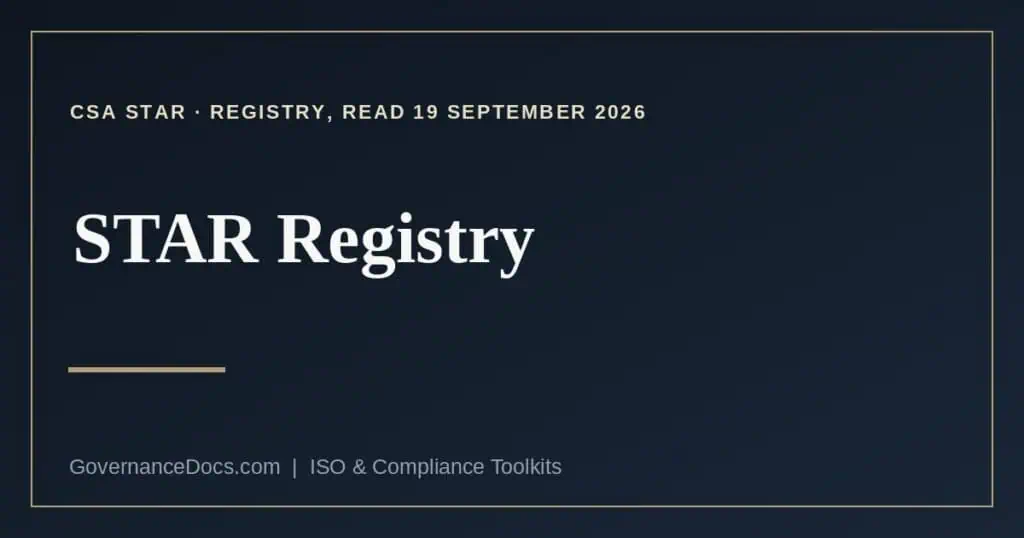
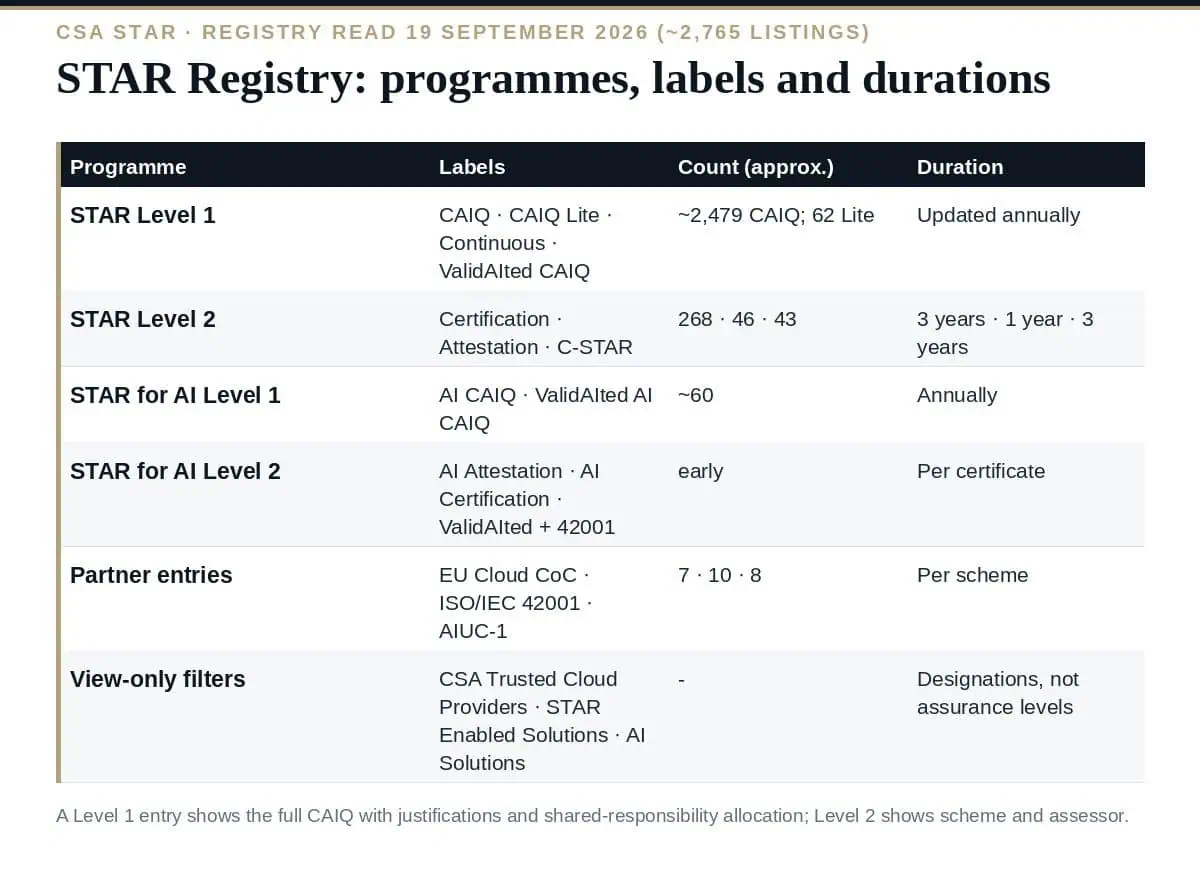
The STAR Registry is the public database at the centre of the Cloud Security Alliance’s STAR programme — the place a cloud provider publishes its self-assessment, certification or attestation once so that every buyer can read it, and the place a buyer goes to compare providers control by control before the first sales call. On 19 September 2026 it held roughly 2,765 listings: about 2,479 CAIQ self-assessments and 62 CAIQ Lite entries at Level 1, 268 STAR Certifications, 46 STAR Attestations and 43 C-STAR certifications at Level 2, around 60 AI-CAIQ submissions under STAR for AI, and partner entries under the EU Cloud Code of Conduct, ISO/IEC 42001 and AIUC-1.
Each entry shows the listing date, the schemes held and, for self-assessments, the questionnaire itself. This guide sets out what the registry contains and how it is organised, the filters buyers use, what each scheme label means and how long it lasts, how to submit and keep an entry current, how to read a competitor’s or a supplier’s listing, and the five ways an entry works against the provider that published it.
Free gap assessment
Where do you actually stand against ISO 27001?
Score every management system clause and all 93 Annex A controls, free, and get a prioritised gap list back.
Run the free ISO 27001 gap assessment → or View premium report sample
| Programme | Scheme labels on the registry | What the label means | Duration |
|---|---|---|---|
| STAR Level 1 | CAIQ; CAIQ Lite; Continuous; ValidAIted CAIQ | A published self-assessment against the Cloud Controls Matrix; Lite is the SME subset; ValidAIted means CSA’s AI tool scored it and awarded the badge; Continuous is CSA’s continuous-assessment variation | Updated annually |
| STAR Level 2 | Certification; Attestation; C-STAR | Certification: ISO 27001 plus the CCM, by a STAR-qualified body; Attestation: a SOC 2 engagement using CCM criteria, by a CPA firm; C-STAR: GB/T 22080-2008 plus the CCM for Greater China | Certification and C-STAR expire after three years unless updated; Attestation after one year |
| STAR for AI Level 1 | AI CAIQ; ValidAIted AI CAIQ | A self-assessment against the AI Controls Matrix, optionally AI-scored | Annually |
| STAR for AI Level 2 | AI Attestation; AI Certification; ValidAIted + 42001 | Third-party AI assurance, or since 20 November 2025 a Valid-AI-ted AI-CAIQ combined with ISO/IEC 42001 certification | Per the underlying certificate |
| Partner entries | AIUC-1; EU Cloud CoC; ISO/IEC 42001 | Listings recognised from partner schemes | Per the scheme |
The registry also carries three “view only” filters — CSA Trusted Cloud Providers, STAR Enabled Solutions and AI Solutions — which are membership and programme designations rather than assurance levels. Our guide to CSA STAR covers the levels; this guide covers the database they land in.
Every STAR Registry listing carries the provider’s name and description, the date it was first listed, and one label per scheme held — a provider can hold a CAIQ and a Certification, or a CAIQ and an Attestation, on the same entry. Clicking through gives the service in scope and, for Level 1, the completed questionnaire: every CCM objective, the yes/no/N/A answer, the justification and the shared-responsibility allocation. For Level 2 the entry shows the scheme and the assessor; the certificate or attestation report is obtained from the provider. The Level 1 questionnaire is therefore the most information-dense object on the registry, and the one a buyer’s security team actually reads.
What is the STAR Registry?
The Cloud Security Alliance’s public database of cloud providers’ security and privacy assurance: Level 1 self-assessments (CAIQ, CAIQ Lite, Valid-AI-ted, Continuous), Level 2 certifications and attestations, STAR for AI entries and partner-scheme listings. It held roughly 2,765 listings on 19 September 2026.
How many providers are on it?
Around 2,765 listings on 19 September 2026, the large majority CAIQ self-assessments, with 268 STAR Certifications and 46 STAR Attestations.
How long does a listing last?
Self-assessments are updated annually; STAR Certification and C-STAR certificates expire after three years unless updated; STAR Attestation listings expire after one year.
Can I see a provider’s actual answers?
For Level 1, yes — the completed CAIQ with justifications is on the entry. For Level 2 the entry shows the scheme and assessor; the report or certificate comes from the provider.
Is there a fee to be listed?
Level 1 is free; Valid-AI-ted is $595 for up to ten attempts (free to corporate members); Level 2 carries CSA fees, reduced for corporate members, on top of the audit.
Use the STAR Registry in both directions: as a buyer, read the date, the version, the justifications and the shared-responsibility column before the first call; as a provider, publish an honest Level 1 entry on the submission version of CAIQ v4.1, score it if you want a badge, add Level 2 when buyers ask for independent testing, and refresh every year. Two thousand seven hundred listings are the questionnaire answered in public; the ones that get read are the ones that are current and true.
The Registry Submission Pack, the CAIQ v4.1 Self-Assessment Workbook, the Cloud Service Scope Statement, the SSRM Matrix Workbook and the Customer Trust Page Content Pack are in the CSA STAR Cloud Security Toolkit, or start with the free templates.

October 11, 2026
October 11, 2026
October 11, 2026
October 11, 2026
October 11, 2026

