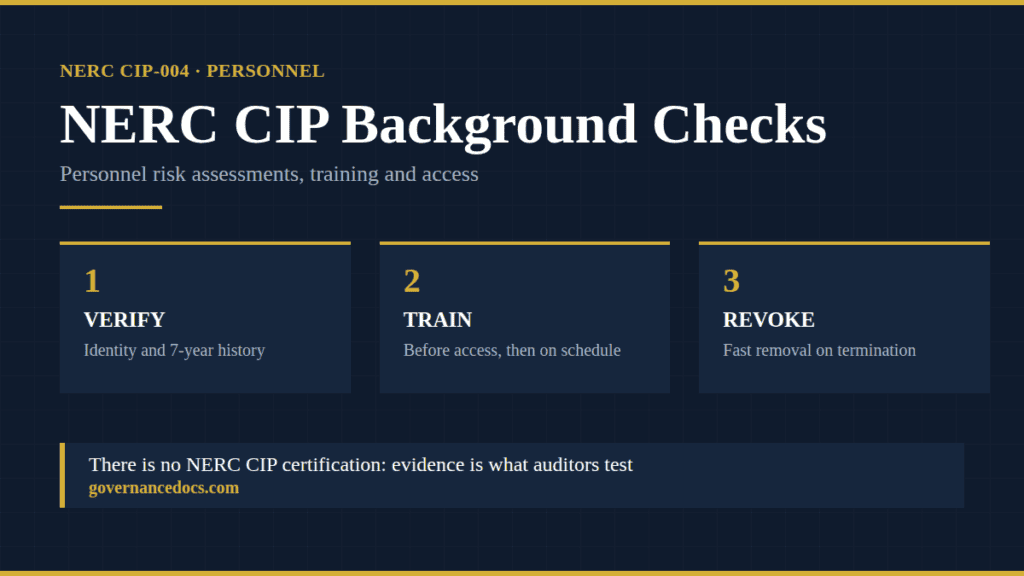
A NERC CIP background check is what CIP-004 calls a personnel risk assessment (PRA), and it must be done before someone gets authorized electronic or unescorted physical access to applicable BES Cyber Systems. Auditors sample it closely, because the evidence is personal, dated and easy to test.
This guide covers the PRA rules in CIP-004, plus the security awareness, training and access revocation timelines that sit around them. It ends with a requirement table you can use as an evidence checklist.
The PRA requirements in CIP-004-7 apply to high impact BES Cyber Systems and to medium impact BES Cyber Systems with External Routable Connectivity. They also cover the associated EACMS (access control and monitoring systems) and PACS (physical access control systems).
Anyone who needs authorized electronic access or authorized unescorted physical access to those systems needs a valid PRA. That includes employees, contractors and service vendors.
Low impact assets are handled differently, under CIP-003. Our NERC CIP low impact guide explains what applies there.
The five parts of a CIP-004 personnel risk assessment
Requirement R3 of NERC CIP-004 asks for one or more documented PRA programs, and it holds every NERC CIP background check rule. Each program must cover five parts, R3.1 to R3.5.
Identity verification (R3.1)
You need a process to confirm identity. CIP-004 does not prescribe the documents to use, so your procedure must say which ones you accept and who checks them.
Seven-year criminal history records check (R3.2)
Each PRA includes a seven-year criminal history records check. It must cover the person’s current residence, however long they have lived there. It must also cover any other location where they lived for six consecutive months or more during the seven years before the check.
If a full seven-year check is not possible, for example because records in one country are unavailable, do as much of it as you can. Then document why the full check could not be performed.
Evaluation criteria (R3.3)
You need criteria or a process to evaluate the results before authorizing access. CIP-004 does not list disqualifying offenses. You decide them, write them down and apply them consistently.
Contractors and service vendors (R3.4)
You need criteria or a process to verify that contractor and vendor PRAs meet R3.1 to R3.3. In practice, that means contract clauses, a vendor attestation and the right to see supporting evidence.
Seven-year renewal (R3.5)
Everyone with authorized access must have a PRA completed within the last seven years. In practice, that means renewing each person’s NERC CIP background check at least once every seven years, and tracking the due dates.
A practical NERC CIP background check workflow
A simple, repeatable workflow keeps the evidence clean. Work with HR and legal counsel on consent forms and local law before you start.
The manager requests access and states the business need.
HR confirms identity using the documents your procedure lists.
HR collects the person’s residence history for the last seven years.
A screening provider runs the criminal history records check for each qualifying location.
Gaps are documented, with the reason a full seven-year check was not possible.
A named reviewer evaluates the results against your written criteria and records the decision.
The PRA date goes into a register that flags the seven-year renewal.
Access is provisioned only after the PRA and training are both complete.
For vendors, swap steps 2 to 6 for a verification step under R3.4. Keep the vendor’s attestation and any evidence you sampled.
NERC CIP training and security awareness
CIP-004 separates awareness from training, and auditors test both.
Security awareness (R1.1). At least once each calendar quarter, you must reinforce cyber security practices for personnel with authorized electronic or unescorted physical access. This applies to high and medium impact BES Cyber Systems. Emails, posters, intranet posts and briefings all count if you keep dated copies and proof of distribution.
NERC CIP training (R2). Your cyber security training program must cover nine topics in Part 2.1:
cyber security policies;
physical access controls;
electronic access controls;
the visitor control program;
handling and storage of BES Cyber System Information (BCSI);
identifying a Cyber Security Incident and making initial notifications under your response plan;
recovery plans for BES Cyber Systems;
responding to Cyber Security Incidents;
cyber security risks from electronic interconnectivity, including Transient Cyber Assets and Removable Media.
Training must be completed before access is granted, except during CIP Exceptional Circumstances (Part 2.2). It must then be repeated at least once every 15 calendar months (Part 2.3).
Access authorization, reviews and revocation
The PRA is only one gate. CIP-004 also controls how access is granted, checked and removed.
Authorization (R4.1): a process to authorize electronic access and unescorted physical access based on need.
Quarterly verification (R4.2): at least once each calendar quarter, confirm that everyone with active access has an authorization record.
Privilege review (R4.3): at least once every 15 calendar months, verify that user accounts, groups or role categories and their privileges are correct and necessary.
Termination (R5.1): remove the ability for unescorted physical access and Interactive Remote Access within 24 hours of the termination action.
Transfers (R5.2): revoke access no longer needed by the end of the next calendar day after you determine it is not needed.
Accounts and passwords (R5.3, R5.4): for high impact systems and their EACMS, revoke non-shared accounts and change known shared-account passwords within 30 calendar days of a termination.
BCSI access (R6): authorize before provisioning, verify every 15 calendar months, and remove the ability to use provisioned access by the end of the next calendar day after termination.
R5.1 and R5.3 are often confused. Removing the ability to get in (24 hours) is different from deleting every account (30 calendar days).
CIP-004 requirements, timelines and evidence
Use this table as a NERC CIP background check and access evidence checklist before an audit. Timelines are from CIP-004-7.
Requirement
Frequency/timeline
Evidence
R1.1 Security awareness
At least once each calendar quarter
Dated awareness material and proof of distribution
R2.2 Training before access
Before access, except CIP Exceptional Circumstances
Training records dated before the access grant
R2.3 Training refresh
At least once every 15 calendar months
Dated individual training records
R3.1 to R3.4 PRA
Before authorized access
Identity check, seven-year criminal history check, evaluation decision, vendor verification
R3.5 PRA renewal
Within the last seven years
PRA register with completion and renewal dates
R4.2 Access verification
At least once each calendar quarter
Reconciliation of authorized list against provisioned list
R4.3 Privilege review
At least once every 15 calendar months
Dated account and privilege review
R5.1 Termination
Within 24 hours of the termination action
Dated workflow and logs showing access removed
R5.2 Transfer
By end of next calendar day after determination
Dated access review and removal records
R5.3 and R5.4 Accounts
Within 30 calendar days of termination
Account revocation and password change records
R6.2 BCSI access review
At least once every 15 calendar months
Authorized versus provisioned BCSI access lists
CIP-004-7 also says to keep evidence for each requirement for three calendar years, unless your Compliance Enforcement Authority directs a longer period. Our NERC CIP audit preparation guide covers how auditors sample this evidence.
Is there a NERC CIP certification?
No. There is no NERC CIP certification for a company. Registered entities show compliance through monitoring by their Compliance Enforcement Authority, which CIP-004-7 defines as NERC or the Regional Entity. Audits use Reliability Standard Audit Worksheets (RSAWs).
Training firms do sell NERC CIP courses with completion certificates. Those show that a person attended training, not that an entity is compliant. NERC’s System Operator Certification is a separate credential for control room operators, not a CIP compliance status.
How often must a NERC CIP background check be renewed?
CIP-004-7 Part 3.5 requires that everyone with authorized access has a PRA completed within the last seven years. Most entities track a renewal date and start the new check well before it.
Does a NERC CIP background check include credit or drug testing?
CIP-004 does not require them. It requires identity confirmation, a seven-year criminal history records check and documented evaluation criteria. Anything beyond that is your own policy choice.
What if someone lived abroad during the seven years?
The check covers any location where the person lived for six consecutive months or more. If records cannot be obtained, complete as much as possible and document why the full check was not performed.
Do contractors need their own PRA?
Yes. Contractors and service vendors need a PRA that meets Parts 3.1 to 3.3. Under Part 3.4, you must have criteria or a process to verify that their PRAs were done that way.
Our NERC CIP Toolkit provides 130 editable templates for a CIP compliance program — including a Personnel Risk Assessment Programme, an Identity Verification and Criminal History Records Check Procedure and a Training Completion and 15-Month Refresher Register — for $99.
When a standard changes, know first
One email a month: edition changes, new deadlines, and what they mean for documentation you already have. No sales sequence.