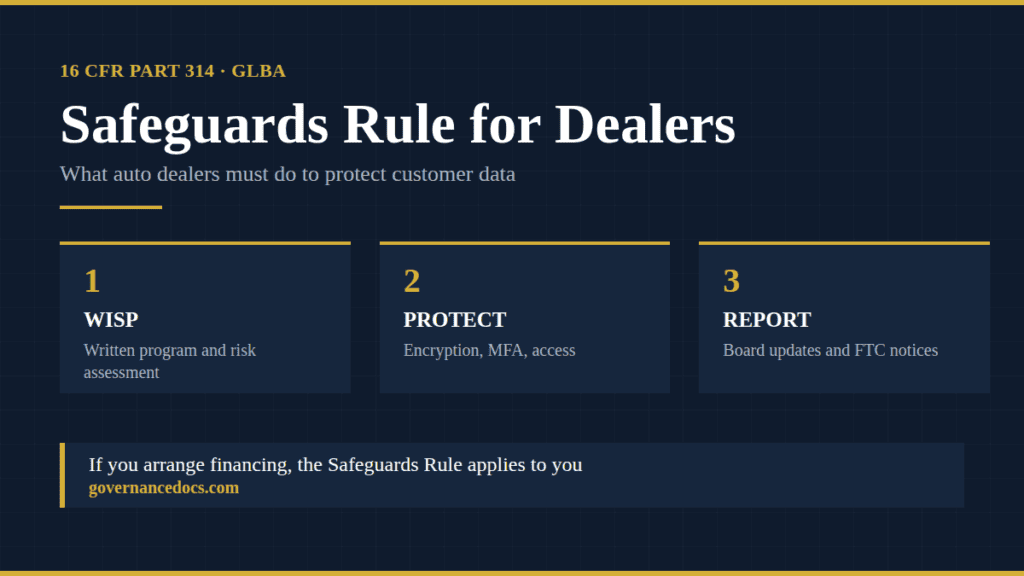
The FTC Safeguards Rule for auto dealers is not a separate rule. It is the same 16 CFR Part 314 that covers every financial institution under FTC jurisdiction, and most dealerships fall inside it the moment they arrange financing or write a lease.
This guide explains why the FTC Safeguards Rule for auto dealers reaches most showrooms, walks through the ten elements of the Rule in dealership terms, shows what the small-dealer exemption removes and ends with a dealership WISP checklist.
Free gap assessment
Where do you actually stand against ISO 27001?
Score every management system clause and all 93 Annex A controls, free, and get a prioritised gap list back.
Why the FTC Safeguards Rule for auto dealers applies
The Gramm-Leach-Bliley Act (GLBA) reaches “financial institutions”, defined by activity, not by what a business calls itself. The GLBA dealership test is simple: do you lend, arrange credit or lease?
The Rule itself gives a dealership example. Under 16 CFR 314.2(h)(2)(ii), a dealership that leases automobiles on a nonoperating basis for longer than 90 days is a financial institution for its leasing business.
The FTC staff Safeguards Rule FAQs for automobile dealers, published in June 2025, go further. They say dealers who finance or facilitate the financing of vehicles are financial institutions too. Staff FAQs are not binding on the Commission, but they show how the FTC reads the Rule.
Many dealers assign the retail installment contract to a lender and assume the FTC Safeguards Rule for auto dealers stops applying. The FTC FAQs say otherwise. Arranging or brokering a loan creates a continuing relationship, and the information stays customer information for as long as you hold it.
What counts as customer information at a dealership
Covered by the Rule
Not covered on its own
Credit and lease applications, with SSNs and income
Names and addresses collected from every buyer, with no sign of how they paid
Deal jackets and copies of documents gathered for financing
Service and maintenance records
Lists of customers who financed or leased with you
Aggregate sales reports not derived from financing
The FAQs add one catch. Systems connected to customer information must be secured too, so the DMS, the CRM and the shared network usually end up in scope.
The ten elements of the FTC Safeguards Rule for auto dealers
Section 314.4 lists ten elements, (a) to (j). The FTC FAQs also count ten. The last column shows which ones a dealer below 5,000 consumers may skip under §314.6.
Element
What it means at a dealership
Exempt below 5,000 consumers?
(a) Qualified Individual
One named person oversees the program. Can be an employee, an affiliate or an outsourced provider.
No
(b) Risk assessment
Identify risks to customer information. The written version with set criteria is (b)(1).
Only the written part, (b)(1)
(c) Safeguards
Access controls, an inventory, encryption at rest and in transit over external networks, MFA, secure disposal, change management, logging of user activity.
No
(d) Testing and monitoring
Regularly test key controls. (d)(2) adds continuous monitoring, or annual penetration testing plus vulnerability scans at least every six months.
Only (d)(2)
(e) Training and personnel
Security awareness training for staff and qualified security personnel.
No
(f) Service providers
Pick capable providers, require safeguards by contract, assess them periodically.
No
(g) Evaluate and adjust
Update the program after tests, incidents and business changes.
No
(h) Incident response plan
A written plan covering seven listed areas.
Yes
(i) Report to the board
The Qualified Individual reports in writing at least annually to the board, or to a senior officer if there is no board.
Yes
(j) FTC notification
Notify the FTC within 30 days of discovering a notification event involving 500 or more consumers.
No
Encryption and MFA
Encrypt customer information at rest and in transit over external networks. If that is infeasible, the Qualified Individual can approve compensating controls. MFA applies to any individual accessing any information system unless the Qualified Individual approves an equivalent control in writing.
The FAQs apply this to vendors. If a service provider gets direct access to your network, require MFA for that access.
Breach notification to the FTC
Section 314.4(j) took effect on 13 May 2024. A notification event is unauthorized acquisition of unencrypted customer information, and encrypted data counts as unencrypted if the key was also accessed. Discovery is the first day any employee, officer or agent knows, other than the person committing the breach. See our guide to FTC Safeguards Rule breach notification for the full 30-day process.
The small-dealer exemption under §314.6
The FTC Safeguards Rule for auto dealers scales down for small dealers. Section 314.6 says four provisions do not apply to institutions holding customer information on fewer than 5,000 consumers: the written risk assessment, the penetration testing and vulnerability scanning rule, the written incident response plan and the annual board report.
Two cautions. First, the exemption removes paperwork, not the work. You still base the program on a risk assessment, test your controls and respond to incidents. Second, count consumers, not this year’s deals. Old deal files still in storage hold customer information and count toward the number.
Dealership risks the WISP has to address
Generic templates miss the places dealership data actually leaks. Cover these in your risk assessment.
Risk area
What goes wrong
Safeguard to document
DMS access
Shared logins, vendor remote access, accounts left active after staff leave
Vendors with direct access to customer data and weak security
Due diligence, contract clauses, periodic review
Email
Deal documents emailed to lenders without encryption
Encrypted transfer or secure portal only
Disposal
Old deal jackets kept for years
Retention schedule and disposal within two years of last use, unless an exception applies
Not every company you share data with is a service provider. The FAQs say an OEM is not one merely because it receives names and addresses for recall notices. For vendors that are, our guide to WISP service provider oversight covers the contract and review steps.
Dealership WISP checklist
Use this checklist to test safeguards rule dealership compliance. It follows the FTC Safeguards Rule for auto dealers in order. Our general FTC Safeguards Rule checklist covers the same elements for other industries.
Appoint a Qualified Individual in writing, using our Qualified Individual role guide. If outsourced, name a senior staff member to oversee them.
Count consumers whose customer information you hold, and record whether §314.6 applies.
Map where customer information lives: DMS, CRM, lender portals, email, paper files, backups.
Complete the risk assessment, in writing if you hold data on 5,000 or more consumers.
Give every user an individual login and remove shared accounts.
Turn on MFA for every system, including vendor remote access.
Encrypt customer information at rest and in transit over external networks.
Lock F&I paper files and set a shredding schedule.
Log user activity in systems holding customer information.
Train all staff on security awareness, with extra training for F&I and IT.
List service providers with access, add safeguard clauses to contracts and review them periodically.
Write the incident response plan, if the exemption does not apply.
Set up the FTC notification procedure for events involving 500 or more consumers.
Have the Qualified Individual report to the owner or board at least annually.
A written plan that covers these items is your dealership WISP. Review it whenever your systems, vendors or ownership change.
FTC Safeguards Rule for auto dealers FAQ
Does the Rule apply if we sell every contract to a lender?
Yes. According to the FTC FAQs, arranging or brokering the loan creates a continuing relationship. You must protect the information you collected for as long as you keep it.
Do we need to hire a CISO?
No. The Rule requires a Qualified Individual, not a title. It can be an employee, someone at an affiliate or an outsourced provider, but the dealership keeps responsibility for compliance.
Is our OEM a service provider?
Not just because you send it customer names and addresses for recalls. A company becomes a service provider when it provides you a service involving access to customer information.
Does the FTC Safeguards Rule for auto dealers apply to cash buyers’ data?
Cash buyers do not become consumers under the Rule, so their data alone is not customer information. In practice it sits on the same systems as financed customers’ data, and those systems must be secured anyway.
Our WISP Toolkit was written for tax and accounting practices. Its sections follow §314.4 element by element and apply to any institution covered by the Rule, but its IRS overlay section does not apply to a dealership.
Our WISP Toolkit provides 74 editable templates built on 16 CFR 314.4 — including the Qualified Individual Designation and Appointment Letter, a Multi-Factor Authentication Policy and the Service Provider Oversight Policy — for $99.
When a standard changes, know first
One email a month: edition changes, new deadlines, and what they mean for documentation you already have. No sales sequence.