The FedRAMP Rev5 sunset changes how every cloud provider selling to US federal agencies should plan for the next three years. In 2026 the program published its Consolidated Rules, which set dates after which the legacy Rev5 path stops accepting new applications and then ends altogether, while a newer approach known as 20x becomes the preferred route.
This guide lays out the dates reported by law firms and security researchers, explains the main changes, and gives a practical plan for providers that already hold a Rev5 authorization and for those that have not started. The program is moving quickly, so treat every date as something to confirm on the official FedRAMP site before you commit budget. We also flag where sources differ.
Free gap assessment
Are you working to the 2026 FedRAMP rules or the old ones?
Score the Key Security Indicators and the CR26 obligations, free, including the Security Decision Record that replaced the SSP.
FedRAMP is the US government program that standardizes security assessment for cloud services used by federal agencies. For years providers followed the Rev5 baselines with a system security plan, an independent assessment and an authorization to operate. In 2026 the program published Consolidated Rules that reorganize the program and describe 20x as the preferred path, with Rev5 treated as legacy.
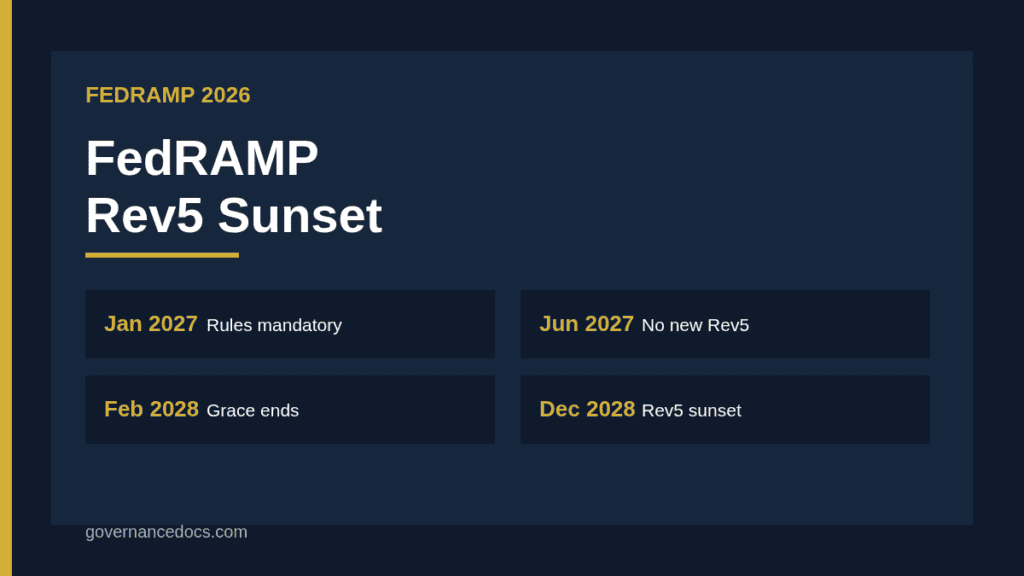
Law firm and research summaries report that FedRAMP will stop accepting new Rev5 applications on 11 June 2027 and that existing Rev5 authorizations will end on 31 December 2028. That is the FedRAMP Rev5 sunset in plain terms: a window during which you can keep what you have, followed by a point after which you must be on the new model. The sources we reviewed agree on those dates; one places the launch in late June 2026 while another describes a July release, so confirm details on the official site.
Key changes in the Consolidated Rules
Reported changes go well beyond the calendar. The terminology shifts from authorization to certification. Reported classes A to D replace the familiar Low, Moderate and High impact levels, with the class depending on the provider’s evidence maturity and automation as well as data sensitivity. Some summaries describe the independent assessor replacing the 3PAO label.
The documentation model changes too. Summaries report that narrative system security plans and plans of action and milestones are being replaced by concise, declarative statements and machine-readable evidence. Quarterly ongoing certification reporting, tiered incident reporting with response times ranging from minutes to one business day, and new rules for significant changes were also reported. Our guides on the FedRAMP SSP and authorization boundary describe the legacy concepts that these changes affect.
How FedRAMP 20x fits in
FedRAMP 20x is the initiative that aims to automate and simplify assessment by using machine-readable evidence and key security indicators. Our article on FedRAMP 20x key security indicators explains the indicators. Under the Consolidated Rules it becomes the preferred approach, so providers that have not started should design for it.
The practical message is that evidence should be generated continuously from your systems instead of assembled in a binder before an assessment. That affects engineering, not just compliance: logging, configuration management, scanning and reporting pipelines all become part of your certification story.
Date
Milestone (as reported)
What it means for you
25 June 2026
Consolidated Rules launched
Start reading the rules and mapping your gaps
7 December 2026
New vulnerability detection and reporting rulesets required
Update scanning and reporting processes
1 January 2027
Consolidated Rules mandatory for all stakeholders
Existing providers follow the new rules
11 June 2027
FedRAMP stops accepting new Rev5 applications
New entrants need the 20x path
1 February 2028
Grace periods expire; non-compliant offerings lose certification
Finish transition before this date
31 December 2028
Existing Rev5 authorizations sunset
Rev5 ends
What to do if you already hold a Rev5 authorization
Commentators advise existing providers to maintain current obligations and consider moving to 20x earlier rather than later. Start with an inventory of your current package, then compare it with the new rules. Identify where your evidence is narrative and where it can be automated.
Confirm with your agency sponsors what they expect. Agencies use your certification to buy, so their view of the transition timeline matters as much as the program’s. Also review your continuous monitoring process, because reporting cadence and incident handling are reported to change.
What to do if you have not started
If you have not begun FedRAMP, the reported cutoff for new Rev5 applications means the 20x path is the realistic choice. Do not build a package to the old model. Begin with scoping, your authorization boundary and your evidence automation plan, and talk to the program office and prospective sponsoring agencies about the current intake process. Our FedRAMP compliance checklist and FedRAMP certification cost pages give a starting structure, but check them against the new rules.
Budget differently too. Automation and engineering time may replace some of the documentation effort, so a consultant-heavy plan may need revisiting.
A practical transition plan
A reasonable plan has five phases, with dates adapted to your own risk and contracts:
Phase 1: read the Consolidated Rules and list the changes that affect you
Phase 2: map your current package, evidence and boundary to the new model
Phase 3: fix tooling so evidence is generated automatically
Phase 4: confirm the class, reporting and change processes with your agency sponsor
Phase 5: complete the transition well before the February 2028 grace-period date
Documentation and templates during the transition
Even with the shift to machine-readable evidence, you still need clear policies, procedures and decision records. The FedRAMP Toolkit was rebuilt for the 2026 rules, with templates for certification package documents and the NIST SP 800-53 Rev 5 baseline set, so your team starts from current structures.
Transition work competes with your product roadmap, so decide early who will do it. Typical workstreams are compliance leadership, security engineering for evidence automation, infrastructure teams for logging and configuration, and a sponsor who manages agency relationships. Smaller providers often borrow engineering time from product teams, which means the transition needs a written priority and a date, not a vague promise. The costs are illustrative until you scope them: assessor fees, tooling, and staff time may all change under the new model, so ask vendors to quote against the Consolidated Rules rather than the legacy process.
Questions to ask your agency sponsor and assessor
Sponsors and assessors are your best source of practical detail. Ask your sponsor how it expects to treat your existing authorization during the transition and whether it plans to renew or reassess. Ask your assessor how it is adapting to evidence-based assessment, how it handles machine-readable evidence and what it will need from your pipelines. Ask both how significant change notifications will work in practice, since the reported new categories include notification windows that your release process must respect. Write the answers down and keep them with your transition plan so the next reviewer can see what was agreed.
Watching for updates after the Rev5 sunset announcement
The program published requests for comment, rules and guidance in quick succession during 2026, and more changes are likely before the mandatory dates arrive. Assign someone to monitor the official FedRAMP site and to report changes in a short monthly note to leadership. When a date or requirement moves, update your plan the same week. Providers who treat the FedRAMP Rev5 sunset as a living project, with a named owner and a dated plan, will be in a far better position than those who read one summary and file it away.
Evidence automation after the FedRAMP Rev5 sunset
Begin with the evidence you already produce. Vulnerability scans, configuration baselines, identity logs and change records can often be exported on a schedule with little work. Decide the format, the storage location and the owner, then test that an assessor could retrieve current evidence without asking your team to assemble it. Gaps tend to appear in asset inventory, configuration drift and third-party components, so start there. Keep a simple register that shows each control statement, the source system of its evidence and the last successful export, because a register like this becomes the backbone of your certification package.
Common mistakes during the FedRAMP Rev5 sunset
The biggest mistake is waiting. The dates sound distant, but assessor availability, engineering work and agency sponsor decisions all take time. A second mistake is treating the new rules as a renaming exercise; the evidence model is different. A third is ignoring incident reporting changes, where response times are much tighter. Finally, do not rely on old checklists or blog posts, including ours, without checking them against the current rules.
FedRAMP Rev5 Sunset FAQ
When does FedRAMP stop accepting new Rev5 applications?
Sources report 11 June 2027. Confirm the date on the official FedRAMP site.
When do existing Rev5 authorizations end?
Reported as 31 December 2028, with grace periods for non-compliant offerings reported to expire on 1 February 2028.
What replaces Rev5?
The Consolidated Rules for 2026 describe 20x as the preferred path, with certification classes A to D and machine-readable evidence.
Do I need to move immediately?
Not necessarily, but commentators advise moving early. Check your agency sponsors’ expectations and the official deadlines.
Is the 3PAO role going away?
Some summaries report the term independent assessor replacing 3PAO and a shift toward evidence-based assessment. Check the official rules for the current role definitions.