

Computer System Validation: The Complete 2026 Practical Guide
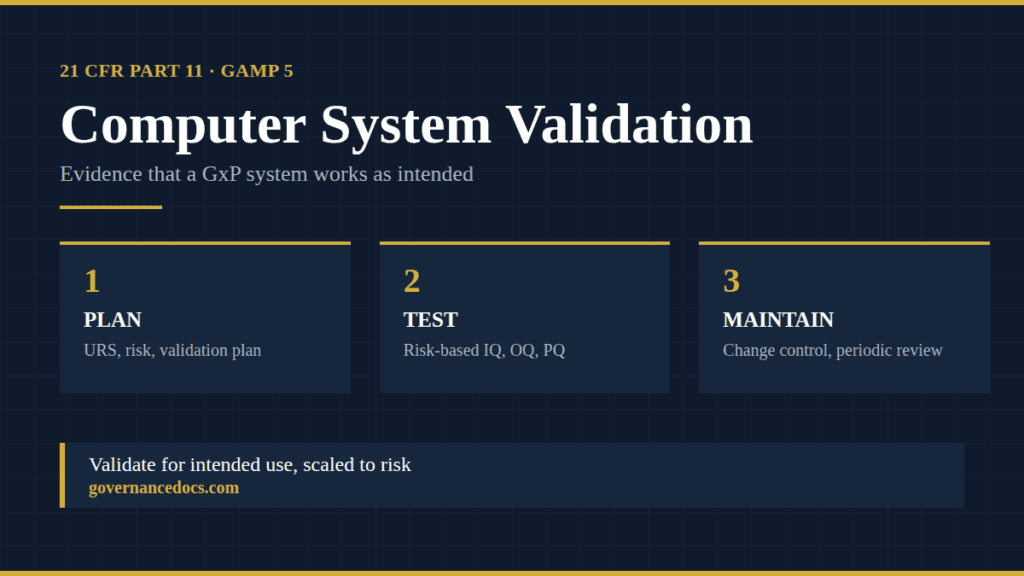
Computer system validation (CSV) is documented evidence that a computerized system does what it is intended to do, consistently, in a GxP environment. If a system creates, changes or stores records a regulator relies on, an inspector will ask to see that evidence.
This guide explains when CSV applies, the V-model and its deliverables, how GAMP 5 categories scale the work, and what FDA’s computer software assurance guidance changed in 2026. It includes a deliverables table you can use as a checklist.
What computer system validation is
Validation is not testing alone. It is a planned set of activities: written requirements, a risk assessment, testing scaled to that risk, and a report that says the system is fit for its intended use.
The output is evidence. An inspector cannot watch your system on the day it went live. They can read your plan, your requirements, your executed tests and your approvals.
You will also hear “CSV validation”, which is redundant but common in job titles and vendor material. In the EU the same work is called computerised system validation.
When computer system validation applies
Computer system validation applies when a computerized system supports a regulated activity, or holds records a regulation requires. These are the main sources of the requirement.
| Regulation | Who it covers | What it asks for |
|---|---|---|
| 21 CFR Part 11 | Records and signatures that FDA predicate rules require, kept electronically | Section 11.10(a): validation to ensure accuracy, reliability, consistent intended performance and the ability to discern invalid or altered records |
| 21 CFR 211.68 | US drug manufacturers under cGMP | Controls so only authorized people change records, input and output checked for accuracy, and backup of data |
| 21 CFR Part 820 (QMSR) | Medical device manufacturers | Incorporates ISO 13485:2016, which requires validation of QMS software (4.1.6), production software (7.5.6) and monitoring and measuring software (7.6) |
| EU GMP Annex 11 (2011 revision) | Medicinal product manufacturers in the EU | Validation across the lifecycle, risk management, supplier assessment and periodic evaluation |
Our guide to 21 CFR Part 11 requirements covers each section from 11.1 to 11.300.
Two dates matter in 2026. The Quality Management System Regulation took effect on 2 February 2026 and removed the old 820.70(i) clause on automated processes. Device software validation now runs through the ISO 13485 clauses above, even though older FDA guidance still cites 820.70(i).
In the EU, EudraLex Volume 4 still lists Annex 11 as the January 2011 revision. The Commission consulted on a rewritten Annex 11 in 2025, but that draft has not been adopted, so the 2011 text is the one inspectors apply.
The V-model and the deliverables of CSV validation
Most validation programs follow a V-model. Each specification on the left side of the V is verified by a matching test on the right side.
- The user requirements specification is verified by performance qualification (PQ).
- The functional specification is verified by operational qualification (OQ).
- The design and configuration specifications are verified by installation qualification (IQ).
- Build or configuration sits at the bottom of the V.
You do not need every document for every system. Risk and system type decide which deliverables you write and how deep each one goes.
Deliverables table for computer system validation
| Deliverable | Purpose | When |
|---|---|---|
| Validation plan | Defines scope, approach, roles, deliverables and acceptance criteria for one system | Before requirements are approved |
| User requirements specification (URS) | States what the system must do for its intended use, including audit trail and e-signature needs | Early, before selection or configuration |
| Risk assessment | Identifies functions whose failure affects product quality, patient safety or data integrity, and sets testing depth | After the URS, updated as the design firms up |
| Functional and configuration specifications | Describe how the system meets the URS and how it is set up | Before configuration; supplier documents can serve |
| IQ protocol and report | Shows the system is installed as specified | After installation |
| OQ protocol and report | Shows functions work as specified, including limits and error handling | After IQ |
| PQ protocol and report | Shows the system works for its intended use in the real process | After OQ, with trained users |
| Traceability matrix | Links each requirement to its risk, specification and test | Kept current throughout; complete before the report |
| Validation summary report | States results, deviations and whether the system is fit for use | Before release |
| Release for use | Formal approval to use the system for GxP work | After the report is approved |
Site-wide decisions, such as which systems are in scope and which templates to use, belong in a validation master plan. The per-system validation plan then points back to it.
The traceability matrix lets an inspector follow any requirement to its test. Our guide to the requirements traceability matrix shows the five links each row needs.
GAMP 5 categories and how they scale the work
GAMP 5 is ISPE’s industry guide to a risk-based approach to compliant computerized systems. The second edition was published in July 2022. It is guidance, not law, but many inspectors and suppliers use its vocabulary.
Its software categories help you decide how much validation effort a component needs. The examples and effort levels below are typical, not prescribed.
| GAMP 5 category | What it covers | Typical example | Typical effort |
|---|---|---|---|
| 1: Infrastructure software | Operating systems, databases, network and security software | Server operating system, database engine | Record versions and qualify the infrastructure |
| 3: Standard system components | Software used as supplied, without configuration to the process | Instrument firmware, off-the-shelf tool on default settings | Verify intended use; lean on supplier evidence |
| 4: Configured components | Software configured to your business process | LIMS, ERP, SaaS quality system | Test the configuration and the critical functions |
| 5: Custom applications | Bespoke code, macros and custom interfaces | In-house application, complex spreadsheet macros | Full lifecycle, including design and code review |
There is no Category 2. The second edition also stresses that categories 3 to 5 are a continuum, and most systems combine components from several categories. Risk to patient, product and data should drive effort more than the label does.
Computer software assurance: what FDA changed
FDA issued “Computer Software Assurance for Production and Quality Management System Software” as final guidance on 3 February 2026. It supersedes the version issued on 24 September 2025. Read it on the FDA guidance page.
Scope matters. Computer software assurance is written for software used in medical device production and quality management systems under Part 820. It supplements FDA’s General Principles of Software Validation and supersedes its Section 6.
The method starts with intended use. You identify reasonably foreseeable failures, decide whether each one poses a high process risk, and pick assurance activities to match.
FDA treats a function as high process risk when its failure may cause a quality problem that foreseeably compromises safety. Those functions may warrant scripted testing or a hybrid approach. Lower-risk functions can use unscripted testing such as scenario testing, error-guessing or exploratory testing.
Drug and biologics sites are outside the guidance’s scope. If you borrow its risk-based logic for a cGMP or Part 11 system, document your justification. That is good practice, not a rule in the guidance.
CSV vs CSA in one paragraph
CSA does not abolish computer system validation. It is a risk-based way to reach the confidence that validation requires, with less scripted testing for low-risk functions. Our post on CSV vs CSA sets out six differences in detail.
Keeping the validated state
Validation does not end at go-live. Two processes keep a system in its validated state: change control and periodic review.
Change control
Every change to a validated system needs an impact assessment before it happens. That includes patches, configuration changes, upgrades, new interfaces and SaaS releases pushed by the supplier.
Retest in proportion to the risk of the change, then update the URS, specifications and traceability matrix. A change that skips this step is a common way for a system to drift out of its validated state.
Periodic review
Annex 11 expects computerized systems to be evaluated periodically to confirm they remain valid and compliant. Part 11 has no equivalent clause, but a periodic review is the simplest way to show a US system is still validated. A review should look at:
- Changes made since the last review, and whether each was assessed.
- Deviations, incidents and open CAPAs linked to the system.
- Findings from audit trail reviews and user access reviews.
- Backup and restore test results.
- Supplier performance and any supplier audit findings.
- Whether the intended use or risk profile has changed.
Audit trail review feeds directly into this. Our audit trail review procedure shows how QA can run it in five steps.
A computer system validation checklist
- List the system in your computerized system inventory and record its GxP impact.
- Write the URS, including data integrity, audit trail, access and signature requirements.
- Assess risk at function level and decide the testing depth for each function.
- Assess the supplier and collect its documentation before you write your own.
- Write the validation plan, naming deliverables and acceptance criteria.
- Execute IQ, OQ and PQ, or risk-based assurance activities, and log every deviation.
- Complete the traceability matrix and the validation summary report.
- Approve release for use, then schedule the first periodic review.
Computer system validation FAQ
Is computer system validation a legal requirement?
For systems in GxP scope, yes. Part 11 section 11.10(a) requires validation of systems that keep records FDA predicate rules require, and EU GMP Annex 11 expects validation of computerized systems used in medicines manufacturing. Systems with no GxP impact do not need it.
Does GAMP 5 have legal force?
No. GAMP 5 is an industry guide published by ISPE. Regulators do not require it, but its categories and risk-based approach are widely used to plan validation work.
Do SaaS systems need validation?
Yes, if they are used for GxP work. You can lean on the supplier’s testing and documentation after assessing the supplier, but you remain responsible for showing the system is fit for your intended use. Put the split of duties in a quality agreement.
How often should a periodic review happen?
Neither Part 11 nor Annex 11 sets an interval. Set it by risk, write the interval and rationale into your procedure, and shorten it when a review finds problems.
Our 21 CFR Part 11 Toolkit provides 105 editable templates for computer system validation under 21 CFR Part 11 and EU GMP Annex 11 — including the validation master plan, URS, IQ, OQ and PQ protocols and the traceability matrix — for $99.
When a standard changes, know first
One email a month: edition changes, new deadlines, and what they mean for documentation you already have. No sales sequence.

Governance Docs
Governance Docs LLC
Recent Posts

November 26, 2026

November 26, 2026

November 26, 2026

November 26, 2026
November 26, 2026