CART
Getting the CCPA service provider classification wrong is how a routine vendor relationship becomes a sale of personal information. California law recognizes three roles for the parties you share data with — service provider, contractor and third party — and the difference between them lives almost entirely in the contract you signed.
This guide sets out what each role means under section 1798.140, what the contract has to say, and the practical test for deciding which one a vendor is.
Free gap assessment
Could you evidence CCPA compliance today?
Score notices, consumer requests, opt-outs and vendor contracts, free, plus the 2026 risk assessment and cybersecurity audit duties.
Run the free CCPA/CPRA gap assessment → or View premium report sample
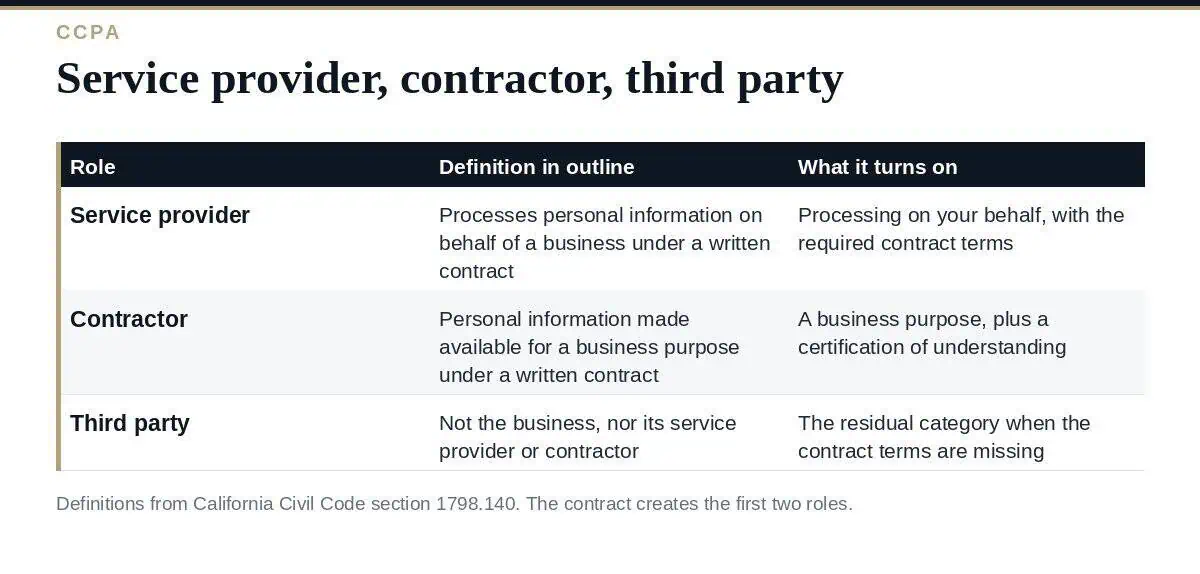
| Role | Definition in outline | What it turns on |
|---|---|---|
| Service provider | A person that processes personal information on behalf of a business, under a written contract | Processing on your behalf, with the required contract terms |
| Contractor | A person to whom the business makes personal information available for a business purpose, under a written contract | Making data available for a business purpose, plus a certification of understanding |
| Third party | A person who is not the business the consumer interacts with, nor a service provider or contractor of it | The residual category — what you are if the contract terms are missing |
Read the third row twice. A CCPA service provider is a status the contract creates, not one a vendor claims. Third party is not a status a vendor elects; it is what remains when the service provider or contractor conditions are not met. A vendor you regard as a processor, without the statutory contract terms, is a third party — and transferring personal information to a third party for anything of value is where “sale” and “sharing” analysis begins.
Both the CCPA service provider and the contractor definitions are contract-dependent, and the required terms overlap almost entirely. The agreement must:
The contractor definition adds one thing the service provider definition does not: a certification by the contractor that it understands the restrictions and will comply with them. It is a single clause and it is the one most often missing from an otherwise adequate agreement.
The right to monitor — including the annual audit right — reads like boilerplate and is not. Its absence is a defect in the definition itself, which means the vendor may not qualify as a service provider or contractor at all, whatever the rest of the agreement says. Reviewing a vendor file against these five points is a two-hour exercise that changes the legal characterization of every relationship it touches.
Work through it in this order for each vendor:
The most common error is assuming the answer at step two and never testing step five. The second most common is treating a GDPR data processing agreement as sufficient: it covers similar ground, but the CCPA terms — particularly the prohibition on combining data and the monitoring right — are not automatically present in a processor annex written for European law.
Three consequences follow from the label:
All of which is why the vendor inventory and the contract review belong together rather than in separate workstreams. Our guide to CCPA compliance in 2026 covers the deadline ladder those obligations sit on.
What is the difference between a CCPA service provider and a contractor?
A service provider processes personal information on the business’s behalf; a contractor is one to whom the business makes personal information available for a business purpose. The contractor’s contract must also include a certification that it understands and will comply with the restrictions.
Is a third party a bad thing?
Not inherently — some relationships genuinely are third-party ones. What matters is recognizing it, because the disclosure and opt-out obligations differ.
Does a GDPR data processing agreement satisfy the CCPA?
Not by itself. The subject matter overlaps but the specific prohibitions and the monitoring right have to be present.
Do we really need an annual audit right?
The definitions contemplate the business being able to monitor compliance, including through measures such as audits at least once every twelve months. Whether you exercise it is a separate question from whether the right exists.
What if a vendor refuses the terms?
Then the vendor is a third party, and you should treat the transfer accordingly rather than describing them internally as a processor.
Classify every vendor deliberately, and let the contract decide rather than the org chart. Run the five required terms against each agreement — no selling or sharing, purpose limitation, no use outside the relationship, no combining, and the monitoring right — add the contractor certification where the role calls for it, and treat anything that fails the test as a third party until the paper is fixed. A vendor list with roles assigned and contracts checked is the artifact that makes every later CCPA question answerable.
Vendor classification registers and contract clause sets are in the CCPA-CPRA Compliance Toolkit, or start with the free ISO templates.

October 13, 2026

October 12, 2026

October 12, 2026

October 12, 2026

October 12, 2026

