The Basel III leverage ratio is a simple, non-risk-based measure that divides a bank’s Tier 1 capital by its total exposure, and it exists to stop banks building up excessive leverage even when their risk-weighted numbers look comfortable. It sits alongside the risk-based capital rules as a backstop, and for many institutions it is the requirement that binds first when balance sheets are large and risk weights are low.
This guide explains how the ratio is defined, what goes into the exposure measure, how the buffer for global systemically important banks works, and where reporting teams commonly go wrong. It also shows a worked calculation and a practical checklist for finance and risk teams.
What the Basel III leverage ratio is for
The Basel Framework describes the ratio as a simple, transparent, non-risk-based measure designed to restrict the build-up of leverage in the banking sector and to act as a backstop to the risk-based capital requirements. The reasoning goes back to the financial crisis: many banks reported strong risk-based ratios while carrying very large balance sheets, and models that assigned low risk weights to some assets understated the danger. A ratio that ignores risk weights cannot be gamed by model assumptions, which is why supervisors keep it beside the more sensitive measures.
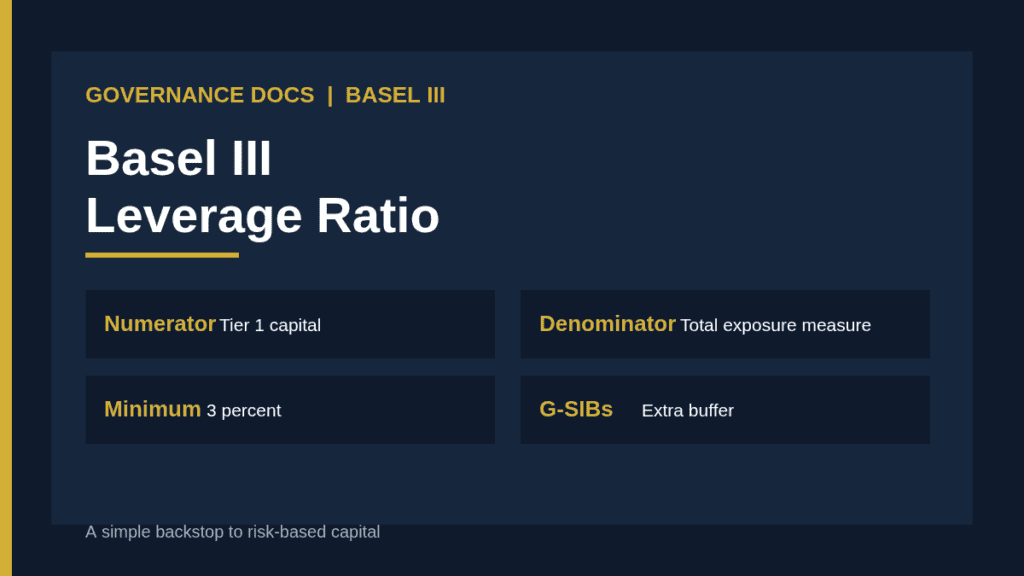
The framework sets a minimum leverage ratio requirement of 3%. Individual jurisdictions may set higher requirements, so always read the rules that apply to your institution, not just the Basel text. You can read the standard on the Bank for International Settlements Basel Framework.
Item
What the Basel Framework says
Purpose
Backstop against build-up of leverage
Numerator
Tier 1 capital
Denominator
Total exposure measure
Minimum
3%
Extra for G-SIBs
Buffer set at 50% of the risk-based higher loss absorbency requirement, met with Tier 1 capital
The exposure measure
The denominator is where most of the work lies. The exposure measure includes four groups of items: on-balance-sheet exposures, generally at accounting values; derivative exposures; securities financing transaction exposures; and off-balance-sheet items. Each group has its own treatment in the framework, and each can be a source of reporting error.
On-balance-sheet items. Included at accounting value, with specified treatment of items such as regulatory adjustments already deducted from Tier 1 capital.
Derivatives. Measured with replacement cost and potential future exposure, subject to netting rules and to the treatment of collateral and client-cleared trades. The 2017 reforms modified this treatment.
Securities financing transactions. Repos and similar transactions are included, with specific rules on netting and on the counterparty credit risk add-on.
Off-balance-sheet items. Commitments and guarantees are converted using credit conversion factors. The 2017 reforms aligned these with the standardised approach to credit risk.
Jurisdictions may allow temporary exclusion of central bank reserves in exceptional macroeconomic circumstances, with a matching recalibration of the minimum requirement. That is a national decision, so check whether your supervisor has used it.
The G-SIB leverage ratio buffer
Global systemically important banks face an additional leverage ratio buffer. It equals 50% of the bank’s risk-based higher loss absorbency requirement and must be met with Tier 1 capital. The Basel Framework gives an example: a bank with a 2% risk-based buffer faces a 1% leverage ratio buffer. Breaching it triggers capital distribution constraints, the same type of consequence that applies to breaches of the risk-based buffers. Our guide to Basel III capital buffers explains how those constraints work on the risk-based side.
A worked Basel III leverage ratio calculation
The figures below are hypothetical and are for illustration only.
Component
Amount (millions)
On-balance-sheet exposures
1,200
Derivative exposures
80
Securities financing exposures
70
Off-balance-sheet items after conversion
150
Total exposure measure
1,500
Tier 1 capital
60
Leverage ratio
4.0%
With Tier 1 capital of 60 and an exposure measure of 1,500, the ratio is 4.0%, which clears a 3% minimum with a cushion of 1 percentage point, or 15 in capital terms. If this bank were a G-SIB with a 2% risk-based buffer and therefore a 1% leverage buffer, the effective requirement would be 4.0% and it would have no cushion at all. The same balance sheet can look comfortable or tight depending on the status of the bank, which is why forward-looking planning matters.
How the Basel III leverage ratio interacts with other requirements
The Basel III leverage ratio is one of several constraints, and the binding one changes with the business mix. A bank with a large low-risk-weight portfolio, such as mortgages or high-quality securities, may find that the leverage ratio binds long before its risk-based ratios do. A trading-heavy bank may see the reverse. Capital planning should therefore project both measures together in the ICAAP, and liquidity planning should check the ILAAP and the LCR and NSFR for interactions, since holding more liquid assets increases the balance sheet. The wider reform package is set out in our overview of Basel III and our note on the Basel III endgame.
Timeline and national implementation
The BCBS summary of the 2017 reforms set 1 January 2018 as the date for the original exposure definition and 1 January 2022 for the revised exposure definition and the G-SIB buffer. The Basel Framework page for the G-SIB requirement shows it in force from 1 January 2023, following the Committee’s deferral of the reform implementation dates. National implementation differs, so the date that matters to you is the one in your own jurisdiction’s rules. Where local rules deviate from Basel, for example with different minimums or exemptions, follow the local rule and document the difference in your methodology.
Planning and monitoring day to day
Do not wait for the quarterly return to learn where you stand. Set an internal management limit above the regulatory requirement, with an amber trigger that starts a conversation and a red trigger that requires action. Project the ratio under your business plan and under stress, and test the effect of large one-off items such as a new repo book, a big undrawn facility or a change in liquidity buffers. When the treasury team wants to hold more central bank reserves or high-quality bonds, ask what that does to the denominator first. Decisions that look sensible on a liquidity view can consume leverage capacity, and the trade-off should be visible to the people making it.
Finally, remember that averaging and quarter-end effects can matter. If your supervisor or your disclosures depend on specific reporting dates, look at how balance sheet size moves around those dates and whether any window dressing questions could arise. Transparent, consistent behavior around reporting dates protects your relationship with the supervisor.
Common reporting errors
Wrong Tier 1 capital. Using a capital figure at a different date or before regulatory deductions from the numerator.
Inconsistent netting. Applying accounting netting to derivatives or repos where the framework does not allow it.
Missing off-balance-sheet items. Undrawn commitments and guarantees left out of the exposure measure or converted at the wrong factor.
Timing mismatches. Capital and exposure measured on different dates, or averages used where a point-in-time figure is required.
Weak reconciliation. No bridge from the financial statements to the exposure measure, so nobody can explain the differences to a supervisor.
Controls that help the Basel III leverage ratio return
Build a documented methodology with one owner, reconcile the exposure measure to the accounts every reporting period, and keep a log of judgments and local interpretations. Add sign-off from finance and risk before submission, and archive the workings. Under Pillar 3 the ratio and its components are disclosed to the market, so errors are visible outside the bank. Our guide to Pillar 3 disclosure covers those requirements.
Documenting your approach
Supervisors and internal audit expect the leverage framework to be written down: policy, methodology, roles, limits, monitoring and escalation. The Basel III Prudential Risk Toolkit provides templates for these documents, which you can adapt to your institution and its regulator. Whichever format you use, make sure the internal limit sits above the regulatory minimum with a clear early-warning trigger, and that the escalation route is agreed in advance.
Basel III leverage ratio FAQ
What is the minimum Basel III leverage ratio?
The Basel Framework sets a 3% minimum, calculated as Tier 1 capital divided by the total exposure measure. Local rules may set a higher figure, so check your jurisdiction.
Why do banks need a leverage ratio if they have risk-based capital?
Risk weights and internal models can understate risk. The leverage ratio does not depend on them, so it works as a simple backstop against excessive balance sheet growth.
What is the leverage ratio buffer for G-SIBs?
It is set at 50% of the G-SIB’s risk-based higher loss absorbency requirement and must be met with Tier 1 capital. Breaching it leads to capital distribution constraints.
Does the leverage ratio apply to small banks?
That depends on national rules. The Basel standards target internationally active banks, and many jurisdictions apply the ratio, or a version of it, more widely. Confirm what your supervisor requires.
How often is the leverage ratio reported?
Reporting frequency is set by your supervisor, and public disclosure follows the Pillar 3 framework. Track the ratio internally more often than you report it, so that you see movements before the reporting date.