

AI Governance Maturity Model: A Practical 2026 Guide
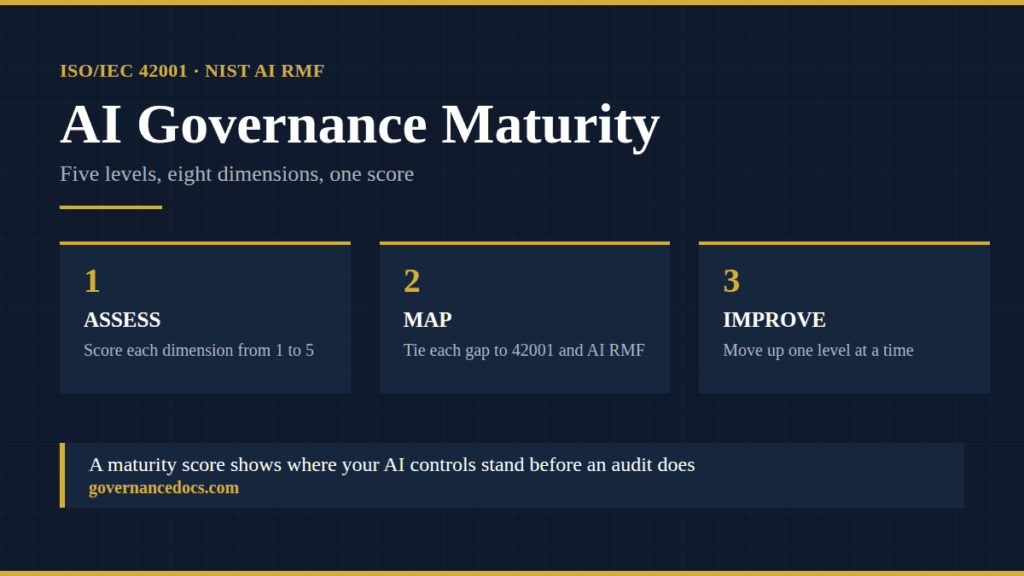
An AI governance maturity model gives you a simple way to measure how well your organization controls the AI it builds, buys and uses, and to decide what to fix next. Most teams sit somewhere between “we have a policy” and “we can prove it works”, and that gap is exactly what auditors and customers probe.
This guide sets out a five-level model across eight dimensions. Each dimension is mapped to what ISO/IEC 42001:2023 and the NIST AI Risk Management Framework expect, and the guide ends with a self-scoring checklist and concrete actions for moving up one level.
Free gap assessment
How much of ISO 42001 could you evidence today?
Score every clause and Annex A control of the AI management standard, free, and see where the programme really sits.
Run the free ISO 42001 gap assessment → or View premium report sample
What an AI governance maturity model is, and what it is not
A maturity model describes stages of capability, from improvised to measured and improving. It is a diagnostic and planning tool. It is not a compliance requirement in its own right.
One point needs to be clear. The model below is ours, built from audit practice, not a published standard. Neither ISO/IEC 42001 nor NIST AI RMF 1.0 defines maturity levels.
ISO/IEC 42001 is a certifiable requirements standard: you either meet a clause or you have a nonconformity. The NIST AI Risk Management Framework, released in January 2023, is voluntary. It is built on four functions, GOVERN, MAP, MEASURE and MANAGE, and uses profiles of current and target states rather than numbered tiers.
So use the levels to plan work and brief your board. Don’t hand a “Level 3” score to a certification body as evidence. Hand over the policies, assessments and records behind it.
Maturity model vs AI governance framework
An AI governance framework, such as ISO/IEC 42001, the NIST AI RMF or your own policy set, tells you what good looks like. The maturity model tells you how far you are from it. Our overview of AI governance frameworks and how to choose one compares the main options.
The five levels of the AI governance maturity model
- Ad hoc. Individuals and teams use AI tools with no inventory, no owner and no rules. Shadow AI is normal and nobody can say which systems touch customer data.
- Aware. Leadership accepts that AI carries risk. A draft policy or acceptable-use note exists and someone is nominally accountable, but practice varies by team.
- Defined. An approved AI policy, assigned roles, a written risk and impact assessment method, an AI inventory and lifecycle gates are in place. The documents exist; the evidence of use is thin.
- Managed. Controls run consistently and leave records. Metrics, monitoring, internal audit and management review run on a fixed cycle.
- Optimised. Governance is measured and improved. Lessons from incidents, monitoring and audits feed back into policy and system design, and AI governance is joined up with privacy, security and enterprise risk.
For ISO/IEC 42001 certification, aim for Level 4 in every dimension within your scope. Certification auditors look for records showing controls operating over time, not just approved documents.
Free AI risk assessment
Which of your AI systems could harm people, or you?
List your AI systems, models and data, pick from 54 AI risk scenarios, including the attacks on AI described in ISO 27090, rate them for the people affected and for you, and plan treatment with ISO 42001 Annex A controls. You get a heat map, a process score and the findings an auditor would raise, free.
Run the free AI risk assessment → or View premium report sample
Maturity table: eight dimensions by level
Read across each row of the AI governance maturity model and mark the cell that best describes you today. Be strict: if a statement is only true for one team, you are not at that level yet.
| Dimension | 1 Ad hoc | 2 Aware | 3 Defined | 4 Managed | 5 Optimised |
|---|---|---|---|---|---|
| Policy and accountability | No AI policy or owner | Draft policy, informal owner | Approved AI policy, roles assigned | Policy reviewed at management review; roles used in decisions | Policy updated from metrics and incidents; board oversight |
| AI inventory | Unknown systems | Partial list in a spreadsheet | Inventory with owner, purpose and risk rating per system | Inventory updated through change control and procurement | Inventory feeds reporting and risk dashboards automatically |
| Risk and impact assessment | None | Informal reviews of big projects | Written method for AI risk and impact assessment | Every in-scope system assessed and re-assessed on change | Assessment results drive design choices and retirement decisions |
| Data governance | Training data source unknown | Some datasets documented | Data quality, provenance and bias criteria defined | Data checks recorded before each training or release | Data issues traced to root cause and fixed upstream |
| Lifecycle controls | Models shipped on judgment | Ad hoc sign-off | Defined gates for design, testing, release and retirement, including third-party AI | Gate records exist for every release | Gates tuned from defect and incident data |
| Monitoring and incidents | Problems found by users | Some dashboards | Monitoring metrics and an AI incident procedure defined | Drift, performance and incidents tracked and reviewed | Trends trigger retraining, redesign or withdrawal |
| Transparency | Users not told AI is used | Ad hoc disclosures | Disclosure rules and system documentation templates | Disclosures and documentation current for each system | Feedback from affected people used to improve explanations |
| Literacy and training | None | One-off awareness session | Competence requirements defined by role | Training records complete; effectiveness checked | Training updated from incidents and audit findings |
Where each dimension sits in ISO 42001 and the NIST AI RMF
The anchors below show which requirement each dimension serves. Use them to link your maturity scores back to the framework you are implementing.
| Dimension | ISO/IEC 42001:2023 | NIST AI RMF 1.0 | Level 4 evidence |
|---|---|---|---|
| Policy and accountability | Clauses 5.1–5.3; Annex A.2, A.3 | GOVERN 1, GOVERN 2 | Signed policy, role descriptions, review minutes |
| AI inventory | Clause 4.3 scope; Annex A.4 resources | GOVERN 1, MAP 1 | Current inventory with change history |
| Risk and impact assessment | Clauses 6.1.2, 6.1.4, 8.2, 8.4; Annex A.5 | MAP, MANAGE 1 | Completed assessments and treatment plans |
| Data governance | Annex A.7 | MAP, MEASURE 2 | Dataset records, quality and bias test results |
| Lifecycle controls | Clause 8.1; Annex A.6, A.10 | MANAGE 2, GOVERN 6 | Release gate records, supplier assessments |
| Monitoring and incidents | Clauses 9.1, 10.2; Annex A.6 | MEASURE 3, MANAGE 4 | Monitoring logs, incident and corrective action records |
| Transparency | Annex A.8 | GOVERN, MEASURE 2 | User notices, system documentation |
| Literacy and training | Clauses 7.2, 7.3 | GOVERN 2 | Training records and competence checks |
The inventory row deserves extra attention because every other dimension depends on it. Our guide to building an AI model inventory that auditors accept covers the fields to capture.
Self-scoring checklist
To place yourself on the AI governance maturity model, answer two yes/no questions per dimension. Question A tests whether the control is defined. Question B tests whether it operates and leaves evidence.
- Policy: (A) Is an AI policy approved by top management? (B) Was it reviewed at a management review in the last 12 months?
- Inventory: (A) Does every AI system have a named owner and risk rating? (B) Did the last three new AI tools enter the inventory before go-live?
- Risk and impact: (A) Is there a written assessment method? (B) Does every in-scope system have a current, signed assessment?
- Data: (A) Are provenance, quality and bias criteria written down? (B) Can you show the data checks for the latest model release?
- Lifecycle: (A) Are release gates defined, including for bought-in AI? (B) Does every release in the last quarter have gate records?
- Monitoring: (A) Are metrics and an AI incident procedure defined? (B) Were monitoring results reviewed and acted on this quarter?
- Transparency: (A) Are there rules for telling people when AI is used? (B) Is the notice and documentation current for each system?
- Literacy: (A) Are competence needs defined by role? (B) Are training records complete for everyone who builds, buys or uses AI?
Scoring: No to A means Level 1 or 2 (Level 2 if a draft exists). Yes to A only means Level 3. Yes to both means Level 4. Claim Level 5 only if you can show a change you made because of a metric, incident or audit finding.
Your overall score is your lowest dimension, not the average. One weak dimension, usually the inventory or monitoring, is enough to fail an audit.
How to move up one level in the AI governance maturity model
Move one level at a time, starting with your weakest dimension. Skipping levels usually produces documents nobody follows.
From Level 1 to Level 2
- Name one executive accountable for AI risk.
- Issue a short acceptable-use rule for generative AI tools.
- Run a quick survey to list the AI tools and models already in use.
From Level 2 to Level 3
- Get the AI policy formally approved and communicated.
- Write the risk assessment and impact assessment methods, including criteria for harm to individuals and groups.
- Turn the survey into a maintained inventory and define release gates.
- Define competence requirements for developers, buyers and users of AI.
From Level 3 to Level 4
- Assess every in-scope system and record treatment decisions.
- Wire the inventory into procurement and change control so nothing ships unrecorded.
- Set monitoring metrics, run an internal audit and hold a management review.
From Level 4 to Level 5
- Track trends in incidents, drift and audit findings, and set improvement objectives from them.
- Feed lessons back into policy, data criteria and release gates, and record what changed.
- Merge AI risk into enterprise risk reporting so the board sees one picture.
Building an integrated AI governance model
An integrated AI governance model runs AI controls through the systems you already have instead of building a parallel bureaucracy. ISO/IEC 42001 shares the harmonized clause structure of ISO/IEC 27001 and ISO 9001, so one internal audit programme and one management review can cover all of them.
Data governance is the natural partner. If you already score data management maturity, align the two scales using our data governance maturity model so the data dimension means the same thing in both.
Choosing a backbone also matters. Our comparison of ISO 42001 vs NIST AI RMF explains when certification is worth it and when the voluntary framework is enough. If you go the NIST route, our NIST AI RMF Toolkit offers 38 templates organized by the four functions.
For a broader view of the principles behind the standard, see how ISO 42001 supports responsible AI.
EU AI Act dates to build into your roadmap
If you operate in or sell into the EU, your AI governance model has fixed deadlines. The AI literacy duty and the original Article 5 prohibitions have applied since 2 February 2025, and the Article 50 transparency duties since 2 August 2026.
Regulation (EU) 2026/1744 did not postpone the original prohibitions. It added new prohibited practices that apply from 2 December 2026, and it moved the Annex III high-risk obligations to 2 December 2027 and the Annex I product-embedded high-risk obligations to 2 August 2028.
In maturity terms, literacy and transparency should already be at Level 3 or above. High-risk providers have until late 2027 to reach Level 4 on risk, data and lifecycle controls.
AI governance maturity model FAQ
Is there an official AI governance maturity model?
No. ISO/IEC 42001 and the NIST AI RMF set requirements and outcomes but do not define maturity levels. Consultancies and vendors publish their own models, including this one, so treat any AI governance maturity model as a planning aid rather than a standard.
What level do we need for ISO 42001 certification?
Plan for Level 4 in every in-scope dimension. Auditors need evidence that controls operate, such as completed impact assessments, internal audit reports and management review minutes. Level 3 documents alone tend to produce nonconformities.
Does the NIST AI RMF have tiers like NIST CSF?
No. NIST CSF 2.0 has implementation tiers, but AI RMF 1.0 uses profiles that describe current and target outcomes. You can still use a maturity scale to measure progress between the two profiles.
How often should we reassess our maturity?
Once a year as part of management review is a sensible baseline. Reassess sooner after a major AI incident, a new high-risk use case or a regulatory change that affects your scope.
Our ISO 42001 Toolkit provides 68 editable templates to take every dimension of this AI governance maturity model to Level 4, including the AI System Inventory, the AI System Impact Assessment Record, the Statement of Applicability and the ISO 42001 Readiness Assessment Tool, for $199.
When a standard changes, know first
One email a month: edition changes, new deadlines, and what they mean for documentation you already have. No sales sequence.

Governance Docs
Governance Docs LLC
Recent Posts

November 27, 2026

November 27, 2026

November 26, 2026

November 26, 2026

November 26, 2026