

HIPAA Training Requirements: The Essential 2026 Guide
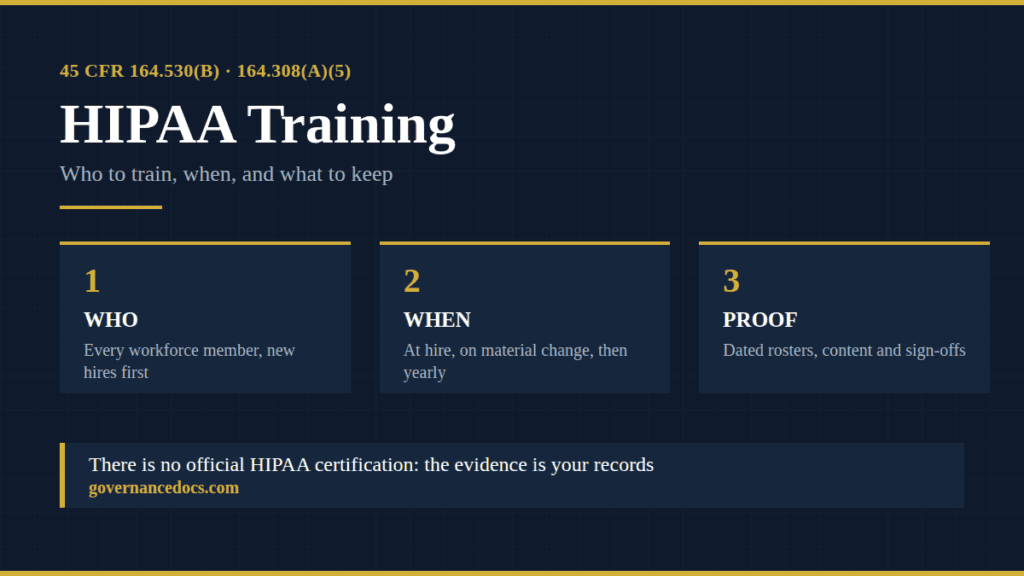
HIPAA training is a legal requirement for every covered entity, but the regulations say far less about it than most course vendors suggest. There is no mandated syllabus, no fixed annual deadline and no official certificate.
What the rules do require is training for the whole workforce, at defined trigger points, with records to prove it. This guide sets out those requirements, a training plan you can adapt, and how HIPAA training differs from OSHA bloodborne pathogens training. For the bigger picture, see our HIPAA Explained guide.
Free gap assessment
Could you evidence your HIPAA safeguards today?
Score every standard and implementation specification, free, including the addressable ones that still need a decision on file.
Run the free HIPAA gap assessment → or View premium report sample
What HIPAA training does the law require?
Two HIPAA rules require training. The Privacy Rule requires training on your privacy policies and procedures. The Security Rule requires a security awareness and training program.
Privacy Rule training: 45 CFR 164.530(b)
45 CFR 164.530(b) says a covered entity must train all members of its workforce on its PHI policies and procedures. The training must be “necessary and appropriate” for each person’s job.
The rule sets three trigger points:
- Every workforce member, by the covered entity’s compliance date.
- Each new workforce member, within a reasonable period after joining.
- Each workforce member whose functions are affected by a material change in your policies or procedures, within a reasonable period after the change takes effect.
You must also document that the training was given. That record falls under the six-year retention rule in 164.530(j).
“Workforce” is broader than payroll. Under 45 CFR 160.103 it includes employees, volunteers, trainees and others whose work is under your direct control, paid or not.
Security awareness and training: 45 CFR 164.308(a)(5)
The Security Rule standard requires a security awareness and training program for all workforce members, including management. It applies to covered entities and to business associates.
It has four implementation specifications, all addressable:
- Security reminders: periodic security updates.
- Protection from malicious software: procedures for guarding against, detecting and reporting malware.
- Log-in monitoring: procedures for monitoring log-in attempts and reporting discrepancies.
- Password management: procedures for creating, changing and safeguarding passwords.
Addressable does not mean optional. You must assess each one and either implement it, implement a reasonable alternative, or document why neither is reasonable. Our guide to HIPAA administrative, physical and technical safeguards shows where training fits among the other standards.
How often is HIPAA training required?
HIPAA does not set an annual training requirement. The Privacy Rule ties training to new hires and material changes, and the Security Rule asks for periodic security reminders without fixing a frequency.
Annual refresher training is still common practice, and it is a sensible default. It gives you a regular, documented point at which every person has been reminded of current policies. Just don’t tell staff or auditors that the regulation demands it.
Material changes are where many programs fall short. On 19 November 2026, HHS published a final Privacy Rule amendment with a compliance date of 19 July 2027. It changes right of access timelines and notice of privacy practices content, so staff who handle those tasks will need retraining once your policies are updated.
Topics your training should cover
Tailor content to the role, but most programs cover these topics:
- What PHI is, and the minimum necessary standard.
- When PHI can be shared, and when an authorization is required.
- Patient rights: access, amendment, accounting of disclosures and restrictions.
- How to spot and report a privacy complaint, security incident or possible breach.
- Phishing, malware, passwords and log-in monitoring.
- Device, email and remote working rules.
- Sanctions for policy violations.
If you are building a program from scratch, our HIPAA implementation guide shows where training sits in the overall rollout.
HIPAA training plan by audience
Use this plan as a starting point. Set the “reasonable period” for new hires in your own policy, and apply it consistently.
| Audience | Topics | Frequency | Evidence to keep |
|---|---|---|---|
| All workforce, including volunteers, trainees and temps | Privacy basics, minimum necessary, incident and complaint reporting, phishing, passwords, sanctions | At hire within your policy’s set period; after material changes; annual refresher as good practice | Sign-in sheet or learning system record, content version, date, signed policy acknowledgment |
| Front desk, health information and release-of-information staff | Identity checks, authorizations vs access requests, response timelines, fees | At hire; after any change to access or disclosure procedures | Attendance record, procedure version, quiz results if used |
| Managers and supervisors | Applying sanctions, handling complaints, approving and removing access | At appointment; after policy changes | Attendance record, role assignment date |
| IT staff and system administrators | Log-in monitoring, malware protection, password controls, incident response, access termination | At hire; when systems or procedures change; periodic security reminders | Training record, reminder log, procedure version |
| Privacy and Security Officials | Regulatory changes, risk analysis, breach risk assessment | When rules change, at least once a year by policy | Course certificates, notes on regulatory updates reviewed |
| Clinical staff with occupational exposure (OSHA, not HIPAA) | The bloodborne pathogens elements in 29 CFR 1910.1030(g)(2)(vii) | At initial assignment, then within one year of the previous training | Dates, content summary, trainer names and qualifications, attendee names and job titles |
Is there a “HIPAA certified” course?
No government body certifies people or organizations as HIPAA compliant. When a course says “HIPAA certified,” it means a private training provider issued a certificate of completion.
HHS addresses this in its FAQ on whether organizations must certify Security Rule compliance. The answer is no, and HHS says it “does not endorse or otherwise recognize private organizations’ ‘certifications'” on the Security Rule.
A course certificate is still useful evidence that a person completed training. It does not show that your organization complies with HIPAA, and it does not replace training on your own policies.
HIPAA and OSHA certification: how the two differ
Healthcare employers often search for “HIPAA and OSHA certification” because both kinds of training land on the same staff. They come from different laws, enforced by different agencies, with different rules.
OSHA bloodborne pathogens training
The OSHA Bloodborne Pathogens Standard, 29 CFR 1910.1030, requires training for each employee with occupational exposure. Unlike HIPAA, it does set a frequency: at initial assignment, then at least annually, within one year of the previous session.
The training must be free to employees and given during working hours. It must also offer interactive questions and answers with a knowledgeable trainer, so check that any online course provides that. Training records must be kept for three years.
Why employers bundle them
A “HIPAA and bloodborne pathogens certification” package usually means one course provider covering both topics in a single session. That is convenient for clinics, dental offices and labs, where the same people handle PHI and potentially infectious materials.
| Point | HIPAA training | OSHA bloodborne pathogens training |
|---|---|---|
| Legal basis | 45 CFR 164.530(b) and 164.308(a)(5) | 29 CFR 1910.1030(g)(2) |
| Regulator | HHS Office for Civil Rights | OSHA |
| Who must be trained | All workforce members, including management | Employees with occupational exposure |
| Frequency | New hires, material changes, periodic security reminders; annual by common practice | At initial assignment, then at least annually |
| Record retention | Six years (164.530(j) and 164.316(b)(2)) | Three years from the training date |
| Official certification | None | None in the standard; providers issue completion certificates |
Bundling is fine, as long as each part meets its own rule. Keep separate records so you can show each regulator exactly what it asks for.
HIPAA training for medical couriers
There is no official HIPAA certification for medical couriers, just as there is none for any other job. What a healthcare client can reasonably ask for is proof that each driver was trained on the courier’s own HIPAA policies, and a business associate agreement (BAA) where one applies.
Is a medical courier a business associate?
It depends on the service. HHS treats “mere courier services,” such as the Postal Service, as conduits rather than business associates. It also calls that exception narrow, and says whether an entity has routine access to PHI is a fact-specific question.
A courier that only carries sealed packages may fall within the conduit exception. A courier whose service involves routine access to PHI, such as manifests with patient names, specimen logs in a tracking app or stored records, is likely a business associate. Its drivers are then the business associate’s workforce, and the security training standard in 164.308(a)(5) applies to them.
Drivers employed directly by a hospital or lab are that covered entity’s own workforce. Many clients require a BAA either way; our guide to the HIPAA business associate agreement covers what it must contain.
What courier training should cover
- Minimum necessary: read only the label and manifest fields needed to collect and deliver, and never photograph or discuss them.
- Chain of custody: a signature or scan at every pickup and handoff, sealed bags, and a locked vehicle whenever PHI is on board.
- PHI on paper: requisitions and route sheets kept face down or in closed folders, then returned or securely destroyed.
- Lost or misdelivered packages: report at once to the courier’s privacy contact. A business associate must notify the client of a breach of unsecured PHI without unreasonable delay and within 60 calendar days of discovery (164.410), and many BAAs set a shorter deadline.
- Phones and apps: screen locks, approved apps only, no PHI in personal texts or photos, and same-day reporting of a lost device.
A prompt report gives the client time to run its four-factor breach risk assessment before its own notification clock runs down.
Free ISO 27001 risk assessment
Which of your risks sit above your appetite line?
Set your own risk criteria, pick from 61 information security risk scenarios, rate likelihood and impact, and decide how to treat each one. You get a heat map, a process score and the findings an auditor would raise, free.
Run the free risk assessment → or View premium report sample
OSHA and DOT training for couriers
OSHA’s bloodborne pathogens standard covers any employee with occupational exposure, meaning reasonably anticipated contact with blood or other potentially infectious materials during their duties. If drivers handle specimen containers that can leak or clean up spills, list the job in your exposure determination under 1910.1030(c)(2) and give them the annual training described above.
For specimens shipped as Category B infectious substances (UN3373), DOT’s 49 CFR 173.199(e) requires each person who offers or transports them to know that section’s packaging requirements, so confirm with your client which transport rules apply to each load.
How to document training: a record checklist
Auditors ask for proof, not slides. Use this checklist for every session:
- Date of the session and the trigger: new hire, material change or refresher.
- Name and job title of each attendee.
- Course title and content version, or a short summary of what was covered.
- Trainer name, plus qualifications for OSHA sessions.
- Completion evidence: signature, learning system record or quiz score.
- Signed acknowledgment of the policies covered.
- Retention date: six years for HIPAA records, three years for OSHA bloodborne pathogens records.
Keep the records where your Privacy Official can produce them quickly. Our HIPAA compliance checklist includes training evidence alongside the other documentation you need.
HIPAA training FAQ
Is annual HIPAA training required by law?
No. HIPAA requires training for new workforce members, after material changes to policies, and through periodic security reminders. Annual refreshers are common practice, not a regulatory requirement.
Do business associates need training too?
Yes, for the Security Rule. Section 164.308(a)(5) applies to business associates as well as covered entities, so their workforce needs security awareness and training.
Does online HIPAA training count?
Yes. HIPAA does not prescribe a delivery method, so online courses work if they cover your own policies and you keep completion records. A generic course alone will not cover your organization’s specific procedures.
Who is responsible for the training program?
The covered entity is responsible. In practice, the Privacy Official owns privacy training and the Security Official owns the security awareness program. Our article on the HIPAA Security Rule vs Privacy Rule explains how those two roles divide the work.
Is there a HIPAA certification for medical couriers?
No. Course certificates show that a driver completed training, nothing more. Clients should look for training on the courier’s own policies, completion records, and a BAA where the courier is a business associate.
Our HIPAA Toolkit provides 160+ editable templates for the Privacy, Security and Breach Notification Rules — including a Security Awareness and Training Policy, a Workforce Training Completion and Tracking Log and a HIPAA Training Sign-in Sheet — for $99.
When a standard changes, know first
One email a month: edition changes, new deadlines, and what they mean for documentation you already have. No sales sequence.

Governance Docs
Governance Docs LLC
Recent Posts

November 26, 2026

November 26, 2026

November 26, 2026

November 26, 2026
November 26, 2026