

HIPAA Release Form: The Complete 2026 Guide and Template
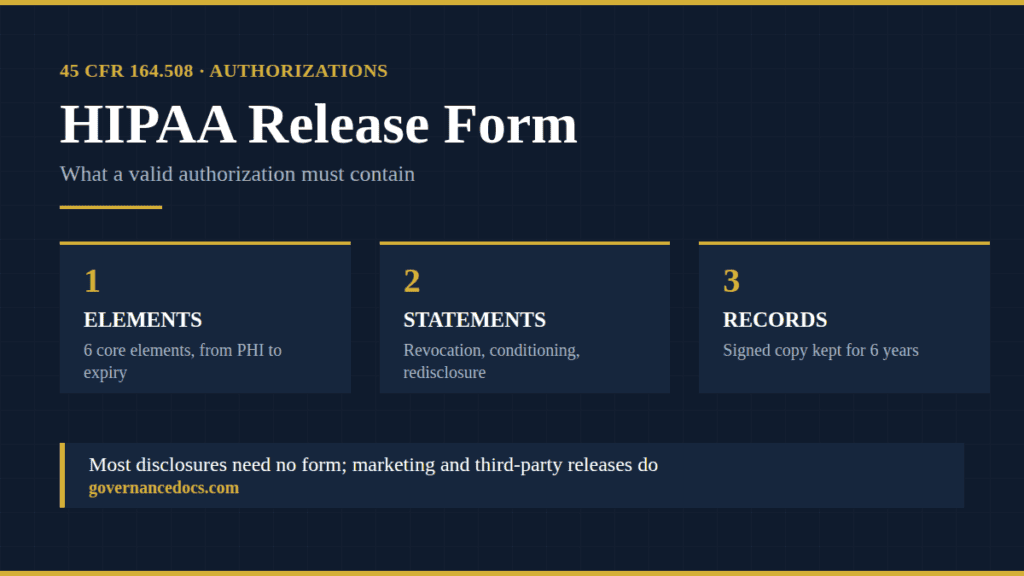
A HIPAA release form is the signed document that lets a covered entity use or disclose a patient’s protected health information (PHI) for a purpose the Privacy Rule does not already permit. The regulation calls it an “authorization,” and the rules sit in 45 CFR 164.508.
Most of the problems I see in audits come from two mistakes. Practices ask patients to sign release forms they don’t need, and the forms they do need are missing a required statement.
Below you will find when a HIPAA authorization is needed, what it must contain, what makes it invalid, and a fill-in skeleton. For the wider picture, start with our HIPAA Explained guide.
Free gap assessment
Could you evidence your HIPAA safeguards today?
Score every standard and implementation specification, free, including the addressable ones that still need a decision on file.
Run the free HIPAA gap assessment → or View premium report sample
What is a HIPAA release form?
“HIPAA release form” is the everyday name. The Privacy Rule term is “authorization,” and the two mean the same thing. You will also see “HIPAA authorization form,” “release of information form” or simply “HIPAA form.”
The general rule in 164.508(a)(1) is short. A covered entity may not use or disclose PHI without a valid authorization, unless another part of the Privacy Rule permits or requires the use or disclosure.
Those other permissions cover most daily activity, so the release form should be the exception, not paperwork for every visit.
When a HIPAA release form is required (and when it is not)
Before you hand a patient a form, check whether the disclosure already has a legal basis. If it does, an authorization adds paperwork and no protection.
Disclosures that need no authorization
Under 164.506, a covered entity may use and disclose PHI for its own treatment, payment and health care operations without the patient’s signature. HHS explains the scope in its guidance on uses and disclosures for treatment, payment, and health care operations.
Other routes also need no authorization:
- Sharing with family or friends involved in the patient’s care, when the patient agrees or does not object (164.510(b)).
- Public interest disclosures listed in 164.512, such as those required by law, public health reporting and health oversight.
- Disclosures to a business associate under a signed contract. Our guide to the HIPAA business associate agreement covers what that contract must contain.
When you must get a signed authorization
You need a valid HIPAA authorization for any use or disclosure that no other rule permits. Common examples are records sent to an employer, a life insurer or an attorney at their request.
Three categories have their own explicit rules in 164.508(a):
- Psychotherapy notes. Almost every use needs an authorization. The exceptions are narrow, such as use by the note’s originator for treatment, or defending a legal action brought by the patient.
- Marketing. Authorization is required unless the communication is face-to-face or a promotional gift of nominal value. If a third party pays you for the marketing, the form must say so.
- Sale of PHI. The authorization must state that the disclosure will result in payment to the covered entity.
Right of access is a different request
When patients ask for their own records, they are using the right of access in 164.524, not granting an authorization. Don’t make them sign a release form as the price of access.
The same applies when a patient asks you to send a copy to someone they name. That is a directed access request. Under the current rule it must be in writing, signed by the patient, and identify the recipient and where to send the copy.
| Request type | Legal basis | Signature needed? | Typical examples |
|---|---|---|---|
| Authorization (release form) | 45 CFR 164.508 | Yes, from the patient or personal representative | Records to a life insurer, employer or attorney; marketing; sale of PHI |
| Right of access request | 45 CFR 164.524 | You may require a written request, but not an authorization form | Patient wants a copy of their own chart, or a copy sent to a person they name |
| No-authorization disclosure | 45 CFR 164.506, 164.510, 164.512 | No | Referral to a specialist, claims to a health plan, quality review, required public health reports |
Free ISO 27001 risk assessment
Which of your risks sit above your appetite line?
Set your own risk criteria, pick from 61 information security risk scenarios, rate likelihood and impact, and decide how to treat each one. You get a heat map, a process score and the findings an auditor would raise, free.
Run the free risk assessment → or View premium report sample
Required elements of a HIPAA authorization form
Section 164.508(c) sets the minimum content. A form can contain more, as long as the extra wording is not inconsistent with the required elements (164.508(b)(1)(ii)).
The six core elements
- A specific and meaningful description of the information to be used or disclosed.
- The name or specific identification of the person(s), or class of persons, authorized to make the disclosure.
- The name or specific identification of the person(s), or class of persons, who will receive it.
- A description of each purpose. “At the request of the individual” is enough when the patient starts the request and does not want to state a purpose.
- An expiration date or expiration event tied to the patient or the purpose. For research, “end of the research study” or “none” is acceptable.
- The patient’s signature and date. If a personal representative signs, add a description of their authority to act.
The three required statements
The form must also contain statements adequate to put the patient on notice of three things (164.508(c)(2)):
- The right to revoke in writing, plus either the exceptions and how to revoke, or a reference to your notice of privacy practices if it covers those points.
- Whether treatment, payment, enrollment or eligibility can be conditioned on signing. Usually the answer is that it cannot.
- That information disclosed under the authorization may be redisclosed by the recipient and no longer be protected by the Privacy Rule.
If you rely on your notice for the revocation details, check that it really contains them. Our guide to the HIPAA Notice of Privacy Practices covers what that document must say.
Plain language and a copy for the patient
The authorization must be written in plain language (164.508(c)(3)). When you are the one asking for the authorization, you must give the patient a copy of the signed form (164.508(c)(4)).
Fill-in HIPAA release form skeleton
Use this table to build or check your HIPAA release form. The example wording is a starting point, not legal advice, and state law may add requirements.
| Element | What to write | Example wording |
|---|---|---|
| Description of information, (c)(1)(i) | Specific records and a date range. Avoid “any and all records” unless the patient wants exactly that. | “Discharge summary and lab results from [date] to [date].” |
| Who may disclose, (c)(1)(ii) | Your legal entity name, or a class such as all of your locations. | “[Practice name], [address], and all of its clinics.” |
| Who may receive, (c)(1)(iii) | A named person or organization, with an address or fax number. | “[Recipient name], [address].” |
| Purpose, (c)(1)(iv) | Each purpose, or “at the request of the individual.” | “Life insurance application.” |
| Expiration, (c)(1)(v) | A date, or an event linked to the patient or the purpose. | “This authorization expires on [date].” |
| Signature and date, (c)(1)(vi) | Signature and date. For a representative, their name and authority. | “Signed by [name], parent of the patient, as personal representative.” |
| Right to revoke, (c)(2)(i) | Revocation must be in writing, the exceptions, and how to revoke, or a reference to your notice. | “You may revoke this authorization at any time by writing to [Privacy Officer, address]. Revocation does not affect actions we took in reliance on it.” |
| Conditioning, (c)(2)(ii) | That you will not condition care on signing, or the consequences of refusing where conditioning is allowed. | “We will not condition your treatment, payment, enrollment or eligibility for benefits on whether you sign this form.” |
| Redisclosure, (c)(2)(iii) | A warning that the recipient may redisclose the information. | “Information disclosed under this authorization may be redisclosed by the recipient and may no longer be protected by federal privacy rules.” |
| Payment statement, (a)(3)(ii) or (a)(4)(ii), only if it applies | That you receive payment, for marketing or a sale of PHI. | “[Practice] will receive payment from [company] for this communication.” |
What makes a HIPAA authorization invalid
Under 164.508(b)(2), an authorization is not valid if it has any of these defects:
- The expiration date has passed, or you know the expiration event has occurred.
- A required element has not been filled out completely.
- You know the patient has revoked it.
- It breaks the rules on compound authorizations or conditioning.
- You know that material information in it is false.
Treat a defective form as no authorization at all. A disclosure made on it has no valid basis.
Compound authorizations
You cannot combine an authorization with another document, such as a consent to treat or a registration packet, to create a compound authorization (164.508(b)(3)). The exceptions are narrow. Research authorizations can be combined with other research permissions, and a psychotherapy notes authorization can only be combined with another one for psychotherapy notes.
Conditioning care on a signature
You may not make treatment, payment, enrollment or eligibility depend on signing, except in three cases (164.508(b)(4)). They are research-related treatment, certain health plan underwriting before enrollment, and care provided solely to create PHI for a third party, such as a pre-employment physical.
HIPAA release form revocation and retention
A patient can revoke at any time, but the revocation must be in writing. It does not undo actions you already took in reliance on the form. It is also limited where the form was a condition of getting insurance and other law lets the insurer contest a claim.
Keep every signed authorization for six years from the date it was created or the date it was last in effect, whichever is later. That comes from 164.508(b)(6) read with the documentation rule in 164.530(j).
File revocations with the original form so staff can see its status before releasing anything. If forms are stored electronically, your Security Rule safeguards apply too. Our comparison of the HIPAA Security Rule vs Privacy Rule explains how the two overlap.
What changes in 2027
On 19 November 2026, HHS published a final rule, HIPAA Privacy Rule: Changes To Support Coordinated Care and Individual Engagement and Reduce Regulatory Burdens. It takes effect on 19 January 2027, and the compliance date is 19 July 2027.
The rule leaves the authorization requirements in 164.508 unchanged. It does change the access side of the comparison table above:
- Access requests must be answered within 15 calendar days instead of 30, with one extension of up to 30 days still allowed.
- The right to direct copies to a third party is limited to electronic copies of PHI in an electronic health record.
- A new section, 164.525, requires a fee schedule if you charge for copies, including copies disclosed under a valid authorization.
The same rule ends the requirement for providers to obtain a written acknowledgment that patients received the notice of privacy practices. Schedule your form and policy updates before July 2027 and track them in your HIPAA compliance checklist.
HIPAA release form FAQ
Do patients need to sign a HIPAA release form for every visit?
No. Treatment, payment and health care operations do not need an authorization under 164.506. A HIPAA release form is only needed for a use or disclosure that no other Privacy Rule provision permits.
Is a HIPAA authorization the same as a consent form?
No. Optional consent for treatment, payment and operations under 164.506(b) cannot stand in for an authorization where 164.508 requires one.
Can a family member get records without a HIPAA form?
Sometimes. Under 164.510(b), you may share information directly relevant to a family member’s involvement in care or payment if the patient agrees or does not object. A full copy of the chart for a relative usually needs an authorization, unless that relative is the patient’s personal representative.
How long is a HIPAA release form valid?
Until the expiration date or event written on it, unless the patient revokes it in writing first. HIPAA sets no maximum period, but a form with no expiration date or event is not valid.
Our HIPAA Toolkit provides 160+ editable templates for the Privacy, Security and Breach Notification Rules — including a HIPAA Authorization for Use or Disclosure of PHI form, a Patient Authorization for Marketing form and a Patient Request for Access to PHI form — for $99.
When a standard changes, know first
One email a month: edition changes, new deadlines, and what they mean for documentation you already have. No sales sequence.

Governance Docs
Governance Docs LLC
Recent Posts

November 26, 2026

November 26, 2026

November 26, 2026

November 26, 2026

November 26, 2026