
CART
No products in the cart.
ISO Compliance Insights & Best Practices
Getting ISO 27001 test data right is one of the cheapest wins in an ISMS and one of the most commonly skipped, because Annex A control 8.33 reads like a one-line instruction to use fake data and is in fact a four-stage lifecycle with an audit trail attached. Most teams write a sentence into a secure development policy, copy last Tuesday’s production database into staging, and never look at it again. That staging copy is now the least protected and most complete store of customer records you own.
This guide covers what the ISO 27001 test data control actually asks for, how it interacts with data masking and information deletion, the legal layer that sits underneath it when the records are personal data, and the evidence an auditor will ask to see.
Free gap assessment
Where do you actually stand against ISO 27001?
Score every management system clause and all 93 Annex A controls, free, and get a prioritised gap list back.
Run the free ISO 27001 gap assessment → or View premium report sample
ISO/IEC 27001:2022 (Edition 3, published October 2022, with one amendment) carries 93 Annex A controls across four themes: 37 organizational, 8 people, 14 physical and 34 technological. A.8.33 Test information sits in the technological theme. Its requirement is short: test information has to be appropriately selected, protected and managed. Read as an instruction, ISO 27001 test data must be chosen deliberately, guarded while it exists, and governed for as long as it exists.
Three verbs, and each one is a separate audit question.
| Attribute | Detail |
|---|---|
| Control reference | A.8.33 Test information |
| Theme | Technological (34 of 93 controls) |
| 2013 predecessor | A.14.3.1 Protection of test data |
| New in 2022? | No — carried over and broadened from “test data” to “test information” |
| Mandatory document? | No. Not on the clause-level mandatory list |
| Nearest neighbours | A.8.31 separation of environments, A.8.11 data masking, A.8.10 information deletion |
The rename from “test data” to “test information” matters more than it looks. The 2013 control pointed at database contents. The 2022 wording pulls in anything you feed a test: configuration exports, log extracts, scanned documents, API payloads captured from production, the CSV someone pasted into a Jira ticket to reproduce a bug. Scoping ISO 27001 test data to the staging database alone is the first mistake.
Note also what A.8.33 does not do. It does not mandate a document. There is no “test data procedure” on the list of mandatory ISO 27001 documents, and you can satisfy the control with rules embedded in a secure development policy. What you cannot do is leave the control marked applicable in the Statement of Applicability with nothing behind it, which is where most nonconformities in this area come from.
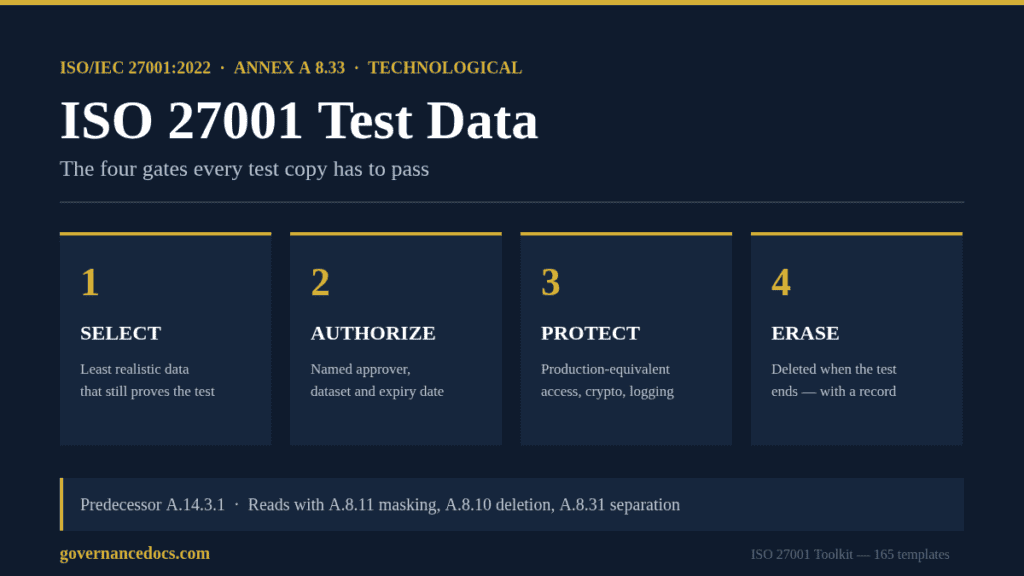
The useful way to read the control is as four gates. Every piece of ISO 27001 test data passes through all four, and an auditor can sample at any one of them.
| Gate | The question | Evidence an auditor samples |
|---|---|---|
| 1. Select | Is this the least realistic data that will still prove the test? | A documented decision rule; the test plan naming the data class used |
| 2. Authorize | Who approved this copy, and on what basis? | An approval record naming the requester, approver, dataset and expiry |
| 3. Protect | Does the test environment carry production-equivalent controls? | Access list, encryption settings and log coverage for the test system |
| 4. Erase | Is it gone now that the test is finished? | Deletion records, environment refresh logs, an inventory with zero overdue copies |
Gate 4 is where almost every organization fails, and it fails quietly. Nobody notices ISO 27001 test data that is still sitting in an environment months after the release it was copied for. The failure shows up in the inventory question an auditor asks second: how many non-production copies of production information exist right now, and who can list them? If the answer takes a week to assemble, the control is not managed.
Gate 2 is the one teams argue about. Authorization feels bureaucratic for a developer who needs to reproduce a bug this afternoon. The answer is a standing authorization for defined, pre-masked ISO 27001 test data sets and a named approver for anything outside that envelope — not a change request per query.
Free ISO 27001 risk assessment
Which of your risks sit above your appetite line?
Set your own risk criteria, pick from 61 information security risk scenarios, rate likelihood and impact, and decide how to treat each one. You get a heat map, a process score and the findings an auditor would raise, free.
Run the free risk assessment → or View premium report sample
The moment your ISO 27001 test data contains customer records, two rulebooks apply at once and the data protection one is stricter. This is the part that competitor guidance on A.8.33 almost universally omits.
Under the GDPR, system testing is processing. That means it needs an Article 6 lawful basis of its own, and it has to survive the purpose limitation principle at Article 5(1)(b) — you collected the data to run an account, not to exercise a release candidate. Gloucestershire County Council’s published Testing with Personal Data standard (version 2.3, built on BSI’s BIP 0002:2009 guide and ICO guidance) is one of the few public documents that works this through properly, and it reaches four conclusions worth borrowing:
The same document records the ICO’s position plainly: live personal data should be avoided for system testing, and if a complaint arrives, the regulator’s first question is why no alternative was found. It also carries two cautionary cases — a hospital that tested a letter-generation system with live patient records and sent a road accident notification to the parents of a pupil who had not been in an accident, and a pension service breached through a test environment whose security was weaker than production while it held names, addresses, dates of birth and beneficiary details.
Pseudonymised data does not get you out of this. Under Article 4(5) pseudonymised data is still personal data, because the additional information that re-links it exists somewhere. Only genuinely anonymous data falls outside the Regulation, and the line between the two is narrower than most teams assume — our breakdown of pseudonymisation versus anonymisation covers where it sits.
Two other regimes are worth a crosswalk, because if either applies to you it is more prescriptive than ISO 27001 is:
| Regime | What it says about test environments |
|---|---|
| PCI DSS v4.x | Requirement 6.5.5 bars live primary account numbers from pre-production environments unless those environments are inside the cardholder data environment and fully protected. 6.5.3 requires pre-production to be separated from production; 6.5.6 requires test data and test accounts to be removed before a system goes live. |
| NIST SP 800-53 Rev. 5 | Control PM-25 is dedicated to minimizing personal information used in testing, training and research: document the rules, limit the volume, authorize each use, review periodically, and prefer placeholder data. |
PM-25 is a useful sanity check on your own wording, because it names the authorization gate explicitly and ties the decision back to whether the use is compatible with the purpose the data was originally collected for. That is the GDPR test in different words, which is a reasonable sign you have found the right question.
The selection gate needs a decision rule, not a preference. There are four realistic sources of ISO 27001 test data, and the trade-off below is laid out honestly, because each one genuinely fails somewhere.
| Option | Test realism | Data protection status | A.8.33 evidence burden | Where it breaks |
|---|---|---|---|---|
| Synthetic / generated | Low to medium | Not personal data | Lightest — mainly proving it is genuinely synthetic | Misses real-world edge cases, encodings and dirty legacy records |
| Masked or pseudonymised production copy | High | Still personal data | Full lifecycle, plus proof the masking cannot be reversed | Referential integrity breaks; re-identification through rare combinations |
| Anonymised extract | Medium | Outside the GDPR if truly anonymous | Medium — the anonymisation assessment is the evidence | Aggregation needed for real anonymity often destroys test utility |
| Unmasked production copy | Highest | Personal data, highest risk | Heaviest — authorization, DPIA, production-grade controls, erasure | Rarely justifiable; the default finding in an audit |
The decision rule that holds up under questioning is the one A.8.33’s selection verb implies: start from synthetic, and escalate only when you can name the specific test property that synthetic data cannot provide — volume for load testing, a legacy character encoding, a migration that must prove it handles twenty years of inconsistent records. Convenience is not a test property. Write the rule down once, and the selection gate answers itself for every future ISO 27001 test data request.
Where you do escalate to a masked copy of production, the masking technique belongs to A.8.11 rather than to A.8.33, and the two controls have to be read together. Our guide to ISO 27001 data masking covers substitution, shuffling and date variance, and why calling a pseudonymised extract “anonymised” in the SoA writes your own nonconformity.
Here is the gap that makes most ISO 27001 test data rules incomplete even when they are well written. They cover the development pipeline and nothing else. But several other controls routinely put production information into a non-production environment, and A.8.33 applies to every one of them.
| Activity | Driving control | Why A.8.33 attaches |
|---|---|---|
| Backup restore verification | A.8.13 Backup | A restore test reproduces production data in full, usually into an environment built for convenience |
| Disaster recovery exercise | A.5.30 ICT readiness for business continuity | Failover testing stands up a complete copy of the estate, often with looser access control |
| Support reproduction of a customer issue | A.8.2 Privileged access rights | An engineer exports a customer record to a laptop to reproduce a defect |
| Vendor or integrator testing | A.5.19 to A.5.21 Supplier relationships | Test data leaves your control entirely and needs contractual terms and a transfer basis |
| Analytics and model training | A.5.34 Privacy and protection of PII | The same purpose-limitation question, with a longer retention tail |
That list is the practical boundary of ISO 27001 test data, and it is wider than any pipeline diagram. The backup collision is the most common and the easiest to fix. If your restore verification writes into a shared test environment, that environment holds a complete, current copy of production and almost certainly does not carry production controls. Restoring into an isolated environment that is torn down afterwards closes both A.8.13 and A.8.33 with one change — our ISO 27001 backup guide covers the restore-testing side.
Separation itself is A.8.31’s job, not A.8.33’s. The distinction matters at audit: A.8.31 asks whether development, test and production are separated; A.8.33 asks what is inside the test environment and who said it could be there. You can pass one and fail the other, and plenty of organizations do.
There are two legitimate shapes for an ISO 27001 test data document. Smaller organizations fold the rules into an existing secure development policy; larger ones write a standalone procedure for using test information, because the approval workflow and the register need somewhere to live. Either is fine. What the document has to contain is the same:
That register is the artefact that turns ISO 27001 test data from a claim into a control. It is also the one thing almost nobody has, which means building it is both the quickest route to a clean audit finding and the fastest way to discover how many forgotten copies you are actually holding. Expect the first run to find more than you want.
For the erasure half, the mechanics belong to A.8.10 information deletion and, where physical media is involved, to secure disposal. Record the deletion, not just the intent — an environment refresh that overwrites a database is evidence only if something logs it.
In a stage 2 audit, expect the ISO 27001 test data conversation to go in this order:
Step 3 is where unmanaged ISO 27001 test data comes apart, because the copy an auditor picks is usually the one created for a migration eighteen months ago that nobody owns. If you do one thing before your audit, do step 2: build the register and close whatever it finds.
No. A.8.33 requires the control to be implemented, not documented in a dedicated policy, so ISO 27001 test data rules can live inside a secure development policy. What is effectively mandatory in practice is the register of non-production copies, because without it you cannot demonstrate the control is managed.
Yes, if it is justified, authorized, protected to production standard and erased afterwards. A.8.33 does not prohibit production data as ISO 27001 test data; it requires the four gates. An auditor who finds a documented justification, a named approver and a deletion record will accept it. One who finds an undated copy and a shrug will not.
Yes — the control still asks you to show how your ISO 27001 test data was selected and that it really is synthetic. The burden is much lighter, which is the argument for synthetic data in the first place. Check restore and DR testing before you claim no production data exists outside production.
The control carried over rather than being created in 2022, but it broadened from “test data” to “test information” and the accompanying guidance is more explicit that sensitive information in test environments should be masked or removed. If your ISMS transitioned from the 2013 edition, check that the scope of your existing rule was widened with the title.
ISO 27001 sets no retention period for ISO 27001 test data — it is a risk and necessity decision you document. The defensible answer is the shortest period that completes the test, with an expiry recorded per copy. Where the data is personal, the GDPR storage limitation principle applies independently and retention beyond the testing purpose is hard to justify.
Build the register first. Everything else in ISO 27001 test data control — the selection rule, the approval workflow, the retention periods — is easier to write once you can see how many non-production copies exist and who created them. Then write the rule, attach it to your secure development policy or stand it up as its own ISO 27001 test data procedure, and make the expiry date a required field.
If you would rather start from working documents than a blank page, our ISO 27001 Toolkit ships 165 templates covering the full clause set and all 93 Annex A controls, including the secure development, data masking, information deletion and backup documents that A.8.33 leans on, for $99. The authoritative reference for the control itself is ISO/IEC 27001:2022 at iso.org, and the wider control set is mapped in our guide to the 93 Annex A controls.

October 23, 2026
October 22, 2026

October 22, 2026
October 22, 2026
October 22, 2026